Scripture Passage
Overview
Have you ever visited a cathedral? If you have, one of the prominent features is the quiet and reverence that seems to be natural there. When Solomon built the original temple in Jerusalem, all the stones, beams, and other building materials where cut and fashioned off site, so that there was very little noise as the temple was being built. In our lesson today, we find a very different picture of the temple. Enter Jesus and His disciples onto the scene. Our lesson will focus on Jesus’ reaction to what He saw around Him, and give a us a picture of what Jesus wants a house of worship to resemble.
Opening Activity: Random Questions
Supplies needed: 1 die
Here is a list of questions that are represented by the numbers on a die.
- How many siblings do you have?
- What instruments do you play?
- Name all the states that you have ever visited or give the total number visited and name your top five.
- Name two books that you have read in the past year.
- Describe a time when you have helped someone else who is not a family member.
- What is your favorite passage in scripture?
Have your students, in order of birthdays starting in January, roll the die and answer the question represented by the number listed above. Go around a couple of times. If the student gets the same number twice, they should roll again so they can have a different question to answer. If you are in Sabbath School via Zoom or FaceTime, the group leader may have to roll the die for the group.
Questions
- What new thing did you learn about someone in our group?
- Which of the questions were difficult to answer?
- If you could create the questions for the game, what would you like to add?
Transition
Chaos is different from noise. Silence doesn’t always mean reverence. Just because something has always been done a certain way, doesn’t make it the right way. Let’s explore the principles behind Jesus’ reaction when He entered the temple.
Bible Study Guide
Read John 2:13-16.
13 When it was almost time for the Jewish Passover, Jesus went up to Jerusalem. 14 In the temple courts he found people selling cattle, sheep and doves, and others sitting at tables exchanging money. 15 So he made a whip out of cords, and drove all from the temple courts, both sheep and cattle; he scattered the coins of the money changers and overturned their tables. 16 To those who sold doves he said, “Get these out of here! Stop turning my Father’s house into a market!”
Questions
- What did Passover represent?
- What picture do you have in your mind about the scene described in John 2:13-16 and the one described below in Desire of Ages ?
- “A great number of sacrifices were offered at the time of the Passover, and the sales at the temple were very large. The consequent confusion indicated a noisy cattle market rather than the sacred temple of God. There could be heard sharp bargaining, the lowing of cattle, the bleating of sheep, the cooing of doves, mingled with the chinking of coin and angry disputation. So great was the confusion that the worshipers were disturbed, and the words addressed to the Most High were drowned in the uproar that invaded the temple.” ( Desire of Ages, p. 156)
- How would you describe Jesus as He was chasing the livestock brokers and money changers from the temple?
- In what ways might you have been afraid of Jesus?
- In what ways would you not have been afraid?
Read John 2:18-22.
18 The Jews then responded to him, “What sign can you show us to prove your authority to do all this?”19 Jesus answered them, “Destroy this temple, and I will raise it again in three days.”20 They replied, “It has taken forty-six years to build this temple, and you are going to raise it in three days?” 21 But the temple he had spoken of was his body. 22 After he was raised from the dead, his disciples recalled what he had said. Then they believed the scripture and the words that Jesus had spoken.
Questions
- Who gave Jesus the authority to cleanse the temple?
- Why were the religious leaders so upset by Jesus’ claim that He could rebuild the temple in three days?
- What event was Jesus referring to regarding His body?
Read Matthew 21:12-17.
12 After this he went down to Capernaum with his mother and brothers and his disciples. There they stayed for a few days. 13 When it was almost time for the Jewish Passover, Jesus went up to Jerusalem. 14 In the temple courts he found people selling cattle, sheep and doves, and others sitting at tables exchanging money. 15 So he made a whip out of cords, and drove all from the temple courts, both sheep and cattle; he scattered the coins of the money changers and overturned their tables. 16 To those who sold doves he said, “Get these out of here! Stop turning my Father’s house into a market!” 17 His disciples remembered that it is written: “Zeal for your house will consume me.”
Questions
- This is the second time Jesus cleansed the temple. What are the differences between the first and the second cleansings of the temple?
- How did the nonreligious leaders react to Jesus’ cleansing of the temple?
- Why do you think these two stories were recorded in scripture?
Application
Houses of worship are to be filled with people, prayer, praise, thanksgiving, and teaching. How do you think Jesus would react if He came to your church? Solemnity doesn’t always mean reverence, but neither does noise always mean disrespect for God. Being careful to show respect and love for God in His churches is important, but so is understanding the Biblical principles of worship. In the second cleansing of the temple, those who were true worshippers flooded the temple. They weren’t afraid of Jesus because they knew Him already and didn’t flee like those who were dishonoring God by their actions.
Follow Up
Worship is important. Using BibleGateway or some other Bible app, look up the word worship and read the descriptions of worship that you find. In what ways does this change your view of worship, or confirm what you already knew?
Scripture Passage
LEADER’S NOTE
For a Relational Bible Study (RBS) you’ll want to get into the Scripture passage and encourage the youth to imagine participating in the story while it’s happening. Then you will be able to better apply it to your own situation today.
You will need to ask God for the Holy Spirit to be present as your small group discusses the questions (no more than 3-6 people in a group is recommended). Start with the opening question. It is a personal question and the answer is unique for each individual. There is no right answer and nobody is an expert here, so don’t be surprised when you hear different responses. You are depending on the Holy Spirit to be present and to speak through your group. Say what God prompts you to say, and listen to what others share.
Take turns reading the chapter out loud. Follow that with giving the students some time to individually mark their responses to the questions (a PDF version of the handout is available as a download). This gives each person a starting point for responding when you start to share as a group. Next, begin the discussion by asking the students to share what they marked and why on each question as you work your way through. Feel free to take more time on some questions than others as discussion warrants.
Encourage each person in the group to apply what is discussed to their personal lives and to share with the group what they believe God wants them to do. Then ask them to pray that God will help each of them to follow through in doing so. Remind them to expect that God will show them ways to live out the message of this passage in the coming week, and that they are free to ask others in the group to help hold them accountable.
Overview
Jesus’ mission here on earth as our Savior had begun. He had been baptized and then spent His 40 days in the desert where He was tempted by and overcame the devil. Through all of the temptations He faced, Jesus replied with a Bible verse. After He returned from His time in the desert, it came time for Jesus to find and call the men that would accompany Him in His ministry. The men he recruited were from all different backgrounds and reputations, but their hearts were with Jesus. Shortly after, Jesus performed His first miracle of His ministry at a wedding where He turned water to wine.
Up until now, Jesus had not had much interaction with the religious leaders, but this would soon change. The sanctity of the temple in Jerusalem had been defiled and in this lesson we will learn how Jesus cleansed the temple.
Bible Study Guide: Cleansed
How do you act when you are in the church sanctuary?
Read John 2:12-22. Compare it with chapter 16 in Humble Hero.
12 After this he went down to Capernaum with his mother and brothers and his disciples. There they stayed for a few days.
13 When it was almost time for the Jewish Passover, Jesus went up to Jerusalem. 14 In the temple courts he found people selling cattle, sheep and doves, and others sitting at tables exchanging money. 15 So he made a whip out of cords, and drove all from the temple courts, both sheep and cattle; he scattered the coins of the money changers and overturned their tables. 16 To those who sold doves he said, “Get these out of here! Stop turning my Father’s house into a market!” 17 His disciples remembered that it is written: “Zeal for your house will consume me.”
18 The Jews then responded to him, “What sign can you show us to prove your authority to do all this?”
19 Jesus answered them, “Destroy this temple, and I will raise it again in three days.”
20 They replied, “It has taken forty-six years to build this temple, and you are going to raise it in three days?” 21 But the temple he had spoken of was his body. 22 After he was raised from the dead, his disciples recalled what he had said. Then they believed the scripture and the words that Jesus had spoken.
1. What Jewish holiday was happening at the time of this story?
- Lent
- Rosh Hashanah
- Yom Kippur
- Feast of Tabernacles
- Hanukkah
- Passover
- Purim
- Other
2. What had overruled the Jews’ concern for honoring the temple?
- Hatred
- Anger
- Concern for Jewish law.
- Concern for Roman law.
- Love of money.
- Fear of the Romans.
- Idealism
- Other
3. How many years did it take to build the temple?
- 29
- 18
- 7
- The Bible does not say.
- 52
- 46
- 33
- Other
4. What temple was Jesus talking about when He said the temple would be restored in 3 days?
- The temple in Jerusalem.
- His body.
- A new temple.
- A hidden temple.
- Our bodies.
- Temples in different countries.
- Religious leaders.
- Other
5. What do you think you would have been doing if you were in the temple?
- Selling sheep.
- Exchanging money.
- Making a sacrifice.
- Selling doves.
- Cheating people.
- Worshipping/praying.
- Talking loudly.
- Other
6. Why do you think the priests fled Jesus and the temple? (Select all that apply.)
- Jesus had soldiers with Him.
- They knew they had sinned.
- They had other places to be.
- They felt the divine power of Jesus.
- They were scared for their lives.
- They knew they could do nothing against Him.
- They had to get more sheep.
- Other
7. Just like the people who were unafraid of Jesus when the priests were, there are people today that are unafraid of Jesus while many others are. What do you think causes this difference? Which category do you fall into?
8. Although we do not have temples here and now like the one in this story, the church and our bodies are still temples. What are some things that defile our temples today?
Summary
The Jewish leaders now knew of Jesus and His mission but did not accept Him as the Messiah. Although the cleansing of the temple was prophesied, they refused to accept this humble Nazarene as the Savior that they expected to rescue them from the Romans. As Jesus’ righteous anger rose and as He cleared the temple of merchants, the priests and religious leaders were filled with fear and they fled. Jesus’ temple had been defiled and must be cleansed.
Afterwards, the angry and pride-bruised priests slowly returned but stayed away from Jesus’ righteous figure. The children and beggars and sinners, however, were unafraid and freely approached the Master seeking blessings. The Man who had seemed so fearsome before now held children and blessed the people.
This event set the tone for the rest of Jesus’ ministry. There would be constant conflict and anger from the religious leaders, but the common people, the ones known as sinners, would freely approach the Savior. His ministry would continue for three years and then Jesus’ words about the temple being destroyed and rebuilt in three days would come true.
Application
- CLEANSING OUR TEMPLES
Just as Jesus cleansed the physical temple in Jerusalem, our temples need to be cleansed as well. Our bodies are the temples of the Holy Spirit and we should treat them as such. While there is not buying and selling going on inside of us, there are other harmful actions. We put unhealthy food and drinks into our bodies and through our eyes we allow our minds to be defiled.
- Take this week, with a family member or friend, to cleanse your temple.
- That might mean taking a break from video games or maybe avoiding caffeine or sweets, but do whatever you think you should to make your temple the best it can be for Jesus.
- OUR MINISTRIES
Jesus’ mission was to save us from sin. Throughout His ministry, He performed many miracles and helped many people. While we are unable to heal people through miracles, there are many other ways for us to minister to the people around us. God has provided us with spiritual gifts meant to be used for God.
- This week, with a mentor or parent, analyze your talents and learn what your gift is. Maybe you are good with kids, maybe you are musically talented; everyone has a gift, including you!
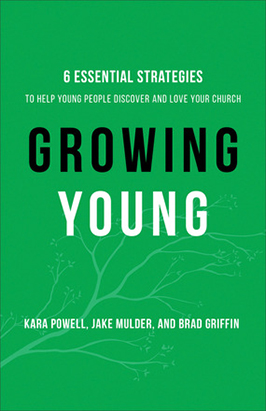
Growing Young
By Kara Powell, Jake Mulder, and Brad Griffin
The alarming reality of many churches today is that they have bare spots created by the youth and young adults missing from their congregation. Results from a Religious Landscape Study conducted by the Pew Research Center in 2007 and 2014 show a marked decline in church attendance and those who self-identified as Christians.
Few religious leaders have taken the time or done the research to discover what churches are doing right. However, Kara Powell, Jake Mulder, Brad Griffin and the research team at Fuller Youth Institute have put together a masterful, accessible work that documents how churches of all sizes, backgrounds, and denominations are effectively connecting with the next generation and have become bright spots.
In Growing Young the authors present their findings in ways that make it easy for church leaders to act. By identifying six fundamental commitments, strategic questions and ideas for action, this book provides a guide to help churches prevent common pitfalls and will result in a congregation that will Grow Young.