



Interact
After the video, prompts are supplied for thinking and sharing with others personal perception and experience. This opening activity prompts participants to think about and relate to the topic, and to share with others.
Question #1: On a 3 × 5 card, answer the question “Who are you?” Here is the challenge:
- You cannot mention your name, age, school, grade, hometown, sport, club, skill, job, or achievement.
- Instead, describe what matters to you, who you belong to, or the kind of person you hope to become.
Discuss: Why is it harder to describe yourself without your usual labels?
Question #2: For each question, choose the setting that best fits your experience: home, school, with friends, or at church.
- Where do people know you best?
- Where do you feel the most pressure to act a certain way?
- Where would people be most surprised to learn something important about you?
- Where do you feel most comfortable asking honest questions?
- Where do you feel most comfortable being yourself?
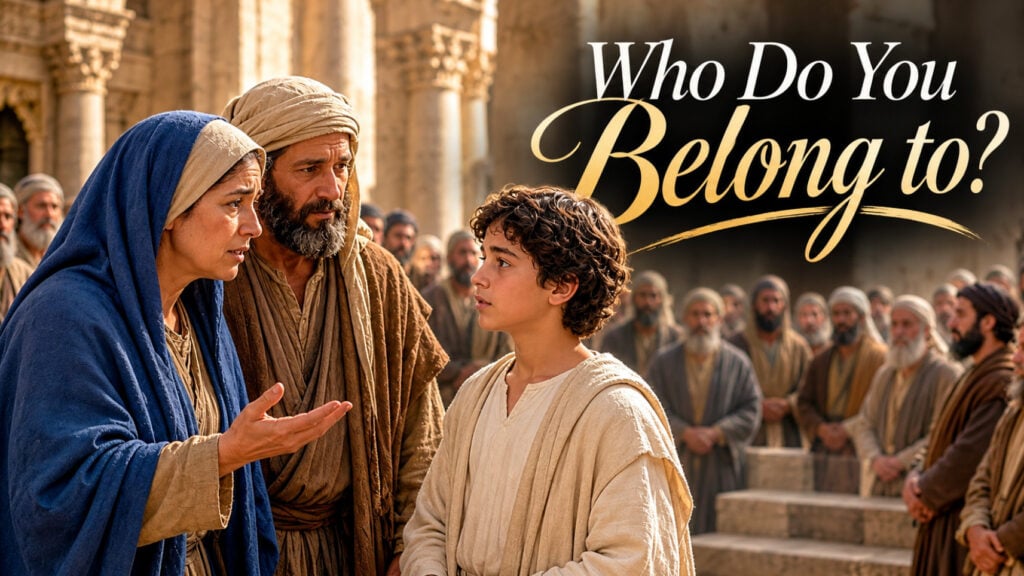
Why is it easier to be yourself in some places than in others? This is the Bible’s only story of Jesus between His infancy and adulthood. Notice what it reveals about His identity: who He is, whose He is, and the purpose shaping His life.

Insight
The Bible discussion begins with a careful reading of the whole passage, either from your own Bibles, or from the provided images below.
Then participants are to ask:
- What is going on in this passage of Scripture?
- What are the key words and phrases? Highlight them.
- Why do you think this passage is included in the Bible?
- What does it contribute to our “knowing Christ” and “living in Christ”?
Jesus’ words, “my Father’s house,” place belonging at the heart of His identity. The temple stood at the center of His community’s faith and daily life, there sacrifices told the story of God’s desire to forgive and save His people. Luke does not tell us how much Jesus understood about His mission at twelve. What we hear is His connection to His Father. His purpose grows out of that relationship.
The belonging approach leaves room to grow. Jesus listens, asks questions, returns home, and honors His parents as He continues growing in wisdom (Luke 2:51-52). He does not need to explain every step ahead to know where He belongs. We, too, can belong to God while still asking questions and discovering our way.
Later, John identifies Jesus as God’s Lamb (John 1:29), the Father affirms Him as His beloved Son (Matthew 3:17), and temptation tests His trust in the Father (Matthew 4:1–11). Throughout these moments, His relationship with the Father gives direction to His mission. For us, too, purpose begins with belonging. Knowing whose we are helps us discover how to live.

Insight Out
A parting video clip with a personal invitation to apply the message to “knowing Christ” and “living in Christ” in the coming week.