



Interact
After the video, prompts are supplied for thinking and sharing with others personal perception and experience. This opening activity prompts participants to think about and relate to the topic, and to share with others
Have you ever been caught off guard by one strategic question or a question that did not just ask for information but had another purpose? Some are invitations to share and some will confront.
Lawyers ask questions in ways that guide, pressure, or shape the conversation (that’s their job). See if you can match each question in the examples below to with a technique/description.
NOTE TO FACILITATOR: (They are in order, to make it as a quiz, mix up the order)
Legal Question Examples
A. “You were upset when you walked in, weren’t you?”
B. “Are you confused, or are you lying?”
C. “Have you stopped ignoring your responsibilities?”
D. “You were there that night?” “You knew him?” “You argued earlier?”
E. “Just answer yes or no.”
F. “So you expect everyone to believe that?”
G. “Why should anyone believe your version?”
Question Techniques
____ Leading Question (Suggests the answer inside the question)
____ Forced Choice (Limits the response to only a few options)
____ Loaded Question (Contains a hidden assumption)
____ Narrative Building (Builds a larger story piece by piece)
____ Yes or No Compression (Forces a complicated issue into a simple answer)
____ Emotional Trigger (Attempts to provoke emotion or defensiveness)
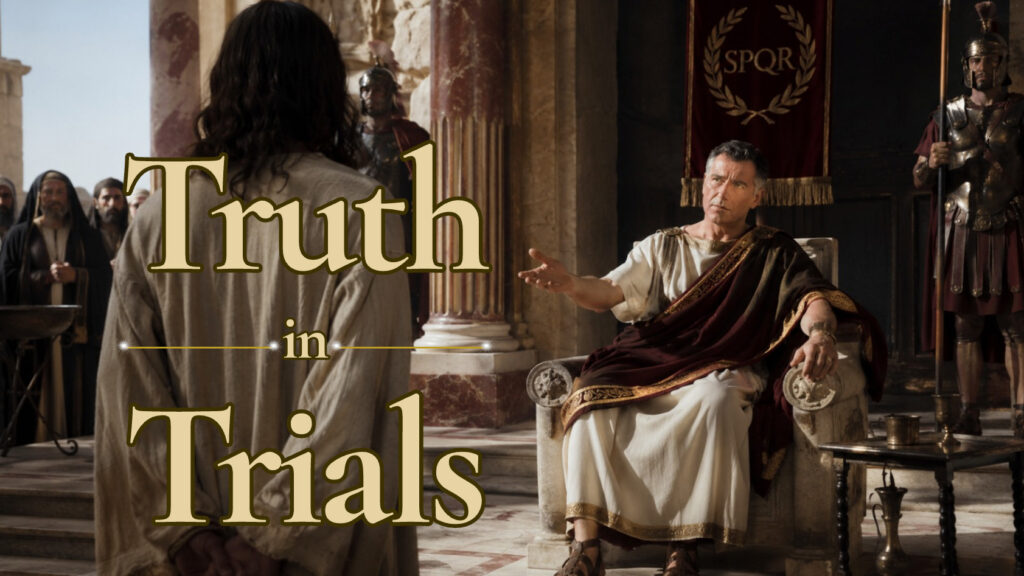
____ Credibility Question (Challenges whether a person can be trusted) When Pilate questions Jesus, what do you think is motivation of his question? Is Pilate inquiring to seek or frame an argument?

Insight
The Bible discussion begins with a careful reading of the whole passage, either from your own Bibles, or from the provided images below.
Then participants are to ask:
- What is going on in this passage of Scripture?
- What are the key words and phrases? Highlight them.
- Why do you think this passage is included in the Bible?
- What does it contribute to our “knowing Christ” and “living in Christ”?
Pilate seems to hold political power, yet throughout the conversation he sounds uncertain. Jesus, however, answers without panic or defensiveness. When He says, “My kingdom is not of this world,” He is not denying that He is King. He is redefining what His kingdom looks like. Earthly kingdoms protect themselves through force, intimidation, and public control. Jesus points to a different kind of authority, one grounded in truth, sacrifice, and faithful witness rather than violence or coercion (Isaiah 42:3). Then Jesus explains why He came. He came to testify to the truth, and those who belong to the truth listen to His voice. The conversation becomes larger than politics or accusations. It becomes a question of allegiance and response. Pilate asks, “What is truth?” but the question feels less like a sincere search and more like a way to step away from the implications standing in front of him. John’s Gospel presents the tension clearly. Truth is not merely an argument to debate or an idea to manage. Truth stands before Pilate in the person of Jesus Himself. The same tension remains today. Voices compete, narratives shift, and pressure surrounds us from every direction. The invitation of Jesus is still both simple and demanding, listen to Him and build your life on His words (John 18:37; John 8:31–32).

Insight Out
A parting video clip with a personal invitation to apply the message to “knowing Christ” and “living in Christ” in the coming week.