



Interact
After the video, prompts are supplied for thinking and sharing with others personal perception and experience. This opening activity prompts participants to think about and relate to the topic, and to share with others
Standing Up
We stand in simple, visible ways, and we stand in deeper, costly ways. Sometimes it is posture. Sometimes it is a decision. Both say something about what matters to us.
When have you stood up in a way that was memorable? What made that moment significant?
Public Signals of Respect and Honor— (Standing shows value without many words. It marks a moment as important.)
Standing for a national anthem— A shared act of identity
Standing during a moment of silence— A posture of remembrance
Standing when a judge enters a courtroom— Respect for authority and order
Standing to honor a speaker, teacher, or elder— Recognizing influence and contribution
Standing for a bride, a graduate, or a life being recognized— Marking a moment as meaningful
Support and Solidarity (Standing becomes personal. It shows where you stand and who you stand with.)
Standing ovations— Public agreement and affirmation
Standing with someone who is alone or under pressure— Refusing to let them stand alone
Showing up at an event, vigil, or gathering— Presence that says this matters
Refusing to sit when something unjust is happening— A visible stand against what is wrong
Speaking when silence would be easier— Using your voice when it costs something
Explore the “standing up” moments of Jesus and what it means to you today.

Insight
The Bible discussion begins with a careful reading of the whole passage, either from your own Bibles, or from the provided images below.
Then participants are to ask:
- What is going on in this passage of Scripture?
- What are the key words and phrases? Highlight them.
- Why do you think this passage is included in the Bible?
- What does it contribute to our “knowing Christ” and “living in Christ”?
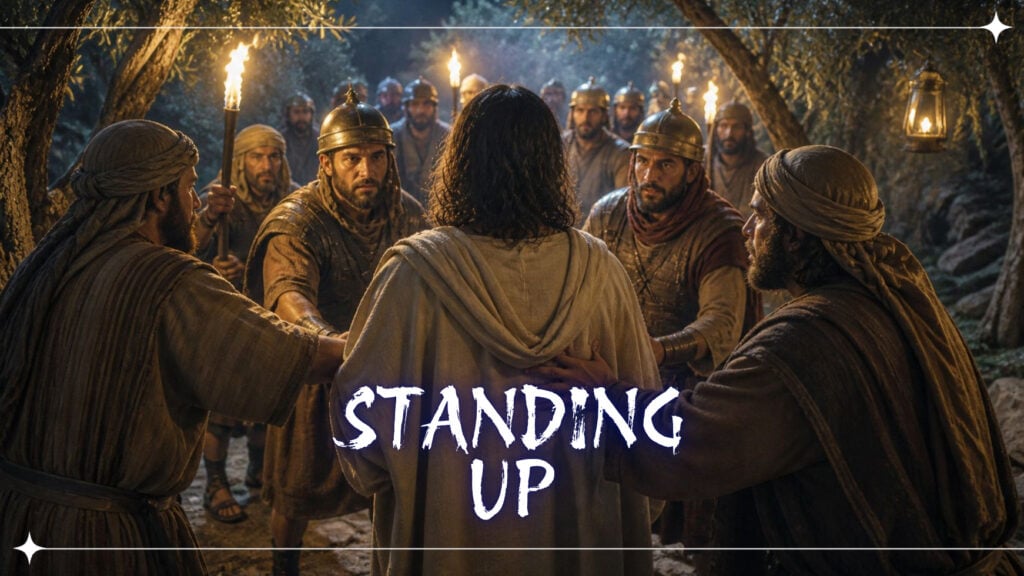
In the garden, everyone reveals something under pressure. Judas stands in the wrong place. The soldiers arrive with force but collapse at a word. The officials come certain, yet lose their footing. The moment exposes how fragile our control can be. Jesus alone remains steady. He does not hide, react, or negotiate His identity. He steps forward and says, “I am,” and the weight of that truth unsettles everyone present. This is not just courage. It is clarity about who He is and why He has come (John 10:18).
What stands out is not only His strength, but His direction. He places Himself between danger and His disciples and says, “let these men go.” Even here, He protects. Even here, He keeps His word. This echoes the promise of a shepherd who guards what is entrusted to Him (John 10:11), and it fulfills His prayer that none would be lost (John 17:12).
For us, this moment is honest. We often imagine we will stand strong, yet pressure reveals what we rely on. The invitation is not to trust our strength, but to anchor our lives in His presence. “God is our refuge and strength, an ever-present help in trouble” (Psalm 46:1). When we know who He is, we begin to stand with a steadiness that is not our own.

Insight Out
A parting video clip with a personal invitation to apply the message to “knowing Christ” and “living in Christ” in the coming week.