



Interact
After the video, prompts are supplied for thinking and sharing with others personal perception and experience. This opening activity prompts participants to think about and relate to the topic, and to share with others.
One of the ways we recognize a room charged with emotion is when people begin to cry. Because nearly all of us know what tears feel like, let’s start with a simple crying test.
True or False
____ 1. Only humans cry because of emotions.
(True–Animals make sounds when distressed, but emotional tears are uniquely human.)
____ 2. Crying usually means someone is falling apart or out of control.
(False–Crying often means someone cares deeply. It’s a sign of connection, not collapse.)
____ 3. Tears made during strong emotions are different from tears caused by dust or onions.
(True–Emotional tears have different chemicals in them.)
____ 4. People are more likely to cry when they feel safe than when they feel in danger.
(True–In danger, the body focuses on survival. Tears come when it’s safe enough to feel.)
____ 5. Crying can actually help calm your body down after stress.
(True–Crying can slow breathing and heart rate, helping the body settle again.)
____ 6. Holding back tears all the time can increase stress in the body.
(True–When emotions stay locked in, stress often shows up in the body.)
____ 7. Most people feel better the moment they start crying.
(False–Relief usually comes later, especially when tears are met with understanding.)
Are you ready for the crying?

Insight
The Bible discussion begins with a careful reading of the whole passage, either from your own Bibles, or from the provided images below.
Then participants are to ask:
- What is going on in this passage of Scripture?
- What are the key words and phrases? Highlight them.
- Why do you think this passage is included in the Bible?
- What does it contribute to our “knowing Christ” and “living in Christ”?
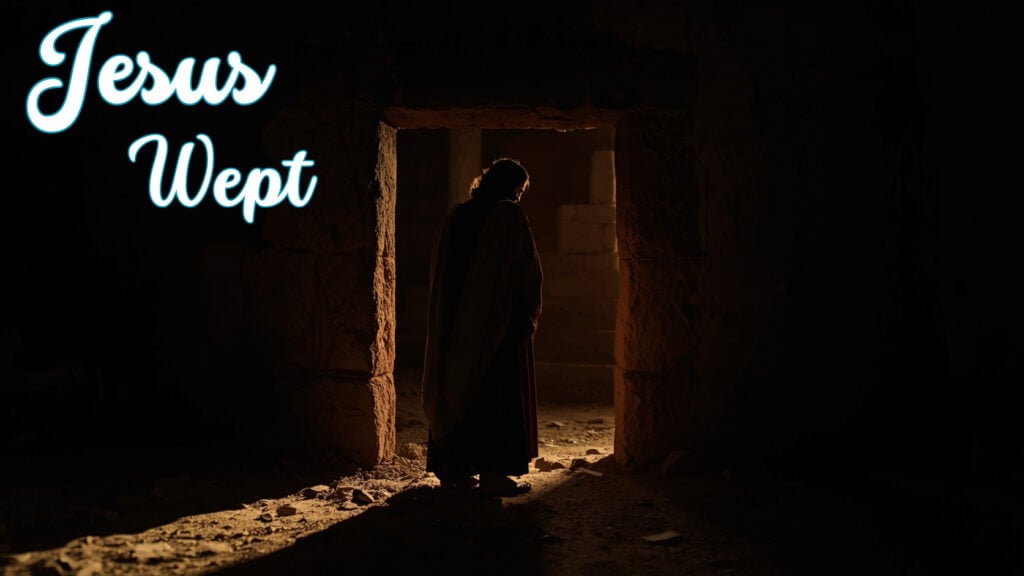
When Mary reaches Jesus, she does not explain with careful words; she comes as she is and weeps. John chooses a word for grief that is outward and audible, the kind of sorrow that fills a space, moves through a room, and draws others into its weight. Those around her are doing the same, and their shared mourning becomes visible, communal, and impossible to ignore. Jesus watches, and he is deeply moved, yet the word used to describe him is different, pointing not to outward grief but to an inner disturbance, a stirring that recognizes something is profoundly wrong. Death here is not only sad. It is a rupture in the order of things.
Jesus asks where Lazarus has been laid, a question that does not bypass the pain but leads him directly toward it. Then Jesus weeps. His tears are quieter and more restrained, yet no less real, flowing from a deeper awareness of what death does to those he loves and to the world God made. Some who witness this see only his love, while others voice the question that so often follows loss: if he healed before, why not now? Scripture does not rush to resolve that tension, leaving space for lament, as in Psalm 13 and Habakkuk.
Jesus goes to the tomb, stirred once more, and when he tells them to remove the stone, Martha answers with honest realism. Lazarus has been there four days, and death has a smell. Her faith is not dismissive, but careful and grounded. Jesus does not correct her. He stands with her and still asks for the stone to be moved.
Where do you recognize both kinds of tears in your own life, the grief that must be expressed aloud, and the deeper ache that knows this is not how things were meant to be?

Insight Out
A parting video clip with a personal invitation to apply the message to “knowing Christ” and “living in Christ” in the coming week.