



Interact
After the video, prompts are supplied for thinking and sharing with others personal perception and experience. This opening activity prompts participants to think about and relate to the topic, and to share with others
Is It Finished? All or Nothing
Some things in life give credit for progress. You can earn points on an assignment, save part of the money you need, or pass some classes with a C or D. Progress matters.
But other things are different. A job application is not even considered until it is submitted. You may have filled out every page, uploaded every document, and answered every question, but until you click “Submit,” the process has not really begun.
Think about it. A text written but not sent. A check written but not mailed. A vote intended but not cast. An apology planned but not spoken. A race run but not finished. A surgery started but not completed. An airplane flown but not landed.
In each case, effort was made. Time was invested. Good intentions were present. Yet the final step was never taken.
There is a unique satisfaction in finishing what you started. Sometimes the difference between “almost” and “finished” is not small at all. Sometimes it is everything.
• Which examples allow for partial credit, and which examples are “all or nothing”?
• What is the difference between making progress and reaching completion?
• Why do some tasks count what has been done, while others depend entirely on the final step?
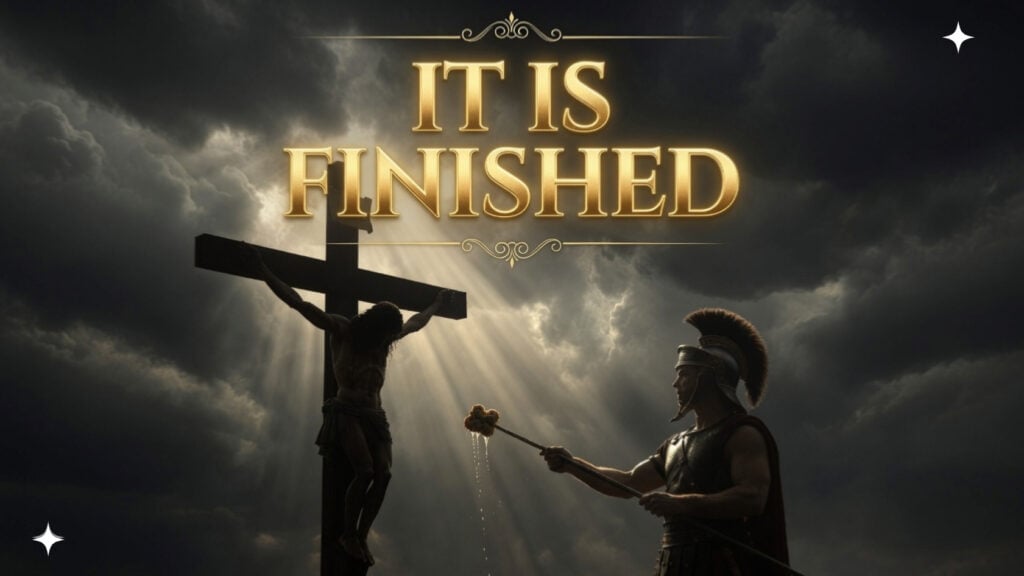
As you discuss today, consider the “all or nothing” significance of Jesus’ words from the cross: “It is finished.” What did Jesus complete that could not be left unfinished?

Insight
The Bible discussion begins with a careful reading of the whole passage, either from your own Bibles, or from the provided images below.
Then participants are to ask:
- What is going on in this passage of Scripture?
- What are the key words and phrases? Highlight them.
- Why do you think this passage is included in the Bible?
- What does it contribute to our “knowing Christ” and “living in Christ”?
John tells us that Jesus knew “everything had now been finished” (John 19:28). Then, after receiving the drink, He declared, “It is finished” (John 19:30). This was not a cry of defeat but a declaration of completion. The work the Father had given Him was accomplished. The Scriptures were fulfilled. The perfect sacrifice for sin had been offered. As Hebrews says, Christ offered “one sacrifice for sins for all time” (Hebrews 10:12).
Yet notice the tension. Jesus says, “It is finished,” but the resurrection is still coming. Pentecost is still coming. The gospel still must be carried to the world. The victory is won, but its results are still unfolding.
Some things are finished: the debt of sin has been canceled (Colossians 2:14), the sacrifice has been made, and salvation has been secured. Other things continue: God is still completing His work in us (Philippians 1:6), and creation still awaits its final restoration (Romans 8:23).
Jesus finished the work of redemption on the cross. We do not add to that work, but we are invited to believe it, receive it, and live in its reality until Christ completes the final restoration of all things.

Insight Out
A parting video clip with a personal invitation to apply the message to “knowing Christ” and “living in Christ” in the coming week.