

Initiate
A video introduction using illustrations, personal stories, metaphors, or active learning examples to begin the discussion.


Interact
After the video, prompts are supplied for thinking and sharing with others personal perception and experience. This opening activity prompts participants to think about and relate to the topic, and to share with others.
Have you ever been asked a question that made you laugh, roll your eyes, or stop and think?
Consider a few quirky questions:
- When you are trying to sign on to some websites, you might be asked, “Are you a robot?” If you are a real robot on a computer, would you admit it?
- On an application have you been asked, “Have you ever lied on a job application?”?
- “If you were a fruit (or an animal, or a kitchen utensil), what would you be?”
- “Where do you see yourself in 10 years?”
- Some medical forms ask, “Do you ever feel stressed or tired?” (If you say “no” you are lying, and if you answer “yes”, you are risk)
- “A plane crashes on the border of the U.S. and Canada. Where do they bury the survivors?” (Trick question. We don’t typically bury survivors)
As you read the story, pay attention to the question being asked and how it is answered.

Insight
The Bible discussion begins with a careful reading of the whole passage, either from your own Bibles, or from the provided images below.
Then participants are to ask:
- What is going on in this passage of Scripture?
- What are the key words and phrases? Highlight them.
- Why do you think this passage is included in the Bible?
- What does it contribute to our “knowing Christ” and “living in Christ”?
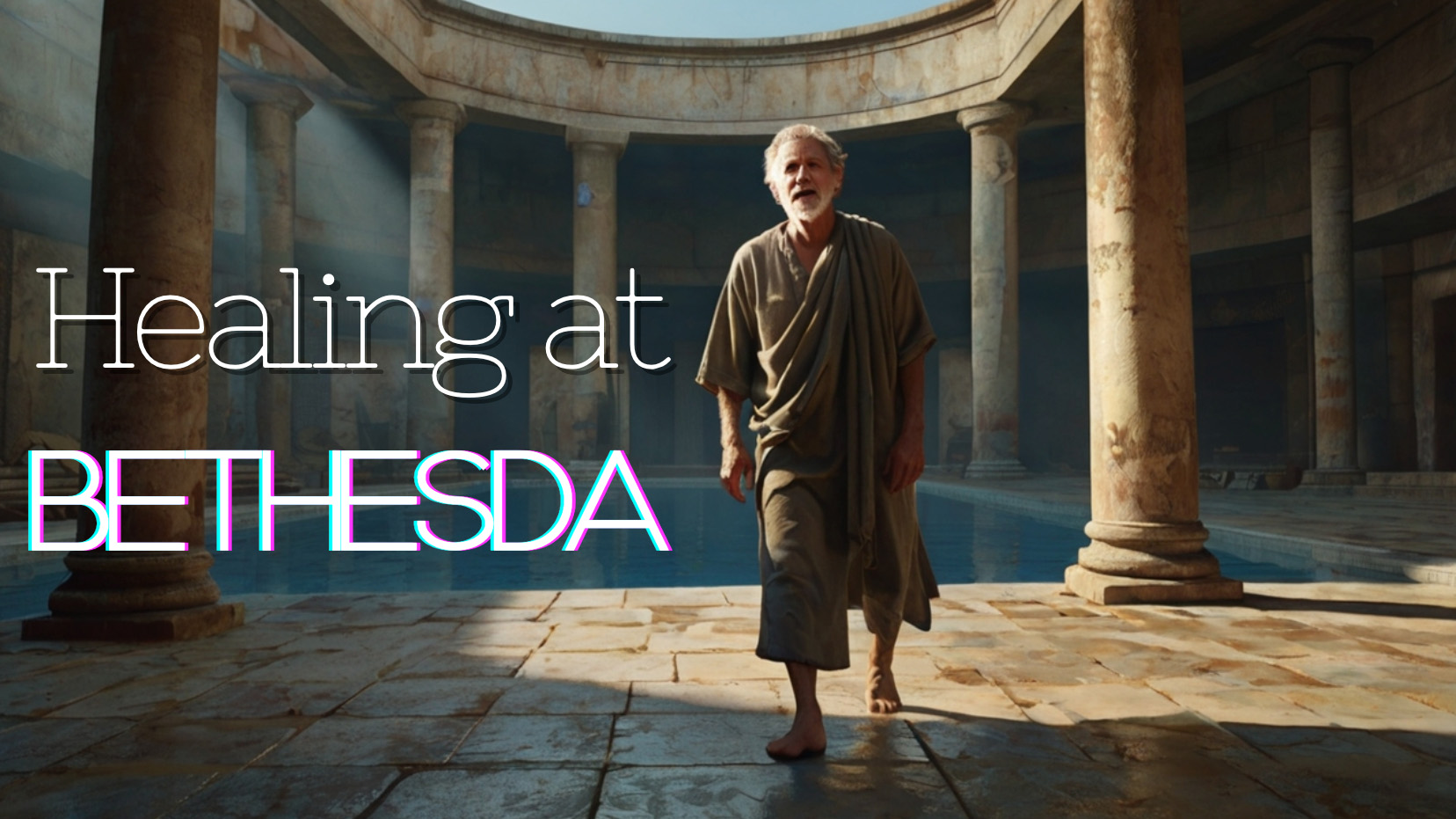
The pool of Bethesda was filled with people hoping for healing, yet one man had waited thirty-eight years. How many left disillusioned, clinging to a legend that never delivered? When Jesus arrived, He asked a direct question: “Do you want to be whole?” This reveals His compassion and authority. The man’s reply exposes his deeper problem: “I have no one.” His words, repeated with I, me, my four times, reveal a focus on his own limits rather than God’s power. Yet standing before him was the One who alone could restore him. As Isaiah 41:10 reminds us, God says, “Do not fear, for I am with you.”
Jesus doesn’t discuss the pool, the stirring water, or excuses. Instead, He speaks life: “Do you want to get well?” Healing begins when we desire and dare to receive His grace. Then comes the command: “Get up! Pick up your mat and walk.” What was impossible for decades happens instantly—not by effort, but by Christ’s word. Like Mark 2:11, the mat that once symbolized his weakness now became his testimony, showing that God’s power is made perfect in weakness (2 Corinthians 12:9).

Insight Out
A parting video clip with a personal invitation to apply the message to “knowing Christ” and “living in Christ” in the coming week.