



Interact
After the video, prompts are supplied for thinking and sharing with others personal perception and experience. This opening activity prompts participants to think about and relate to the topic, and to share with others.
How can we be fully present and recognize the significance of the moments we have waited for?
Here are ten life moments people often spend a long time anticipating. For each event that matters to you, rate how much it occupies your thoughts while you wait.
1. Rarely on my mind: I hardly think about it.
2. Often on my mind: I think about it regularly, but it does not dominate my day.
3. Eagerly anticipated: I think about it frequently and count down the days.
4. All consuming: It is hard to focus on anything else.
Discuss: What makes some events occupy our thoughts more than others?
- ____ Christmas or a birthday: Counting the days when you are young.
- ____The first day of school or college: Wondering where you will fit in and who you will become.
- ____Getting your driver’s license: Waiting for the freedom to go somewhere on your own.
- ____Graduation: Finally reaching the finish line after years of work.
- ____An acceptance letter or job offer: Waiting to learn whether a door will open.
- ____Your wedding day: Imagining the moment you begin a life together.
- ____The arrival of a child: Months of anticipation before finally meeting someone you already love.
- ____An important medical result: Waiting for news that could change your life.
- ____A vacation or reunion: Saving, planning, and imagining the moment you arrive or embrace someone.
- ____Retirement: Looking forward to a different pace and time for things you have postponed.
Imagine generations waiting for the promised Messiah. What might help them keep hoping, and what might make Him difficult to recognize when He arrived?

Insight
The Bible discussion begins with a careful reading of the whole passage, either from your own Bibles, or from the provided images below.
Then participants are to ask:
- What is going on in this passage of Scripture?
- What are the key words and phrases? Highlight them.
- Why do you think this passage is included in the Bible?
- What does it contribute to our “knowing Christ” and “living in Christ”?
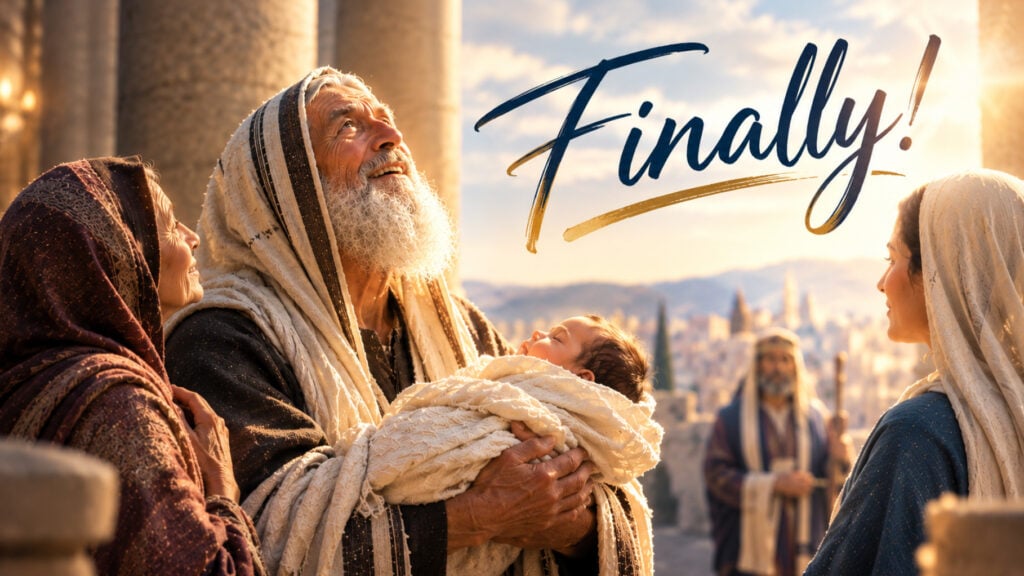
Simeon was “waiting for the consolation of Israel,” longing for God to comfort and restore His people. Would the Messiah change their circumstances or address their deepest problem? His hope echoed Isaiah’s words, “Comfort, comfort my people” (Isaiah 40:1). Waiting can discourage us when nothing seems to change, but Simeon remained open to God’s leading. “Moved by the Spirit,” he entered the temple and encountered Jesus. His hope included a willingness to respond. When we focus on what we want God to do next, are we attentive to what He is doing today?
“My eyes have seen your salvation,” Simeon declared, holding a baby. Jesus had not yet preached or healed anyone, yet Simeon recognized God’s promise taking shape in his arms. This child would be a light for the nations (Isaiah 49:6). We also live with promises still unfolding: Jesus’ presence (Matthew 28:20), rest for the weary (Matthew 11:28), and His return (John 14:1-3). While we wait, we can pause over His words, give someone our full attention, or respond to an opportunity to care.

Insight Out
A parting video clip with a personal invitation to apply the message to “knowing Christ” and “living in Christ” in the coming week.