



Interact
After the video, prompts are supplied for thinking and sharing with others personal perception and experience. This opening activity prompts participants to think about and relate to the topic, and to share with others
Learn By Doing or Learn from Others?
Today, if you want to learn almost anything, you can watch a YouTube video or search online. But not everything should be learned by trial and error. Some lessons are best learned by doing, while others are better learned from the experience of someone else.
Read each activity and decide which column it belongs in: Learn by Doing or Learn from Others (Don’t learn by doing).
| I’d rather learn by doing | I’d rather NOT learn by doing |
|---|
Riding a bicycle Landing a passenger airplane Baking cookies Brain surgery
Playing guitar Defusing a bomb Learn to Swim Kayaking
Painting a picture Skydiving without proper training How to Fish Learn to cook
Fighting a wildfire Driving a golf cart Flying a helicopter Plant a garden
Learning a sport Handle a venomous snake Public speaking Change a tire
Disarm an explosive Learn a language Use a power tool Is it Spicy?
What’s something you’ve learned by experience that you wish you had simply listened to someone else about?
Consider Thomas and his approach for learning and faith!

Insight
The Bible discussion begins with a careful reading of the whole passage, either from your own Bibles, or from the provided images below.
Then participants are to ask:
- What is going on in this passage of Scripture?
- What are the key words and phrases? Highlight them.
- Why do you think this passage is included in the Bible?
- What does it contribute to our “knowing Christ” and “living in Christ”?
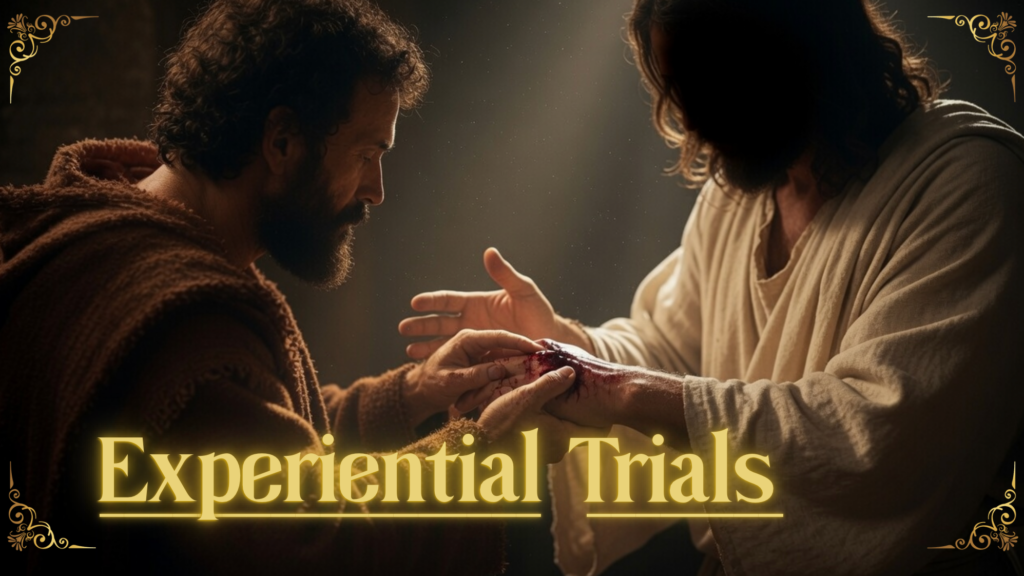
Nicknames are not always fair. Thomas is often remembered as “the doubter,” but that is only part of his story. Earlier, when Jesus announced that He was returning to Judea, Thomas courageously told the other disciples, “Let us also go, that we may die with him” (John 11:16). He was not lacking courage or commitment. He was wrestling with an extraordinary claim. Since people do not simply rise from the dead, Thomas wanted to know it was really true. Jesus did not rebuke his honest questions. Instead, He graciously invited Thomas to see and touch His wounds. Faith is not pretending. It is trusting the One who has proven Himself trustworthy.
Thomas’s response, “My Lord and my God!” is one of the clearest declarations of Jesus’ divinity in John’s Gospel. His story reminds us that honest questions can lead to deeper faith when they bring us to Jesus instead of away from Him. We believe through the testimony of those who saw the risen Christ (John 20:30–31; 1 John 1:1–3). Are your questions drawing you closer to Jesus? What evidence has He already given you that invites your next step of faith?

Insight Out
A parting video clip with a personal invitation to apply the message to “knowing Christ” and “living in Christ” in the coming week.