



Interact
After the video, prompts are supplied for thinking and sharing with others personal perception and experience. This opening activity prompts participants to think about and relate to the topic, and to share with others
In Denial
Read the three statements below. Rank them from 1 to 3 based on which one feels most common or most relatable for teenagers and young adults today.
1 = Most common
2 = Sometimes true
3 = Least common
___ “It won’t happen to me.” Optimism bias. Believing consequences, addiction, failure, regret, or danger happen to other people, not us.
___ “I’m actually doing okay.” Hidden emotional struggle. Looking fine outwardly while quietly stressed, anxious, lonely, overwhelmed, or emotionally exhausted.
___ “I’ll be strong when it matters.” Overestimating the future self. Assuming we will make the right decision later, resist pressure, speak up, or stay strong when the moment finally comes.
Consider Real Stories
Many people admit they were surprised by what they were capable of doing or not doing.
“Just this once”
A college student said she always viewed cheating as something dishonest people did, not her. But under pressure, deadlines, and fear of failure, she copied answers during an online exam and later admitted, “I honestly never thought I would do that.”
“Piling on”
A high school student described watching classmates mock another student online. At first she stayed silent. Then she joined in because it felt normal in the group. Later she reflected, “I never thought I’d become one of those people.”
“Did nothing”
A teenager witnessed another student being publicly humiliated but did not step in because he froze and worried about what others would think. “I became a spectator,” he admitted. Later he reflected, “I always thought I’d be the kind of person who would help.”
People are often surprised not only by what they suffer, but by what they are capable of doing, ignoring, joining, accepting, or becoming.
Why do people sometimes become the very person they once believed they never would.

Insight
The Bible discussion begins with a careful reading of the whole passage, either from your own Bibles, or from the provided images below.
Then participants are to ask:
- What is going on in this passage of Scripture?
- What are the key words and phrases? Highlight them.
- Why do you think this passage is included in the Bible?
- What does it contribute to our “knowing Christ” and “living in Christ”?
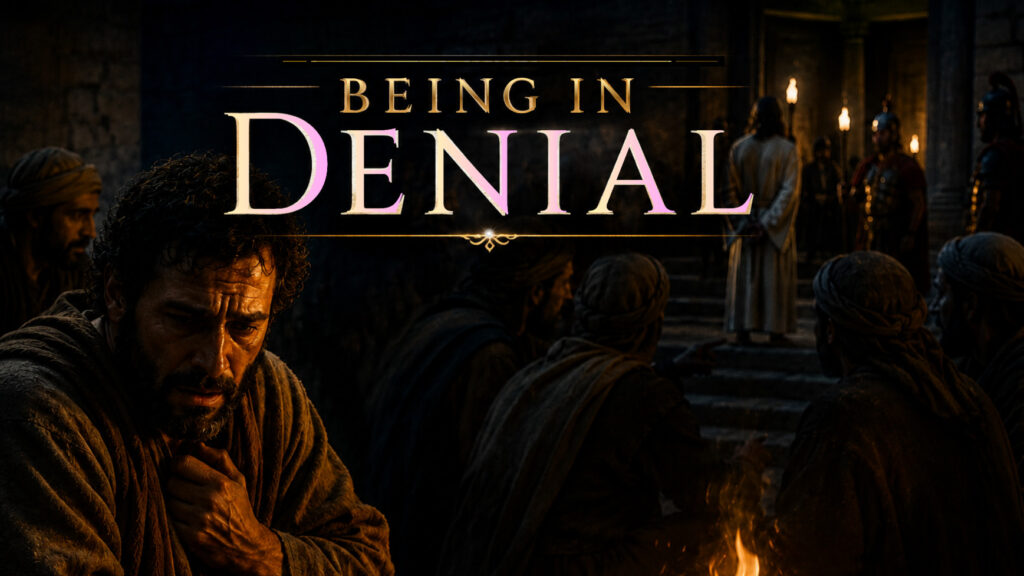
Peter stays close enough to the fire to keep warm, yet far enough away to avoid being fully connected to Jesus in the moment of conflict. He lives in the uneasy space between proximity and commitment. But eventually a person must move one direction or the other. As Jesus is questioned, Peter is recognized and asked, “You are not one of His disciples, are you?” (John 18:25). Peter answers, “I am not.”
The question reaches deeper than whether Peter simply knows Jesus. The word disciple asks whether he belongs to Him as a close follower and companion. Earlier in John’s Gospel, Jesus repeatedly says, “I am” (John 18:5–8). Now Peter echoes those same words in reverse. Under pressure, fear narrows his vision and self-protection takes over.
Peter likely never imagined he would deny Jesus only hours after boldly declaring loyalty (Luke 22:33). His failure exposes something deeply human. We often assume we will be stronger, braver, and more faithful when the moment comes. Yet Jesus had already prayed for Peter before he failed (Luke 22:31–32). Our identity is not finally defined by our greatest confession or our worst failure, but by whether we remain in Him. “Apart from me you can do nothing” (John 15:5).

Insight Out
A parting video clip with a personal invitation to apply the message to “knowing Christ” and “living in Christ” in the coming week.