



Interact
After the video, prompts are supplied for thinking and sharing with others personal perception and experience. This opening activity prompts participants to think about and relate to the topic, and to share with others.
Eliana spoke of kairos time, the significance of a moment that changes our lives. We measure chronos time with clocks and calendars, but we recognize kairos moments by their lasting meaning. A birth, wedding, graduation, or loss can become a reference point that divides our story into “before” and “after.”
Pivotal moments might include:
- A birth: someone’s arrival changes a family.
- A milestone birthday: a new stage of life begins.
- Graduation: preparation opens into new possibilities.
- A wedding: two people commit to a shared future.
- A death or memorial: loss reshapes life and relationships.
- A diagnosis or recovery: the future suddenly looks different.
- A decision to follow Jesus: faith gives life a new direction.
- The end of a war: an announcement changes the future of nations.
What are the Kairos Moments in your life? Share the significance of the time/moments we experience in our lives.
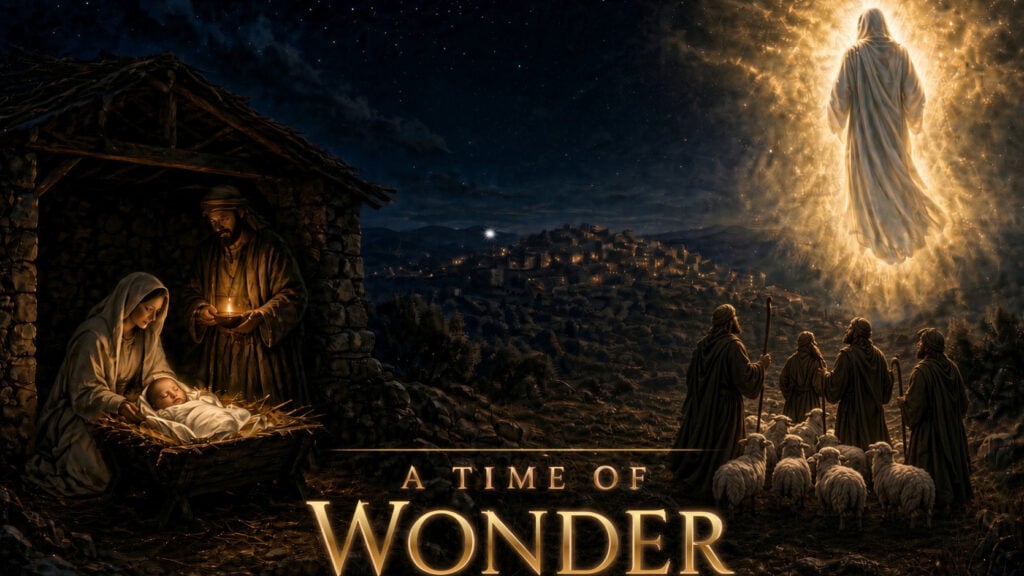
As we read Luke 2:4-12, we move from the date we celebrate to the moment that changed our world. At the right time, God sent his Son to redeem us (Galatians 4:4-5). Look closely at the ordinary details Luke includes. What might they reveal that our familiar Christmas traditions have led us to overlook?

Insight
The Bible discussion begins with a careful reading of the whole passage, either from your own Bibles, or from the provided images below.
Then participants are to ask:
- What is going on in this passage of Scripture?
- What are the key words and phrases? Highlight them.
- Why do you think this passage is included in the Bible?
- What does it contribute to our “knowing Christ” and “living in Christ”?
Consider the ordinary details of this pivotal moment. “While they were there, the time came” tells us that Mary and Joseph were already in Bethlehem when Jesus was born (Luke 2:6). Luke does not describe an urgent arrival or a desperate search for lodging. Yet this birth belongs to something extraordinary: “When the fullness of time had come, God sent forth his Son” (Galatians 4:4). God’s promise entered human life through pregnancy, birth, and a mother’s care. The promised Savior had come.
“There was no room in the guest room” helps us picture the setting differently. The Greek word katalyma refers here to a guest room, also used in Luke 22:11. Some homes of that time sheltered animals under the same roof, so a manger could be part of an ordinary household. A birth in a home is a reasonable understanding, although Luke does not describe the building. What might we overlook when familiar Christmas scenes shape our reading? The manger points to the humble surroundings of Christ’s arrival. Shepherds doing their everyday work receive the extraordinary announcement: the Savior has been born.

Insight Out
A parting video clip with a personal invitation to apply the message to “knowing Christ” and “living in Christ” in the coming week.