

Overview
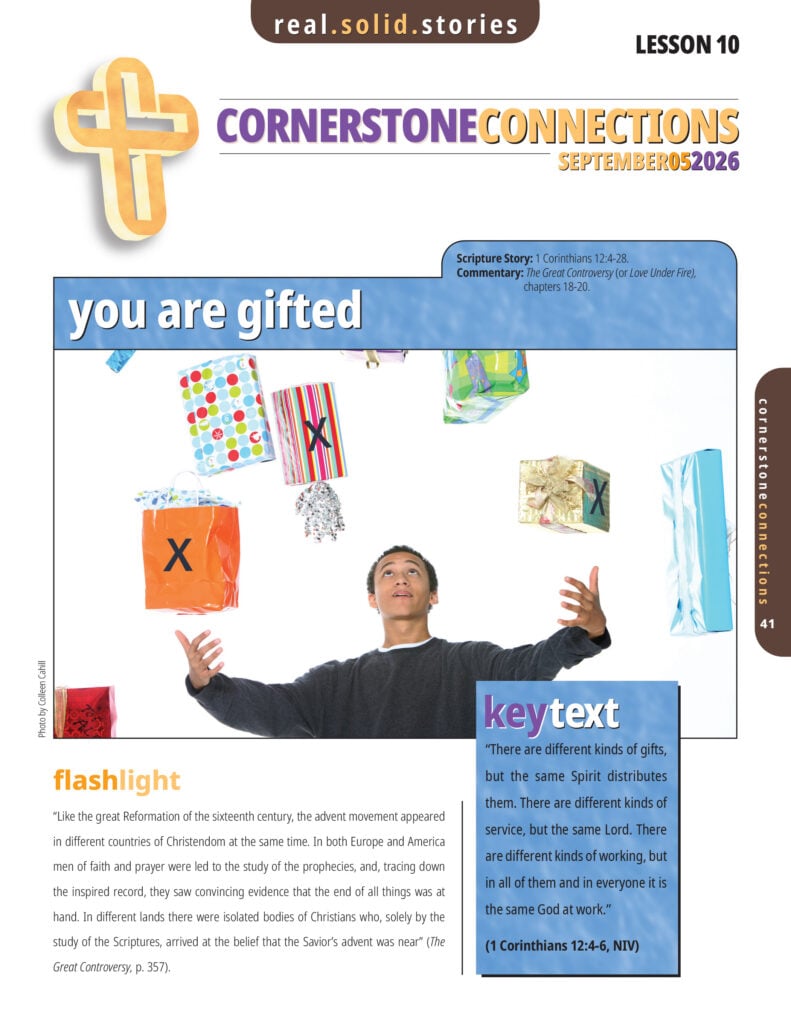
This week’s lesson explores the truth that every follower of Christ has been given unique spiritual gifts by the Holy Spirit. Based on 1 Corinthians 12, students are encouraged to recognize that no gift is more important than another and that each person has a valuable role in the body of Christ. The lesson challenges young people to discover, develop, and faithfully use their God-given abilities to serve others, strengthen the church, and make a difference in their communities—all with a heart of love and humility.
Scripture
1 Corinthians 12
Discussion Video

Lesson 1
SCRIPTURE PASSAGES
OVERVIEW
Have you ever made cookies from scratch? Some cookies are easy to make with a few simple ingredients. Other cookies are difficult to make because they require many ingredients and have complicated steps to follow in combining those ingredients. Which cookies are better? (If you can answer this question definitively for everyone–please open a bakery.) The one thing all cookies have in common is that they are all cookies. They aren’t all the same shape and size. They don’t all taste the same, but again, they are all cookies. Our lesson today is about unity amidst diversity. In this lesson we will explore what it is like to be uniquely different yet still part of the body Christ.
OPENING ACTIVITY:
MARSHMALLOW CHALLENGE (Made famous by Tom Wujec)
To play, you simply divide your Sabbath School class into groups of four and give each group 20 sticks of spaghetti, one yard of tape, one yard of string, and a marshmallow. Whichever team can build the tallest structure wins – the trick is, the marshmallow must be on top.
QUESTIONS
- What was the most difficult part of this activity?
- Which supply did you not find particularly useful and why?
- Compare and contrast the different team building principles discovered in this activity and apply them to your church’s approach to spreading the Gospel.
TRANSITION
God has given each of us abilities. Not everyone’s are the same, but everyone has some. Our uniqueness provides us with an opportunity to be useful to the cause of Christ.
BIBLE STUDY GUIDE
Read 1 Corinthians 12:4-11.
4 There are different kinds of gifts, but the same Spirit distributes them. 5 There are different kinds of service, but the same Lord. 6 There are different kinds of working, but in all of them and in everyone it is the same God at work.
7 Now to each one the manifestation of the Spirit is given for the common good. 8 To one there is given through the Spirit a message of wisdom, to another a message of knowledge by means of the same Spirit, 9 to another faith by the same Spirit, to another gifts of healing by that one Spirit, 10 to another miraculous powers, to another prophecy, to another distinguishing between spirits, to another speaking in different kinds of tongues, and to still another the interpretation of tongues. 11 All these are the work of one and the same Spirit, and he distributes them to each one, just as he determines.
QUESTIONS
- What is one core principle found in this passage that applies to all Christians?
- Explain the principle of diversity and unity found in this passage.
- According to this passage which ability is the most important?
- Where do all gifts come from and why is this important?
Read 1 Corinthians 12:12-19.
12 Just as a body, though one, has many parts, but all its many parts form one body, so it is with Christ. 13 For we were all baptized by one Spirit so as to form one body—whether Jews or Gentiles, slave or free—and we were all given the one Spirit to drink. 14 Even so the body is not made up of one part but of many.
15 Now if the foot should say, “Because I am not a hand, I do not belong to the body,” it would not for that reason stop being part of the body. 16 And if the ear should say, “Because I am not an eye, I do not belong to the body,” it would not for that reason stop being part of the body. 17 If the whole body were an eye, where would the sense of hearing be? If the whole body were an ear, where would the sense of smell be? 18 But in fact God has placed the parts in the body, every one of them, just as he wanted them to be. 19 If they were all one part, where would the body be?
QUESTIONS
- Describe why it is important to understand the concept that everyone is different but is part of the same body.
- What is the glue that holds the “body” together?
Read 1 Corinthians 12:20-26.
20 As it is, there are many parts, but one body.
21 The eye cannot say to the hand, “I don’t need you!” And the head cannot say to the feet, “I don’t need you!” 22 On the contrary, those parts of the body that seem to be weaker are indispensable, 23 and the parts that we think are less honorable we treat with special honor. And the parts that are unpresentable are treated with special modesty, 24 while our presentable parts need no special treatment. But God has put the body together, giving greater honor to the parts that lacked it, 25 so that there should be no division in the body, but that its parts should have equal concern for each other. 26 If one part suffers, every part suffers with it; if one part is honored, every part rejoices with it.
QUESTIONS
- Which part of the body is the most important?
- What does it mean when it talks about “no schism” in verse 25?
Read 1 Corinthians 12:27-28.
27 Now you are the body of Christ, and each one of you is a part of it. 28 And God has placed in the church first of all apostles, second prophets, third teachers, then miracles, then gifts of healing, of helping, of guidance, and of different kinds of tongues.
QUESTIONS
- Which occupation listed is the most important one to the Gospel mission?
- How would your church/school be different if everyone followed the principles outlined in theses passages?
Read Ephesians 4:1-6.
1 As a prisoner for the Lord, then, I urge you to live a life worthy of the calling you have received. 2 Be completely humble and gentle; be patient, bearing with one another in love. 3 Make every effort to keep the unity of the Spirit through the bond of peace. 4 There is one body and one Spirit, just as you were called to one hope when you were called; 5 one Lord, one faith, one baptism; 6 one God and Father of all, who is over all and through all and in all.
QUESTIONS
- How are followers of Christ supposed to live?
- Define “unity of spirit.”
- What core values is this passage sharing with us?
APPLICATION
Unity is like being on a sports team. By definition there is more than one player on a team. Each player is on the team because of their abilities. On a baseball team not everyone is a pitcher. If everyone was a pitcher who would play the outfield or guard the bases? The one skill that it would be good for everyone to have is hitting. However, not everyone on a baseball team can hit, but they are still just as important as those who can make the ball fly over the fence. Unity is important. Having the same goal—in this case building a saving relationship with Jesus and sharing the Gospel with the world. Not everyone needs to have the same interests, gifts, or talents, but they do need to use the ones God gave them. Being different isn’t always bad; in fact, it is necessary. In Matthew chapter 4, when Jesus called the disciples, were they all cut by the same cookie cutter, or were they each chosen because of their different skills and personalities? In the infamous words of Larry the Cucumber from Veggie Tales, “God made you special, and He loves you very much!” (https://bigidea.fandom.com/wiki/God_Loves_You_Very_Much)
FOLLOW UP
- Make a list of all the things you like about your church.
- Make a list of things you would like your church to change.
- Pray over both of your lists, thanking God for the good things, and asking for wisdom about how to handle the things that need to change.
- Create a list of ways that you could help your church become a better place.
Lesson 2
SCRIPTURE PASSAGE
LEADER’S NOTE
For a Relational Bible Study (RBS) you’ll want to get into the Scripture passage and encourage the youth to imagine participating in the story while it’s happening. Then you will be able to better apply it to your own situation today.
You will need to ask God for the Holy Spirit to be present as your small group discusses the questions (no more than 3-6 people in a group is recommended). Start with the opening question. It is a personal question and the answer is unique for each individual. There is no right answer and nobody is an expert here, so don’t be surprised when you hear different responses. You are depending on the Holy Spirit to be present and to speak through your group. Say what God prompts you to say, and listen to what others share.
Take turns reading the chapter out loud. Follow that with giving the students some time to individually mark their responses to the questions (a PDF version of the handout is available as a download). This gives each person a starting point for responding when you start to share as a group. Next, begin the discussion by asking the students to share what they marked and why on each question as you work your way through. Feel free to take more time on some questions than others as discussion warrants.
Encourage each person in the group to apply what is discussed to their personal lives and to share with the group what they believe God wants them to do. Then ask them to pray that God will help each of them to follow through in doing so. Remind them to expect that God will show them ways to live out the message of this passage in the coming week, and that they are free to ask others in the group to help hold them accountable.
OVERVIEW
Most Christians have heard of the term “spiritual gifts” but most Christians remain rather clueless about them. Even Paul’s introduction to our passage begins with the need to combat their ignorance or misunderstanding (compare translations of 1 Corinthians 12:1) about spiritual gifts.
Instead of jumping right into naming various spiritual gifts, let’s step back and see the bigger picture. At the end of His ministry, Jesus explained to His disciples that following His death and resurrection, He would return to heaven to be with His Father, but they would send the Holy Spirit to the disciples so the disciples would do the same things Jesus had been doing (see John 14:12). Amazing! Miraculous! Also very “commonplace.” That’s what Jesus did. He healed people, even raising the dead. He cast out demons. But He also listened to people, played with children, and ate with sinners and the religious elite. He spent time with people, forgave those who were guilty, encouraged the disheartened, and cultivated hope.
We’re called to do the same. But it’s not a matter of simply trying harder. We’re talking about the supernatural operating through us! The Holy Spirit is God. When you accept Jesus into your life, He comes in the form of the Holy Spirit. In addition to the Holy Spirit shaping your character to be like Jesus (love, joy, peace, kindness, patience, goodness, etc.), the Holy Spirit also gives you the ability to do the same things Jesus did!
In our RBS this week, we’ll look at one of the three main passages about spiritual gifts (1 Corinthians 12:1-31; the other two are Romans 12:1-18 and Ephesians 4:4-16).
Some people confuse talents with spiritual gifts. Talents are abilities you’re given that you can further develop for however you choose to use them. You might have a talent with music and practice so you can perform for others, to earn a living, or to just enjoy the music yourself. You might use it to feed your ego, gift it to others, hold a job to earn a living, or combine with others to make music.
A spiritual gift is used to serve others, just like Jesus. It begins when the Holy Spirit comes into your life. It can transform a talent or start in an instant because God operates instantly and over time. You might be able to further develop it, but it always comes from God.
GIFTS GALORE
Describe a time when someone gave you an awesome gift.
Read 1 Corinthians 12:1-31.
1Now about the gifts of the Spirit, brothers and sisters, I do not want you to be uninformed.
2 You know that when you were pagans, somehow or other you were influenced and led astray to mute idols. 3 Therefore I want you to know that no one who is speaking by the Spirit of God says, “Jesus be cursed,” and no one can say, “Jesus is Lord,” except by the Holy Spirit.
4 There are different kinds of gifts, but the same Spirit distributes them. 5 There are different kinds of service, but the same Lord. 6 There are different kinds of working, but in all of them and in everyone it is the same God at work.
7 Now to each one the manifestation of the Spirit is given for the common good. 8 To one there is given through the Spirit a message of wisdom, to another a message of knowledge by means of the same Spirit, 9 to another faith by the same Spirit, to another gifts of healing by that one Spirit, 10 to another miraculous powers, to another prophecy, to another distinguishing between spirits, to another speaking in different kinds of tongues, and to still another the interpretation of tongues. 11 All these are the work of one and the same Spirit, and he distributes them to each one, just as he determines.
Unity and Diversity in the Body
12 Just as a body, though one, has many parts, but all its many parts form one body, so it is with Christ. 13 For we were all baptized by one Spirit so as to form one body—whether Jews or Gentiles, slave or free—and we were all given the one Spirit to drink. 14 Even so the body is not made up of one part but of many.
15 Now if the foot should say, “Because I am not a hand, I do not belong to the body,” it would not for that reason stop being part of the body. 16 And if the ear should say, “Because I am not an eye, I do not belong to the body,” it would not for that reason stop being part of the body. 17 If the whole body were an eye, where would the sense of hearing be? If the whole body were an ear, where would the sense of smell be? 18 But in fact God has placed the parts in the body, every one of them, just as he wanted them to be. 19 If they were all one part, where would the body be? 20 As it is, there are many parts, but one body.
21 The eye cannot say to the hand, “I don’t need you!” And the head cannot say to the feet, “I don’t need you!” 22 On the contrary, those parts of the body that seem to be weaker are indispensable, 23 and the parts that we think are less honorable we treat with special honor.
And the parts that are unpresentable are treated with special modesty, 24 while our presentable parts need no special treatment. But God has put the body together, giving greater honor to the parts that lacked it, 25 so that there should be no division in the body, but that its parts should have equal concern for each other. 26 If one part suffers, every part suffers with it; if one part is honored, every part rejoices with it.
27 Now you are the body of Christ, and each one of you is a part of it. 28 And God has placed in the church first of all apostles, second prophets, third teachers, then miracles, then gifts of healing, of helping, of guidance, and of different kinds of tongues. 29 Are all apostles? Are all prophets? Are all teachers? Do all work miracles? 30 Do all have gifts of healing? Do all speak in tongues? Do all interpret? 31 Now eagerly desire the greater gifts.
1. How can a person know if they have the Holy Spirit?
- You can never know for sure.
- What is the Holy Spirit?
- The person has to be nicer than they used to be.
- There is evidence that the person is “pro-Jesus.”
- By demonstrating spiritual gifts.
- You get this special “zing” feeling inside.
- Pray for the Holy Spirit and then believe you’ve received it.
- If you can speak in tongues, you definitely have the Spirit.
- Other.
2. Why does the Holy Spirit give gifts to God’s people?
- The Holy Spirit is generous and loves to give.
- There are plenty of gifts, so why not pass them out?
- The gifts are intended to build up God’s Church.
- Spiritual gifts are to increase the service projects a church does.
- So people will grow in their spiritual lives.
- It’s the way God continues the ministry of Jesus on earth.
- God’s people need supernatural means to do what’s needed.
- Spiritual gifts call for those gifted to work together.
- Other.
3. What determines who gets which spiritual gift(s)?
- It depends on who’s naughty and who’s nice.
- You have to be old enough to use these properly.
- The talents you’ve been given.
- If you use what you’ve been given, then you get more.
- It’s based on seniority.
- The Holy Spirit makes the call.
- It’s determined by how much faith a person has.
- Other.
4. The spiritual gifts I’ve seen in my church include:
- Teachers and apostles.
- Prophets and helpers.
- Organizers and those who speak in tongues.
- Miracle-workers and donors.
- Visionaries and worker-bees.
- Preachers and healers.
- Interpreting tongues and administration.
- Other.
5. What do you think about the topic of spiritual gifts?
- I have no idea what you’re talking about.
- I don’t think about this much.
- This is the key to unlock God’s work in our church and in our world.
- I’d like to know more about it.
- I took a spiritual gifts inventory and then nothing happened after that.
- This topic is sorely neglected in my church.
- I think this applies to the church in Corinth more than to my church.
- This is awesome!
- Other.
6. In what way is your Church Body out of balance when it comes to spiritual gifts?
- Too much preaching; not enough faith.
- Too many miracles; not enough helpers.
- Too many prophets; not enough organizers.
- Too many worker-bees; not enough praying people.
- Too many teachers; not enough speakers in tongues.
- Lots of activity, but not much evidence of God.
- We expect God to do what we should already be doing.
- Other.
7. Which spiritual gifts have you been given? How do you know? How and when do you use your spiritual gift(s)?
8. To illustrate how spiritual gifts work together, Paul used the analogy of the human body. What’s another analogy that could explain this today?
SUMMARY
Paul wrote to the church members in Corinth telling them he didn’t want them to be clueless about spiritual gifts. That same message could be repeated today. So Paul gave lots of clues about spiritual gifts. The big picture is that the Holy Spirit empowers God’s people to continue to do the things Jesus did while He was on earth. The narrow picture is that the Holy Spirit empowers YOU to do what Jesus did, along with the rest of the parts of the Body of Christ. Use the application options to put this into practice.
APPLICATION
Here are some ideas and plans to discover your spiritual gifts by experimenting and putting into action the things the Holy Spirit enables you to do to serve others. You may want to implement more than one of these application options.
- CHECK IT OUT
Spiritual gifts tests or “inventories” have become popular and are even available online. Their biggest drawback is that some people take the test/inventory and then do nothing with it. The purpose is to go into action. A better way to discover your spiritual gifts is to begin to experiment.
- Download the “Check It Out” sheet to see how to discover your spiritual gifts in action, not merely in theory. Hint: You’ll experiment for competence, joy, and success. You can find out more by reading the handout.
- GET IT TOGETHER
Spiritual gifts enable the Body of Christ to function as a body—working together. Spiritual gifts are not individual achievements or accomplishments. They are part of the bigger picture of how the Holy Spirit ministers to others through the combination of gifts working together in a unifying manner.
- As you experiment to discover your spiritual gifts, ask yourself the two questions on the downloadable “Get It Together” sheet.
- The first question is “How do you fit in what Jesus is doing through you, with what Jesus is doing through others?”
- The second question is, “How is what Jesus is doing through our Youth Sabbath School integrating what Jesus is doing through our whole church?”
-
LET’S SHARE
- Ask your pastor and head elder if representatives from Youth Sabbath School (or the entire Youth SS) can meet with the church elders and/or the church board to dialogue about spiritual gifts in your church and how the youth can best fit in with what God is doing to continue Christ’s ministry to build up the church. This includes spiritual growth for those already attending and reaching out to others who aren’t part of what’s happening.
- Explain that you’ve been studying about spiritual gifts in Sabbath School and you want to have the Holy Spirit do amazing things through you and through the entire church. The meeting will probably take place on a weeknight, so plan in advance to be part of it and to plan your dialogue—the questions you have, the ideas you have, and the listening you’ll do.
- Expect to take back a report of the discussion to your entire Youth Sabbath School. Hopefully the dialogue will spread to the entire church and unify your church as everyone combines their spiritual gifts into the Body of Christ.