

Overview
This lesson explores the Sabbath as a lasting gift from God and a memorial of His role as Creator and Sustainer. It examines Jesus’ teaching in Matthew 5 that He did not come to abolish God’s law, distinguishing the enduring moral law from the ceremonial laws fulfilled in Christ. Students are encouraged to understand why the seventh-day Sabbath remains meaningful, while also recognizing that Sabbathkeeping is not about legalism or proving a point, but about expressing love for God through obedience. The lesson emphasizes that the Sabbath is meant to be a delight—a time of rest, worship, communion with God, and a reminder of His creative and redemptive work—and challenges students to know what they believe, live it authentically, and share the joy of the Sabbath with others.
Scripture
Matthew 5
Discussion Video

Lesson 1
SCRIPTURE PASSAGES
OVERVIEW
Reality shows are the rage on television these days and have been for a long while. People are looking for treasure, trying to survive the elements, living off the grid, or any one of a hundred different scenarios. Gold mining in the Yukon or Alaska is one scenario that has captured the attention of millions because deep inside a lot of us is the desire to find riches. It’s risky and the reward can be high, but so can the losses. After the ground has been stripped of worthless dirt and rock, the gold processed and weighed, the non-glamorous work has to be done—reclaiming the ground that was disturbed. In some places this is a simple task, but in others the ground needs to look very similar to what it did before the gold was extracted. In fact, failure to do so has cost some miners the ability to mine. Our lesson today is about God reclaiming and transforming our hearts.
OPENING ACTIVITY:
WHAT IF?
Discuss the following question as a group.
- If you gained five minutes of life every time you did a specific thing, which habit of yours would allow you to live forever?
QUESTIONS
- What about living forever on earth interests you or would make it not attractive?
- What are the pros of living forever? What are the cons?
- Would you want to live forever if you were the only one who could do so?
- How would your perspective on life change if you knew you would live forever?
TRANSITION
So far in this lesson, we have encountered the concept of how God never changes and the prospect of looking at life that never ends. Although they might seem to be unrelated, they’re not. God wants to restore us to a perfect relationship with Him and for us to live forever in that condition. Those two concepts may be mind boggling because most things in our lives are in a constant state of flux, and as we all know, life, as we know it, doesn’t last forever. God wants to reclaim the perfect, beautiful life that was His original plan and our lesson today is about the foundational principles that allow that to happen.
BIBLE STUDY GUIDE
Read Ecclesiastes 12:9-14.
9 Besides being wise, the Preacher also taught the people knowledge, weighing and studying and arranging many proverbs with great care. 10 The Preacher sought to find words of delight, and uprightly he wrote words of truth.
11 The words of the wise are like goads, and like nails firmly fixed are the collected sayings; they are given by one Shepherd. 12 My son, beware of anything beyond these. Of making many books there is no end, and much study is a weariness of the flesh.
13 The end of the matter; all has been heard. Fear God and keep his commandments, for this is the whole duty of man. 14 For God will bring every deed into judgment, with every secret thing, whether good or evil.
QUESTIONS
- How important is wisdom?
- Can an intelligent person be unwise?
- What is the most important concept a person can learn about life?
- How does understanding this concept change how you live?
Read Matthew 5:17-22.
17 “Do not think that I have come to abolish the Law or the Prophets; I have not come to abolish them but to fulfill them. 18 For truly, I say to you, until heaven and earth pass away, not an iota, not a dot, will pass from the Law until all is accomplished. 19 Therefore whoever relaxes one of the least of these commandments and teaches others to do the same will be called least in the kingdom of heaven, but whoever does them and teaches them will be called great in the kingdom of heaven. 20 For I tell you, unless your righteousness exceeds that of the scribes and Pharisees, you will never enter the kingdom of heaven.
Anger
21 “You have heard that it was said to those of old, ‘You shall not murder; and whoever murders will be liable to judgment.’ 22 But I say to you that everyone who is angry with his brother will be liable to judgment; whoever insults his brother will be liable to the council; and whoever says, ‘You fool!’ will be liable to the hell of fire.”
QUESTIONS
- How permanent is God’s law? Why is this an important concept?
- When Jesus says He came to “fulfill the law” what is He talking about?
- How does His fulfillment of the law change how one lives?
- After reading this passage, how important do you think evangelism is?
- If you could make an adjustment to how the church does evangelism, what would you do?
- How would you rephrase to make it more understandable for today’s culture? “For I say to you, that unless your righteousness exceeds the righteousness of the scribes and Pharisees, you will by no means enter the kingdom of heaven.”
- Describe how anger could be worse than murder.
- According to the Collins Dictionary, Raca means “worthless or empty.” Jesus says that telling someone this is dangerous and calling someone a fool puts them in danger of “hell fire.” What principle is being taught here and what is the practical application?
- Ponder, then respond:
- What is most of the comedy on TV or streaming based on?
- How does this square with the concepts taught in scripture?
- Should Christians have fun if it means putting someone else down or making fun of them?
APPLICATION
Hebrews 13:8 describes an unchanging God. This concept changes everything and provides a solid foundation on which to build one’s life. The alternative is a capricious god who changes based on whims and preferences. Knowing this provides both stability and freedom. Knowing that God always loves us and has our best interest at heart can foster trust and certainty. Sin caused chaos in this world. It changed the landscape of our lives, but God has chosen to turn the chaos in our lives into a beautiful treasure and reclaim what was lost. It’s a reality where everyone has the potential to strike it rich.
FOLLOW UP
This week share God’s love for you by:
- Doing something nice for someone at school who annoys you.
- Cleaning up the kitchen at home without being asked.
- Volunteering to read a book to an elderly person or a child outside your home.
- Having a conversation with God each day.
- Sitting down with a parent/guardian and telling them how much you appreciate them.
Lesson 2
SCRIPTURE PASSAGES
LEADER’S NOTE
For a Relational Bible Study (RBS) you’ll want to get into the Scripture passage and encourage the youth to imagine participating in the story while it’s happening. Then you will be able to better apply it to your own situation today.
You will need to ask God for the Holy Spirit to be present as your small group discusses the questions (no more than 3-6 people in a group is recommended). Start with the opening question. It is a personal question and the answer is unique for each individual. There is no right answer and nobody is an expert here, so don’t be surprised when you hear different responses. You are depending on the Holy Spirit to be present and to speak through your group. Say what God prompts you to say, and listen to what others share.
Take turns reading the chapter out loud. Follow that with giving the students some time to individually mark their responses to the questions (a PDF version of the handout is available as a download). This gives each person a starting point for responding when you start to share as a group. Next, begin the discussion by asking the students to share what they marked and why on each question as you work your way through. Feel free to take more time on some questions than others as discussion warrants.
Encourage each person in the group to apply what is discussed to their personal lives and to share with the group what they believe God wants them to do. Then ask them to pray that God will help each of them to follow through in doing so. Remind them to expect that God will show them ways to live out the message of this passage in the coming week, and that they are free to ask others in the group to help hold them accountable.
OVERVIEW
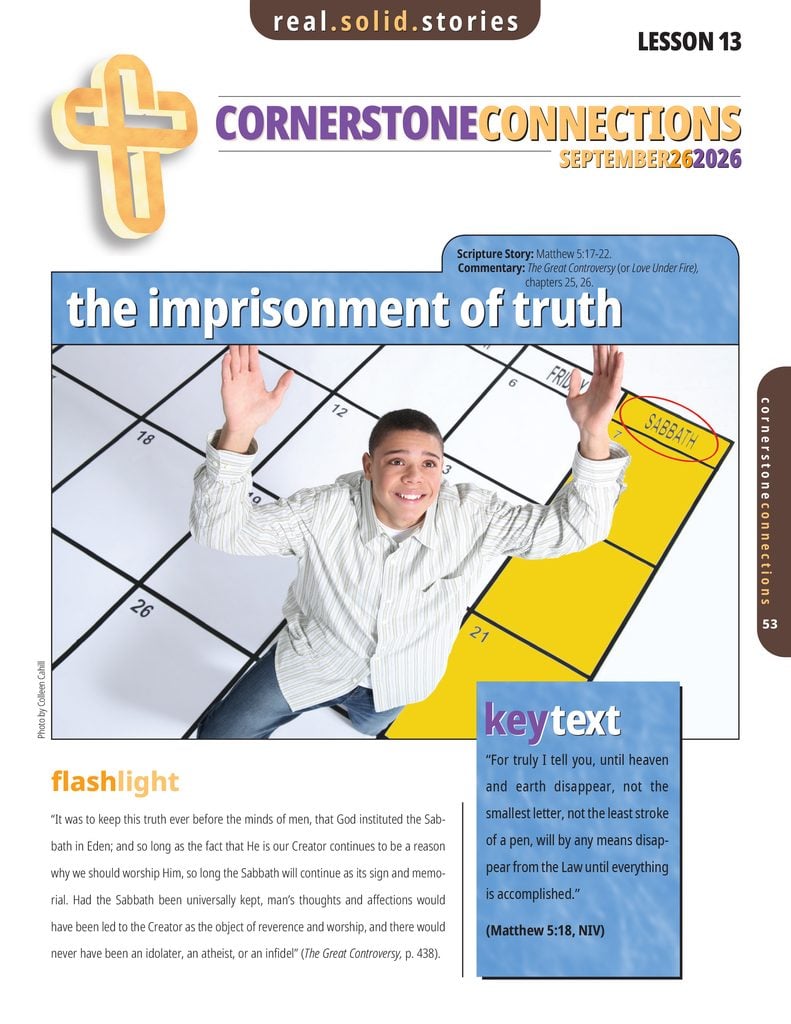
Again and again, Jesus broke what the Jews called the Law. He did not observe the handwashings that the Law laid down; He healed sick people on the Sabbath, although the Law forbade such healings; He was in fact condemned and crucified as a lawbreaker; and yet here He seems to speak of the Law with a veneration and a reverence that no Rabbi or Pharisee could exceed.
Significantly, Jesus identifies His teaching with the Old Testament Scriptures and affirms their timeless authority. He calls us to faithfulness to even the least of God’s commandments, yet He avoids a legalism that focuses on the letter of the Law in the fashion of the scribes and Pharisees.
All that the Old Testament says about God is revealed more clearly in Christ. The Bible is God’s Word written and Jesus Christ is God’s Word personified, actualized, for “the Word was made flesh, and dwelt among us” (John 1:14, KJV).
In the Jewish community the standard of God was laid down for all time in the Torah, the Law of God. Schools of interpretation had hedged in the Law, with safeguards against infringement. In Jesus’ day the debate was between two such schools: those of Hillel and of Shammai. There were 613 commandments, rules, traditions, and examples without number, which made the Law a confusing exercise for the mind and a burden for the conscience.
When the Jews referred to the Law, they meant either the Ten Commandments or the first five books of the Old Testament, or, by referring to “the Law and the Prophets,” they meant the whole of Old Testament Scripture, or they meant the Oral Law. The Oral or Scribal Law was the most common in Jesus’ day. Jesus cut through the traditions and legalistic interpretations and disclosed the broad principles of the Law from which He interpreted its basic intent. This intent was not to focus on the righteousness of the Law but on the need for righteousness with God. Paul says that “Christ is the end of the law for righteousness to everyone that believeth” (Rom. 10:4, KJV). He does not say that Christ is the end of the Law, as is often misquoted, for the Law still serves to show us our sin, our sinfulness, and to show us our need of the Savior (Rom. 7). But the Law is no more than a pointer, a reminder of our need for the righteousness of God. To answer this need, Christ is the end of the Law for righteousness. He is the “end” to which the Law pointed.
So, Jesus assured His Jewish listeners that He was not anti-law at all. On the contrary, He was going to fulfill it; that is, both keep and explain fully its original intention, which they had managed to miss over the centuries.
There is much debate over what Jesus meant by the word fulfill. The word means to fill out, or to expand. It does not mean to end. Jesus was not taking away from the law, nor was he adding to it. He was clarifying its original meaning. After all, he was its author. And we must not forget that Jesus, as a Jew, related well to the law, not as it was commonly understood, but as it was originally intended.
“Unrest!”
What is it that makes you uneasy or very uncomfortable?
Read Matthew 5:17-20.
17 “Do not think that I have come to abolish the Law or the Prophets; I have not come to abolish them but to fulfill them. 18 For truly, I say to you, until heaven and earth pass away, not an iota, not a dot, will pass from the Law until all is accomplished. 19 Therefore whoever relaxes one of the least of these commandments and teaches others to do the same will be called least in the kingdom of heaven, but whoever does them and teaches them will be called great in the kingdom of heaven. 20 For I tell you, unless your righteousness exceeds that of the scribes and Pharisees, you will never enter the kingdom of heaven.
Read James 2:8-10.
8 If you really fulfill the royal law according to the Scripture, “You shall love your neighbor as yourself,” you are doing well. 9 But if you show partiality, you are committing sin and are convicted by the law as transgressors. 10 For whoever keeps the whole law but fails in one point has become guilty of all of it.
1. What ingredients do you need for a perfect Sabbath?
- Relationships.
- Rest.
- Church (11:00am Divine Worship).
- AYM.
- Outdoor musings.
- Service activities.
- Sabbath School fellowship.
- Potlucks
- Other.
2. What is John’s main point in Matthew 5:17-20?
- Keeping the Law is most important.
- Jesus is here; the Law is unnecessary.
- Jesus will hang those who refuse to keep the Law.
- Anyone who teaches others to keep the Law should be killed.
- Your Law-keeping game must be flawless.
- Jesus loves hanging out with lawless people anyway.
- Keep your focus on the smallest details of the Law.
- Other.
3. What do you think is the meaning of Matt. 5:17-18?
- Jesus is advocating good Sabbath keeping.
- Jesus is the one who explains the Law.
- Jesus is the one who gives the Law its meaning.
- Jesus loves the “nitty-gritty” aspects of the Law.
- Jesus is teaching that the Law of God is eternal.
- Jesus is saying that the prophets’ writings are very vital.
- Jesus is expressing that He is just as important as the Law.
- Other.
4. What are some reasons people attack the Sabbath in God’s law?
- It is a rebuke to their wayward lifestyles.
- Sabbath is a break from work, and people don’t take money breaks.
- This day is sanctified by God and evil people don’t respect it.
- Seventh-day Adventists will cage all who are against Sabbath keeping.
- People love to fight about novel things; Sabbath is one of them.
- This Law is one that Satan hates; he attacks people who keep it.
- “What?!” People everywhere love the Sabbath; nobody attacks it.
- People just don’t know enough about this special day.
- Other.
5. In Matt. 5:19 what is the difference between “least” and “great”?
- Commandment breakers are “least,” and hell bound.
- The “great” are commandment keepers and should be praised.
- The “great” are influencers of good.
- The “least” are influencers of evil.
- The “great” represent the people already in heaven.
- The “least” represent the people already in hell.
- Both “least” and “great” are cool. There is no difference between them.
- Other.
6. In view of Matt. 5:20, what is the key to entering heaven?
- We must be more righteous that Scribes and Pharisees.
- We need to know Jesus.
- There are no requirements; all are welcome.
- Anyone who follows Jesus will have the key.
- Keeping Sabbath as Jesus did.
- Mending all broken relationships.
- Perfect Sabbath School attendance.
- Memorizing the key text each week.
- Other.
7. What challenges have you experienced as a Sabbath keeper?
8. Are you prepared to suffer even death for upholding God’s law?
SUMMARY
Jesus’ teaching here awakened His people to what the Law [CM9] meant from the beginning. He clarified God’s longstanding desire that His creation be characterized by both internal (attitudes) and external (actions) obedience and holiness. Fulfilled Law is written on the heart. Jesus Himself fulfilled the law in several ways: (1) by keeping it perfectly; (2) by fulfilling the Old Testament messianic types and prophecies; and (3) by providing the way of salvation that meets all the righteous requirements of the Law. Therefore, we are only able to keep God’s Law through Jesus Christ. In a loving Christ-centered relationship His Law becomes meaningful and practical to each of us.
APPLICATION
To the average person trying to eke out a living, the Pharisees were the truly holy people. Jesus claimed that even they were not good enough! No amount of law-keeping was good enough because the problem is the human heart. The point was hard for the self-righteous to swallow. No one, not even the super law-keeping Pharisees, could enter heaven. All needed a Savior!
Below, find some application activities to interface with this lesson. These are simply to provide ideas, or to invite you to imagine and create some of your own, as you impact the lives of teens for God’s glory.
- POLICE CONNECTIONS
- Plan a talkback with local law enforcement agencies.
- Discuss with them what it means to be a good citizen and how we can assist them in doing their jobs.
- Open the key text for our lesson, , and share it with them.
- Ask for their explanation of it.
- You may be shocked to know just how spiritually connected some cops are.
LAW-LEARNING
- As young people, ask for an audience with your church and ask for some information regarding how we are expected to keep God’s Law.
- Have prepared questions for them.
- A good idea would be to have some more personal application questions for them such as: How would you keep God’s Law if you were under attack for doing so?
- You might just be surprised at the answers you would get!
- AFFLICTED TESTIMONIES
- Seek out a member of your church this week who had an issue with being afflicted for keeping God’s Sabbath.
- Share with them what your lesson is about this week and read with them your key passage.
- Ask them questions about how they handled those afflictions.
- Pray for that person and ask them for permission to share their testimony of affliction with the class.
- Make good notes and share those with your class.