

Overview
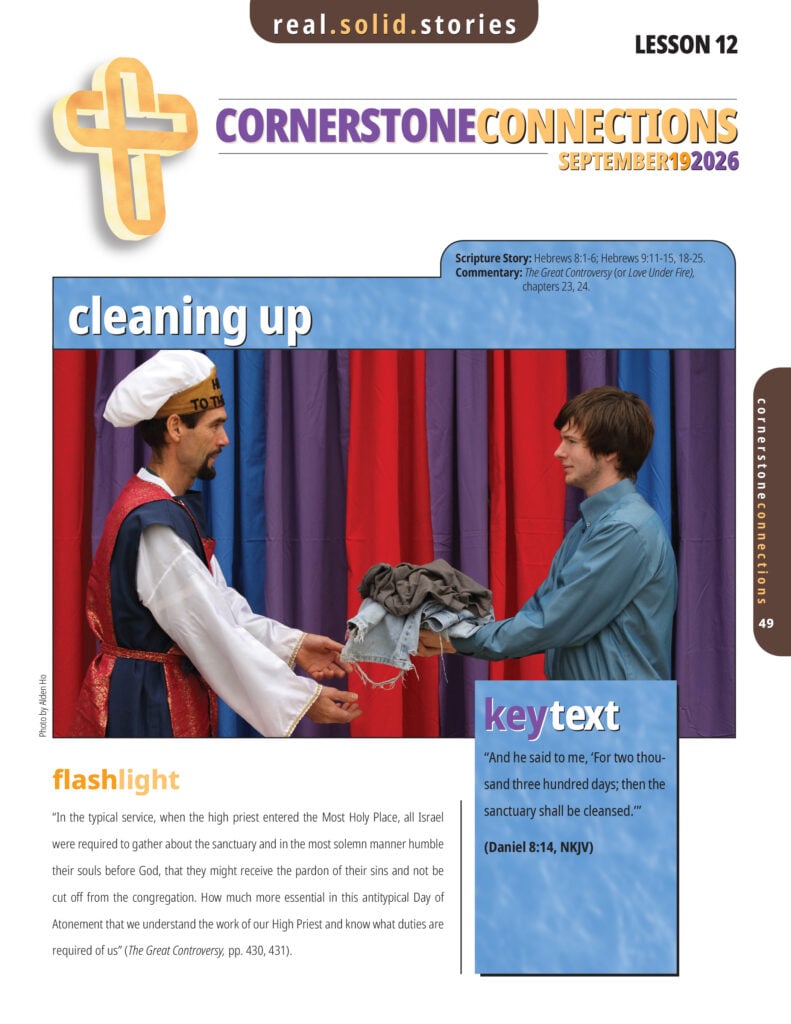
This lesson explores Jesus’ ongoing ministry as our High Priest in the heavenly sanctuary and the significance of the sanctuary service in understanding God’s plan of salvation. Through Hebrews 8–9, the lesson connects the earthly sanctuary to the heavenly reality, emphasizing that Christ’s sacrifice provides complete forgiveness and that He now ministers on our behalf. Students are encouraged to understand the investigative judgment as a serious but hopeful reminder to examine their hearts, turn away from sin, and depend fully on Christ’s righteousness. The lesson also connects this truth with the three angels’ messages and challenges young people to share God’s final warning with the world in love while preparing themselves for Jesus’ return.
Scripture
Hebrews 8–9
Discussion Video

Lesson 1
SCRIPTURE PASSAGES
Hebrews 8:1-6
Hebrews 9:11-15
Hebrews 9:23-28
OVERVIEW
In this lesson we will be looking at the concept of salvation and faith through the lens of Romans 1-3. This text has proved to be foundational to protestant Christianity’s idea of righteousness by faith and salvation by grace.
OPENING ACTIVITY:
BLIND REPLICAS
Supplies needed: Play dough (best) OR pencil/paper (OK). Blindfolds. Search the pictures/structures below on your phone to show to students, or print out the pictures beforehand (you super teachers!).
Game: You will be recreating either a famous piece of art or a building, depending on which medium you have on hand. (If you need play dough, you might check out the younger children’s
Sabbath School rooms.)
You can have students separate into pairs or take a couple of volunteers, depending on the size of your group. Have one student be the describer. The other student will be blindfolded and will be the replicator. Give the describer a picture of what the replicator will be making/drawing They can only use their voice to help the replicator, but CANNOT tell the replicator what they are making/drawing. Having two teams go at the same time and building different things makes the game more complicated and fun.
Building or Picture Ideas:
Buildings
- Statue of Liberty
- Eifel Tower
- Leaning Tower of Pisa
- Big Ben
- Great Pyramid
Pictures
- Mona Lisa
- Starry Night (van Gogh)
- The Last Supper
- George Washington
- LeBron James
QUESTIONS
- What did you like or not like about this game?
- Which job do you think was harder, describer or replicator? Why?
- In your opinion, were some things easier to replicate? What made it so?
- How could the describer have been clearer in their descriptions? What difference would that have made?
TRANSITION
This week we are looking at a few complex concepts from the book of Hebrews. The first section talks about the heavenly sanctuary. Even with the detailed descriptions that God gave Moses, I have a feeling that a tent in the wilderness is not at all comparable to the sanctuary it was modeled after. Kind of like a blindfolded artist who can’t see the masterpiece that is reality! BUT, that doesn’t stop God. It is amazing that even though He knows we won’t fully understand, He still tries to reveal His plan to us. That is what we are going to be studying today in the book of Hebrews!
BIBLE STUDY GUIDE
As we open up the book of Hebrews today to look at our texts there are some terms or ideas that we will want to be clear on before we start because in our passage because they play a prominent role.
The first one is a covenant.
- Spend some time with your group talking about what a covenant is.
- How might a covenant with God be different from other legal covenants?
The second term is High Priest.
- It might seem a little silly to us to talk about this one but what might the readers of the New Testament think of when they hear High Priest?
- Would Old Testament readers maybe think differently?
- What are some of the roles of a High Priest vs just the Priest? (Leader note: do some homework on this if you would like, but one of the big roles here in Hebrews of the High Priest is the role of mediator and intercessor before God for the people.)
Note: Hebrews has already established that Jesus is our High Priest, so when you read that in the following passages, remember that it’s talking about Jesus.
Read Hebrew 8:1-6.
1 Now the main point of what we are saying is this: We do have such a high priest, who sat down at the right hand of the throne of the Majesty in heaven, 2 and who serves in the sanctuary, the true tabernacle set up by the Lord, not by a mere human being.
3 Every high priest is appointed to offer both gifts and sacrifices, and so it was necessary for this one also to have something to offer. 4 If he were on earth, he would not be a priest, for there are already priests who offer the gifts prescribed by the law. 5 They serve at a sanctuary that is a copy and shadow of what is in heaven. This is why Moses was warned when he was about to build the tabernacle: “See to it that you make everything according to the pattern shown you on the mountain.” 6 But in fact the ministry Jesus has received is as superior to theirs as the covenant of which he is mediator is superior to the old one, since the new covenant is established on better promises.
QUESTIONS
- Think momentarily of the term ‘throne of the Majesty in heaven.’ Can you even begin to imagine what that is like? One of Jesus’ roles is to sit on the right hand of that throne. (Think God’s right-hand-man or wingman; in ancient times it means a place of honor.) Combine this position with the definition of High Priest. What does that mean for us?
- Role 2 for Jesus is minister in the holy places, in God’s special tent (probably better than your Pathfinder tent). Review some of the ministry of the earthly holy place (Candlestick, Table of Shewbread, Altar of Incense). All of those things are intercessory for humans.
- What do you think the heavenly sanctuary is like? (Remember, the one Moses oversaw was a shadow or copy.) How could God describe something like that to us?
- Finally, before we move on, look at verse 6 again. What do you think about Jesus doing things better? Is it possible for God to get better? The covenant is better! (Think of an NFL player getting a better agent and signing a better deal!) Jesus is our agent, and the deal keeps getting better!
The wonderful thing about being a Christian is that unlike the Jews of Jesus’ time, we get to see God’s promises fulfilled perfectly or in a better and fuller way than in the Old Testament prior to Jesus. One of the things that I am glad changed is that I don’t have to do animal sacrifices. (Of course that is selfish because the only reason I don’t is because Jesus died and paid the price that the animals represented.) Hebrews talks about why Jesus’ blood is better.
Read Hebrews 9:11-15.
11 But when Christ came as high priest of the good things that are now already here, he went through the greater and more perfect tabernacle that is not made with human hands, that is to say, is not a part of this creation. 12 He did not enter by means of the blood of goats and calves; but he entered the Most Holy Place once for all by his own blood, thus obtaining eternal redemption. 13 The blood of goats and bulls and the ashes of a heifer sprinkled on those who are ceremonially unclean sanctify them so that they are outwardly clean. 14 How much more, then, will the blood of Christ, who through the eternal Spirit offered himself unblemished to God, cleanse our consciences from acts that lead to death, so that we may serve the living God!
15 For this reason Christ is the mediator of a new covenant, that those who are called may receive the promised eternal inheritance—now that he has died as a ransom to set them free from the sins committed under the first covenant.
QUESTIONS
- Remember the Holy places from the last section. In the earthly sanctuary the Priest could only enter the Holy Place after making a sacrifice and then using the laver (a washbasin) to clean the blood of the sacrifice so that the Holy Place could remain blood free. What makes Jesus’ blood different and better than the animals? What does the text say?
- Note that the text also talks about Jesus’ sacrifice being done through the Holy Spirit. In this text we have all three members of the trinity. Why might that be important?
- In modern times we are uncomfortable with blood sacrifices (maybe for good reason). How do feel about Jesus’ blood sacrifice on behalf of humanity (which includes you)?
Finally, here’s the best news about all this! I think it is better than anything we could ever imagine about God. Jesus, on our behalf, died. I heard a pastor recently say that Jesus didn’t die ‘for’ us, he died ‘as’ us. And this text is proof of that.
Read Hebrews 9:23-28.
23 It was necessary, then, for the copies of the heavenly things to be purified with these sacrifices, but the heavenly things themselves with better sacrifices than these. 24 For Christ did not enter a sanctuary made with human hands that was only a copy of the true one; he entered heaven itself, now to appear for us in God’s presence. 25 Nor did he enter heaven to offer himself again and again, the way the high priest enters the Most Holy Place every year with blood that is not his own. 26 Otherwise Christ would have had to suffer many times since the creation of the world. But he has appeared once for all at the culmination of the ages to do away with sin by the sacrifice of himself. 27 Just as people are destined to die once, and after that to face judgment, 28 so Christ was sacrificed once to take away the sins of many; and he will appear a second time, not to bear sin, but to bring salvation to those who are waiting for him.
QUESTIONS
- How might this text support Jesus dying ‘as us’ versus ‘for us’? Do you agree with that assessment?
- Isn’t it good news for all of us that Jesus only needed to die one time?
- What does this text say about the timing of judgement on the basis of Jesus dying for our sins?
- Sometimes I used to think that Jesus was stuck in the Most Holy Place just doing judging all the time. How might these texts in Hebrews broaden our view of Jesus’ post-resurrection role?
- This text ends with people eagerly awaiting the second coming. How can your youth group more eagerly await and talk about the second coming? How is that difficult to do? How is that easy to do?
APPLICATION
- This week can you think back to times when you could have made things better by doing something in a Kingdom way?
- Share if you have that story, but more importantly work on acting in a Kingdom way this week.
- Maybe God is trying to communicate something in your life, even though it might be not fully revealed yet.
- Whatever God’s heavenly plan is, don’t be afraid to listen to God!
- Please be willing to share your story about how you sense God might be speaking to you next week at Sabbath School.
Lesson 2
SCRIPTURE PASSAGE
LEADER’S NOTE
For a Relational Bible Study (RBS) you’ll want to get into the Scripture passage and encourage the youth to imagine participating in the story while it’s happening. Then you will be able to better apply it to your own situation today.
You will need to ask God for the Holy Spirit to be present as your small group discusses the questions (no more than 3-6 people in a group is recommended). Start with the opening question. It is a personal question and the answer is unique for each individual. There is no right answer and nobody is an expert here, so don’t be surprised when you hear different responses. You are depending on the Holy Spirit to be present and to speak through your group. Say what God prompts you to say, and listen to what others share.
Take turns reading the chapter out loud. Follow that with giving the students some time to individually mark their responses to the questions (a PDF version of the handout is available as a download). This gives each person a starting point for responding when you start to share as a group. Next, begin the discussion by asking the students to share what they marked and why on each question as you work your way through. Feel free to take more time on some questions than others as discussion warrants.
Encourage each person in the group to apply what is discussed to their personal lives and to share with the group what they believe God wants them to do. Then ask them to pray that God will help each of them to follow through in doing so. Remind them to expect that God will show them ways to live out the message of this passage in the coming week, and that they are free to ask others in the group to help hold them accountable.
OVERVIEW
Up until Jesus came to earth and made the ultimate sacrifice for us on the cross, the Jewish temple service included certain practices that were mandated on Mount Sinai to Moses. The sanctuary was divided into three parts: the outer courtyard, the Holy Place, and the Most Holy Place. Priests of all kinds ministered within the first two parts of the temple, but only the High Priest was allowed within the Most Holy Place. On the Day of Atonement, the High Priest would enter the Most Holy Place and sprinkle blood from the sacrifice onto the Ark of the Covenant, as a symbol of atonement for the sins of the nation. The Most Holy Place was heavily guarded and was never accessed by the common public.
On the day of Jesus’ death on the cross, the veil that separated the Most Holy Place from the rest of the tabernacle tore, symbolizing the end of this practice and the establishment of Jesus as our new High Priest. Ever since His ascension, Jesus has been ministering in the true version of the tabernacle up in heaven, interceding for us day after day. Although the tabernacle and the covenant of atonement were upgraded to the services that are now provided in heaven, every promise that we find in the Bible is being incorporated into our divine intervention, and the new covenants that are drawn up between God and His people are better than ever. As the force of evil grows stronger as the end grows near, we should feel secure in the fact that we have our High Priest (who is also at the right hand of God) on our side, taking out the old and making way for the biggest upgrade of our lives—heaven.
Out with the Old, In with the New
Have you ever upgraded a product?
Read Hebrews 8:1-6.
1 Now the main point of what we are saying is this: We do have such a high priest, who sat down at the right hand of the throne of the Majesty in heaven, 2 and who serves in the sanctuary, the true tabernacle set up by the Lord, not by a mere human being.
3 Every high priest is appointed to offer both gifts and sacrifices, and so it was necessary for this one also to have something to offer. 4 If he were on earth, he would not be a priest, for there are already priests who offer the gifts prescribed by the law. 5 They serve at a sanctuary that is a copy and shadow of what is in heaven. This is why Moses was warned when he was about to build the tabernacle: “See to it that you make everything according to the pattern shown you on the mountain.” 6 But in fact the ministry Jesus has received is as superior to theirs as the covenant of which he is mediator is superior to the old one, since the new covenant is established on better promises.
-
Who is our High Priest?
- Jesus.
- Aaron.
- God.
- The prophet Muhammed.
- Melchizedek.
- He’s appointed every 4 years.
- Jesus in heaven; a pastor on earth.
- Other.
-
What does our High Priest do?
- Intercede for us.
- Sprinkles blood on the ark of the covenant.
- Kills a lamb.
- Makes a sacrifice for us.
- Dies for us.
- Sits beside God on the throne.
- Makes covenants with God on our behalf.
- Other.
-
What sacrifice did our High Priest make?
- Killed a lamb.
- He died on a cross for us.
- Tore the veil in the temple.
- Went back to heaven.
- Stayed on earth.
- Gave His blood as an eternal sacrifice, unlike the yearly ones.
- Became a priest on earth.
- Other.
-
What warning did God give to Moses about the Tabernacle?
- It would eventually be torn down.
- It needed to be exactly as it was ordained by God.
- It was fake.
- God wouldn’t preside there.
- This priesthood was sacred, like a heaven on earth.
- This was only a shadow of what happens in heaven.
- This was God’s way of communicating with His people.
- Other.
-
Where does our High Priest minister?
- In heaven.
- At the tabernacle in Jerusalem.
- In a heavenly tabernacle.
- In the desert with Moses.
- In a place that was built by the Lord.
- At the right hand of God.
- In our hearts.
- Other.
-
What is the difference between the heavenly and earthly Tabernacles?
- Heavenly tabernacle is far superior.
- Earthly tabernacle served as a temporary stand-in.
- Humans acted as priests on earth; Jesus is priest in heaven.
- Earthly tabernacle required animal blood; Jesus’ blood acts in heaven.
- New covenants vs. old covenants.
- Old covenants no longer apply since they are fulfilled.
- Earthly tabernacle is far superior.
- Other.
- What do we have to do to foster a relationship with the High Priest?
- How does the knowledge of the sacrifices that our High Priest made impact you?
SUMMARY
Although making an upgrade feels like the best treat in the world, it doesn’t work if you don’t know what you are upgrading for. The “upgrade” between the heavenly and earthly Tabernacle is enormous and signifies a new covenant that will be permanent for eternity. When Jesus died on the cross, He took on the burden of being our High Priest, of bearing our sins, and instead of clearing them through a ritual, He became the sacrifice, and fulfilled the covenant of old. With that being done, He is now able to intercede for us in the majestic heavenly tabernacle, creating bonds through the promises left for us in the Bible and giving us hope of our eternal future. All we need to do is trust our High Priest and take that step into the upgrade of our lives today!
APPLICATIONS
Knowing who is interceding for us and learning about the upgrade of our covenant is crucial to our lives as modern-day believers. It is always a necessary part of studying to sit back and meditate about how a story applies to us today as youth. Below you will find three applications that can benefit the youth in your group and help them meditate on the word shared today. These applications work both individually and in a group.
UPGRADES
Have you ever upgraded a phone, contract, or anything else? It’s a great feeling! But you also must have been advised to never agree to “upgrades” without knowing what you are getting into. Reading contracts thoroughly may not be so fun, but it can save you lots of headache later on. The same goes for our covenant with God; we need to read all the “fine print” in the Bible to know what we are being offered.
- This week, as a group or individually, take time to read different passages in which God is promising you something.
- As you are fully informed of the “fine print,” take time to thank your High Priest for everything He is doing on your behalf, and for keeping you informed on everything He does to make your life better!
CONTRACTS
When you are receiving a preliminary contract for some deal or something you’re buying, you are always given time to revise and add to the contract.
- Take time to review the contract that God is offering you; the selfless love of His son, and all your sins cleared through His blood. What can you offer in return? God doesn’t ask for much.
- Take your time to write your own contract with your High Priest, and offer it up in prayer, asking Him to help you fulfill your end of the deal.
TABERNACLE
Although we do not worship in outdoor tabernacles following the Old Testament model any more, most of us have a place of worship that we call home. Jesus is working on our behalf 24/7 in heaven, but that does not mean that He is not present with us when we convene to worship here on earth. In fact, He says, “For where two or three are gathered together in my name, I am there among them (Matt. 18:20).”
- We must treat our “tabernacle” with sanctity and respect. Take special notice of the state your church is in, and what you can do to help keep it in its best condition.
- Perhaps as a youth group, you can organize a clean-up day in which you can take care of your Holy Place.
- Every time you are in church, remember that you are in a holy place, and make sure to be reverent and treat it as such.