

Overview
This lesson, based on David’s encounter with Goliath in 1 Samuel 17, explores the importance of knowing God and understanding who we are becoming through Him. David faced criticism from his brother, doubt from King Saul, and threats from Goliath, yet he refused to let the expectations or opinions of others define him. Instead, his confidence came from his past experiences of God’s faithfulness and his willingness to trust God using the gifts and abilities he had been given. The lesson challenges us to recognize the difference between our authentic selves and the “false self” we may create to gain approval, emphasizing that genuine spiritual growth involves knowing ourselves, resisting outside pressure, and allowing Christ to transform our character so that our lives reflect Him.
Scripture
1 Samuel 17
Discussion Video
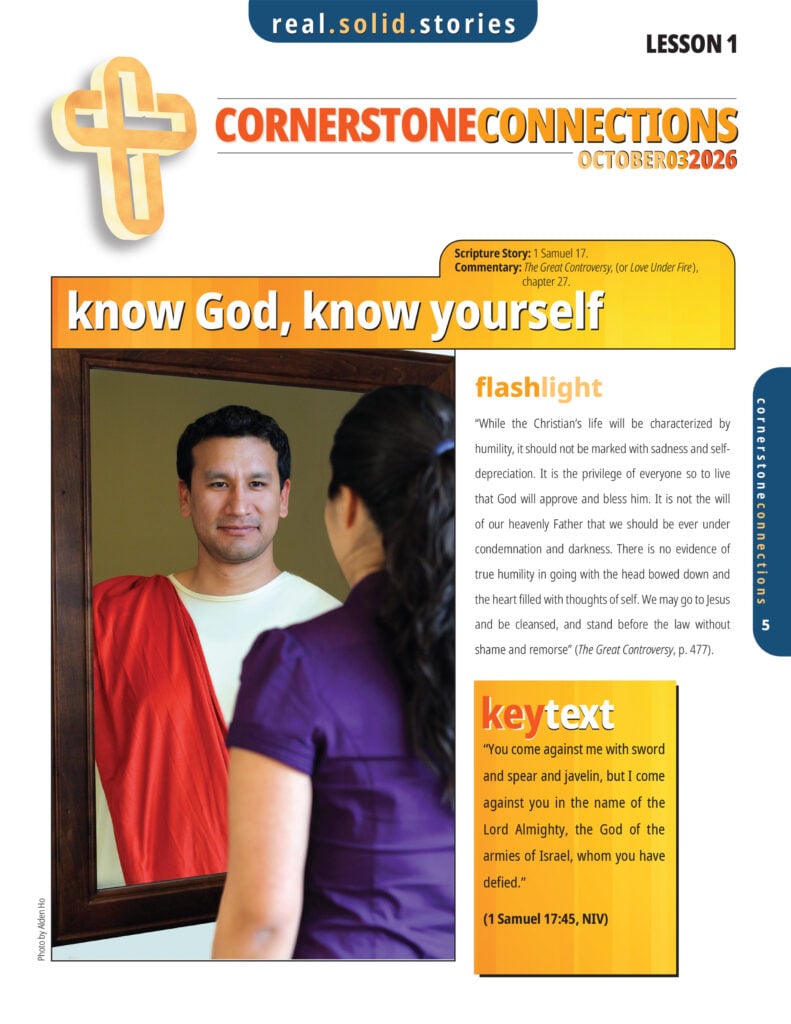

Lesson 1
SCRIPTURE PASSAGES
OVERVIEW
There are times in life when it would seem that the odds are stacked against you. How you handle those moments will often dictate how the remainder of your life will go. Adversity isn’t always bad—think of a baby chick pecking their way out of an egg or a moth coming out of the cocoon. In today’s study we will look at some lessons learned in the face of adversity.
OPENING ACTIVITY:
SLAYING GIANTS
Items Needed:
- 1 small balloon for each participant.
- Enough marshmallows for each participant to have 5. Marshmallow can be whatever size you want to play the game with (how far you want to sling them).
- 1 cup for each player. Make sure the cup and balloons are compatible in size. (The balloon, when cut off, will need to fit snuggly to the cup.)
Each player will need a “slingshot.”
- Tie a knot at the open end of the balloon.
- Cut off the tip of the balloon.
- Cut away the bottom of a sturdy paper cup.
- Gently stretch the balloon over the bottom of the paper cup. Pull up the balloon as far as possible on the cup. If you need to, tape the balloon to the cup (black electrical tape recommended).
- Marshmallows, one at a time, are “loaded” into the tied-off end of the balloon, grasped with two fingers, and pulled back until the “balloon” shooter is taught. Then release, holding the paper cup firmly with the other hand.
Instructions:
- Ask for volunteers (giants) to stand across the room from the participants (Davids).
- Give each David a “slingshot.”
- Provide each David with 5 marshmallows.
- Have each David, using their sling, sling marshmallows into the cup that one of the giants is holding.
- Whichever David is able to get the most marshmallows into the giants’ cups wins!
QUESTIONS
- What was the most difficult part of this activity?
- Why do you think the winner was able to get the most hits?
- If you had been David, how difficult do you think it would have been to hit Goliath?
- What life lessons can be learned from this activity?
TRANSITION
It was a silly game, but what if the outcome of this game meant the difference between life and death? This might seem a little of absurd, but our society is obsessed with this concept. There are lots of TV shows and movies that are based on the concept of “winning.” What happens when play affects reality?
BIBLE STUDY GUIDE
Read 1 Samuel 1:11.
11 And she made a vow, saying, “Lord Almighty, if you will only look on your servant’s misery and remember me, and not forget your servant but give her a son, then I will give him to the Lord for all the days of his life, and no razor will ever be used on his head.”
QUESTIONS
- Who are the main characters in this section?
- What are distinguishing characteristics of each one?
- Describe current events that have parallels to this story so far.
- In looking at this story, what type of decisions could have led the Israelites to be in this position?
Read 1 Samuel 1:12-15.
12 As she kept on praying to the Lord, Eli observed her mouth. 13 Hannah was praying in her heart, and her lips were moving but her voice was not heard. Eli thought she was drunk 14 and said to her, “How long are you going to stay drunk? Put away your wine.
15 “Not so, my lord,” Hannah replied, “I am a woman who is deeply troubled. I have not been drinking wine or beer; I was pouring out my soul to the Lord.
QUESTIONS
- Who are the main characters in this portion?
- What do we know about them?
Read 1 Samuel 17: 20-31.
20 Early in the morning David left the flock in the care of a shepherd, loaded up and set out, as Jesse had directed. He reached the camp as the army was going out to its battle positions, shouting the war cry. 21 Israel and the Philistines were drawing up their lines facing each other. 22 David left his things with the keeper of supplies, ran to the battle lines and asked his brothers how they were. 23 As he was talking with them, Goliath, the Philistine champion from Gath, stepped out from his lines and shouted his usual defiance, and David heard it. 24 Whenever the Israelites saw the man, they all fled from him in great fear.
25 Now the Israelites had been saying, “Do you see how this man keeps coming out? He comes out to defy Israel. The king will give great wealth to the man who kills him. He will also give him his daughter in marriage and will exempt his family from taxes in Israel.”
26 David asked the men standing near him, “What will be done for the man who kills this Philistine and removes this disgrace from Israel? Who is this uncircumcised Philistine that he should defy the armies of the living God?”
27 They repeated to him what they had been saying and told him, “This is what will be done for the man who kills him.”
28 When Eliab, David’s oldest brother, heard him speaking with the men, he burned with anger at him and asked, “Why have you come down here? And with whom did you leave those few sheep in the wilderness? I know how conceited you are and how wicked your heart is; you came down only to watch the battle.”
29 “Now what have I done?” said David. “Can’t I even speak?” 30 He then turned away to someone else and brought up the same matter, and the men answered him as before. 31 What David said was overheard and reported to Saul, and Saul sent for him.
QUESTIONS
- Describe the responses of the different groups of people to Goliaths taunts.
- Describe modern day situations in which people have similar responses to “giants” in their lives.
- What motivations did the following people have: David, Saul, David’s brothers, soldiers?
- What are the core lessons that can be learned from this portion of the story?
Read 1 Samuel 17:32-40.
32 David said to Saul, “Let no one lose heart on account of this Philistine; your servant will go and fight him.”
33 Saul replied, “You are not able to go out against this Philistine and fight him; you are only a young man, and he has been a warrior from his youth.”
34 But David said to Saul, “Your servant has been keeping his father’s sheep. When a lion or a bear came and carried off a sheep from the flock, 35 I went after it, struck it and rescued the sheep from its mouth. When it turned on me, I seized it by its hair, struck it and killed it. 36 Your servant has killed both the lion and the bear; this uncircumcised Philistine will be like one of them, because he has defied the armies of the living God. 37 The Lord who rescued me from the paw of the lion and the paw of the bear will rescue me from the hand of this Philistine.”
Saul said to David, “Go, and the Lord be with you.”
38 Then Saul dressed David in his own tunic. He put a coat of armor on him and a bronze helmet on his head. 39 David fastened on his sword over the tunic and tried walking around, because he was not used to them.
“I cannot go in these,” he said to Saul, “because I am not used to them.” So he took them off. 40 Then he took his staff in his hand, chose five smooth stones from the stream, put them in the pouch of his shepherd’s bag and, with his sling in his hand, approached the Philistine.
QUESTIONS
- Compare and contrast the objections of King Saul with the responses of David.
- Why did King Saul finally acquiesce to David’s request?
- What does it mean to fight in one’s own armor?
- How important is this concept?
Read 1 Samuel 17:41-50.
41 Meanwhile, the Philistine, with his shield bearer in front of him, kept coming closer to David. 42 He looked David over and saw that he was little more than a boy, glowing with health and handsome, and he despised him. 43 He said to David, “Am I a dog, that you come at me with sticks?” And the Philistine cursed David by his gods. 44 “Come here,” he said, “and I’ll give your flesh to the birds and the wild animals!”
45 David said to the Philistine, “You come against me with sword and spear and javelin, but I come against you in the name of the Lord Almighty, the God of the armies of Israel, whom you have defied. 46 This day the Lord will deliver you into my hands, and I’ll strike you down and cut off your head. This very day I will give the carcasses of the Philistine army to the birds and the wild animals, and the whole world will know that there is a God in Israel. 47 All those gathered here will know that it is not by sword or spear that the Lord saves; for the battle is the Lord’s, and he will give all of you into our hands.”
48 As the Philistine moved closer to attack him, David ran quickly toward the battle line to meet him. 49 Reaching into his bag and taking out a stone, he slung it and struck the Philistine on the forehead. The stone sank into his forehead, and he fell facedown on the ground.
50 So David triumphed over the Philistine with a sling and a stone; without a sword in his hand he struck down the Philistine and killed him.
QUESTIONS
- Describe the confidence level of David, Goliath, Saul, Philistines, and Israel.
- Who do you most resemble of these folks? Why?
- How do you think David felt as he was running toward Goliath?
- What do you think was the last thing that went through Goliath’s mind?
- How do you think King Saul felt when Goliath was killed?
- How do you think David’s brothers felt?
APPLICATION
- What kind of giants are in your life? Social media, drugs, food, or some of the many other forms of addictions?
- How do you face them?
- What lessons can you learn from this story?
- How would you feel if you could watch the giants in your life fall?
God wants you to be victorious over the giants you are facing. David wasn’t really that special—what I mean is that you can have the same confidence and victory. He spent much of his time listening and building his relationship with God. You too can have what he had and possibly even more.
FOLLOW UP
- During your prayer time this week, make a list of giants in your life.
- After you have made the list, ask God to help you fight them.
- Pray over the list each day—listen for God to speak and help you to know how to face your giants.
Lesson 2
SCRIPTURE PASSAGE
LEADER’S NOTE
For a Relational Bible Study (RBS) you’ll want to get into the Scripture passage and encourage the youth to imagine participating in the story while it’s happening. Then you will be able to better apply it to your own situation today.
You will need to ask God for the Holy Spirit to be present as your small group discusses the questions (no more than 3-6 people in a group is recommended). Start with the opening question. It is a personal question and the answer is unique for each individual. There is no right answer and nobody is an expert here, so don’t be surprised when you hear different responses. You are depending on the Holy Spirit to be present and to speak through your group. Say what God prompts you to say, and listen to what others share.
Take turns reading the chapter out loud. Follow that with giving the students some time to individually mark their responses to the questions (a PDF version of the handout is available as a download). This gives each person a starting point for responding when you start to share as a group. Next, begin the discussion by asking the students to share what they marked and why on each question as you work your way through. Feel free to take more time on some questions than others as discussion warrants.
Encourage each person in the group to apply what is discussed to their personal lives and to share with the group what they believe God wants them to do. Then ask them to pray that God will help each of them to follow through in doing so. Remind them to expect that God will show them ways to live out the message of this passage in the coming week, and that they are free to ask others in the group to help hold them accountable.
OVERVIEW
Although it might not be a stand-out in your yearly cycle, this Sabbath marks the start of the fourth quarter of the fourth year of the walk through the Bible and Conflict of the Ages books. We’ll start anew in January of 2023 with the book of Genesis. The current curriculum follows the five books in the “Conflict of the Ages” series, with corresponding Bible passages for those chapters. The final book in the series is The Great Controversy, which covers history after the Bible was written. The section for this week deals with “Modern Revivals” and the Scripture passage selected is the familiar story of David and Goliath.
You may choose a different passage, such as Jacob and his family making a recommitment to God at Shechem as they relocated to Bethel (Genesis 35). You might choose the miracle at Pentecost (Acts 2) or the revival in Ephesus in which the people burned their magic books and the Gospel upset the status quo of the entire city (Acts 19). Or, you could use the study below, which continues to inspire all ages.
Some elements that might have special meaning to teens could include the age of David—probably in his teens like those in Youth Sabbath School—when he fought Goliath. David was the youngest of eight brothers. The age to join the military was 20. Only his three oldest brothers were fighting in Israel’s army at this time. Do the math. If Jesse’s wife had a son each year, it’s quite possible that David was only 15 years old, or possibly even younger. Let that captivate the imagination of your teens.
Kings usually served as the military leader for their people. Saul had done this (1 Samuel 11:1-11; 13:1-14; 15:1-23), and later David did the same when he became the king of Israel (2 Samuel 8:1-14). This means King Saul should have been the person who fought against Goliath. It also made sense from a one-on-one battle showdown between Goliath and the biggest person on Israel’s side (see 1 Samuel 17:8-11 and 1 Samuel 9:2). But size matters only from a human point of view. With God, size or age or experience are not the deciding criteria; God is. And God can use someone of any age or size to defeat a giant that intimidates most people.
Don’t trust the wicked. The deal was: Whichever side loses will become slaves to the others (1 Samuel 17:9). But the Philistines fled when Goliath fell, instead of becoming Israel’s slaves. You can’t trust the wicked.
People may also ask, “What prompted David to want to fight instead of flee like all the other soldiers when he heard Goliath’s verbal threats?” The Bible doesn’t name it, but if you read the chapter before this story, you’ll find two key principles for the youth to put into practice right now as Yahweh’s special people today. The first is that the Spirit of the Lord (the Holy Spirit) came mightily upon David from the moment Samuel anointed him, and it continued (1 Samuel 16:13). What counts is being anointed by the Holy Spirit! But David didn’t become the king of Israel that day even though God anointed him at that time. The same verse indicates that Samuel returned to his home rather than leading David to replace Saul as the king. David stayed home and continued in the lowly job of watching sheep for the family. Little did he know that those experiences would be what prepared him to respond to Goliath, and to explain to Saul why God would continue to work through him in the same way God had done so while David cared for the sheep (see 1 Samuel 17:34-37).
Here’s the Relational Bible Study for the story of David and Goliath (and the story of God—known as Yahweh to the Israelites). You may prefer to read the entire chapter (verses 1-58), or the slightly shorter segment identified here (verses 12-52).
God Has You Where He Wants You
What is one part of the story of David and Goliath that sticks in your mind?
Read 1 Samuel 17:12-52.
12 Now David was the son of an Ephrathite named Jesse, who was from Bethlehem in Judah. Jesse had eight sons, and in Saul’s time he was very old. 13 Jesse’s three oldest sons had followed Saul to the war: The firstborn was Eliab; the second, Abinadab; and the third, Shammah. 14 David was the youngest. The three oldest followed Saul, 15 but David went back and forth from Saul to tend his father’s sheep at Bethlehem.
16 For forty days the Philistine came forward every morning and evening and took his stand.
17 Now Jesse said to his son David, “Take this ephah of roasted grain and these ten loaves of bread for your brothers and hurry to their camp. 18 Take along these ten cheeses to the commander of their unit. See how your brothers are and bring back some assurance from them. 19 They are with Saul and all the men of Israel in the Valley of Elah, fighting against the Philistines.”
20 Early in the morning David left the flock in the care of a shepherd, loaded up and set out, as Jesse had directed. He reached the camp as the army was going out to its battle positions, shouting the war cry. 21 Israel and the Philistines were drawing up their lines facing each other.
22 David left his things with the keeper of supplies, ran to the battle lines and asked his brothers how they were. 23 As he was talking with them, Goliath, the Philistine champion from Gath, stepped out from his lines and shouted his usual defiance, and David heard it. 24 Whenever the Israelites saw the man, they all fled from him in great fear.
25 Now the Israelites had been saying, “Do you see how this man keeps coming out? He comes out to defy Israel. The king will give great wealth to the man who kills him. He will also give him his daughter in marriage and will exempt his family from taxes in Israel.”
26 David asked the men standing near him, “What will be done for the man who kills this Philistine and removes this disgrace from Israel? Who is this uncircumcised Philistine that he should defy the armies of the living God?”
27 They repeated to him what they had been saying and told him, “This is what will be done for the man who kills him.”
28 When Eliab, David’s oldest brother, heard him speaking with the men, he burned with anger at him and asked, “Why have you come down here? And with whom did you leave those few sheep in the wilderness? I know how conceited you are and how wicked your heart is; you came down only to watch the battle.”
29 “Now what have I done?” said David. “Can’t I even speak?” 30 He then turned away to someone else and brought up the same matter, and the men answered him as before. 31 What David said was overheard and reported to Saul, and Saul sent for him.
32 David said to Saul, “Let no one lose heart on account of this Philistine; your servant will go and fight him.”
33 Saul replied, “You are not able to go out against this Philistine and fight him; you are only a young man, and he has been a warrior from his youth.”
34 But David said to Saul, “Your servant has been keeping his father’s sheep. When a lion or a bear came and carried off a sheep from the flock, 35 I went after it, struck it and rescued the sheep from its mouth. When it turned on me, I seized it by its hair, struck it and killed it. 36 Your servant has killed both the lion and the bear; this uncircumcised Philistine will be like one of them, because he has defied the armies of the living God. 37 The Lord who rescued me from the paw of the lion and the paw of the bear will rescue me from the hand of this Philistine.”
Saul said to David, “Go, and the Lord be with you.”
38 Then Saul dressed David in his own tunic. He put a coat of armor on him and a bronze helmet on his head. 39 David fastened on his sword over the tunic and tried walking around, because he was not used to them.
“I cannot go in these,” he said to Saul, “because I am not used to them.” So he took them off. 40 Then he took his staff in his hand, chose five smooth stones from the stream, put them in the pouch of his shepherd’s bag and, with his sling in his hand, approached the Philistine.
41 Meanwhile, the Philistine, with his shield bearer in front of him, kept coming closer to David. 42 He looked David over and saw that he was little more than a boy, glowing with health and handsome, and he despised him. 43 He said to David, “Am I a dog, that you come at me with sticks?” And the Philistine cursed David by his gods. 44 “Come here,” he said, “and I’ll give your flesh to the birds and the wild animals!”
45 David said to the Philistine, “You come against me with sword and spear and javelin, but I come against you in the name of the Lord Almighty, the God of the armies of Israel, whom you have defied. 46 This day the Lord will deliver you into my hands, and I’ll strike you down and cut off your head. This very day I will give the carcasses of the Philistine army to the birds and the wild animals, and the whole world will know that there is a God in Israel. 47 All those gathered here will know that it is not by sword or spear that the Lord saves; for the battle is the Lord’s, and he will give all of you into our hands.”
48 As the Philistine moved closer to attack him, David ran quickly toward the battle line to meet him. 49 Reaching into his bag and taking out a stone, he slung it and struck the Philistine on the forehead. The stone sank into his forehead, and he fell facedown on the ground.
50 So David triumphed over the Philistine with a sling and a stone; without a sword in his hand he struck down the Philistine and killed him.
51 David ran and stood over him. He took hold of the Philistine’s sword and drew it from the sheath. After he killed him, he cut off his head with the sword.
When the Philistines saw that their hero was dead, they turned and ran. 52 Then the men of Israel and Judah surged forward with a shout and pursued the Philistines to the entrance of Gath and to the gates of Ekron. Their dead were strewn along the Shaaraim road to Gath and Ekron.
1. What was David doing before the day he faced Goliath?
- Taking care of sheep.
- Delivering food to his older brothers who served in the army.
- Writing various Psalms.
- Working out with weights.
- Reading his Bible.
- Taking care of his aging father.
- Winning slingshot tournaments.
- Studying for tests.
- Other.
2. What was happening on the battlefield when David arrived?
- Nothing.
- Lots of posturing.
- Battle preparations.
- Casualties on both sides.
- Verbal abuse, especially against Yahweh and Yahweh’s people.
- Peace negotiations with representatives from both sides.
- Prayer groups.
- A growing fear among Yahweh’s people.
- Other.
3. Why did Eliab use put-downs on his little brother (vs. 28)?
- That’s what big brothers do.
- He felt embarrassed about how he cowered at Goliath’s taunts.
- David was a little brat.
- Eliab feared for David’s safety at the battlefront.
- Eliab didn’t like the food David had brought.
- He was jealous Samuel had anointed David ( ).
- David should have hurried home to care for the sheep.
- Other.
4. Why did Saul allow David to fight Goliath?
- Nobody else had offered to fight the giant.
- Saul was big ( ), but not nearly as big as Goliath.
- David’s credentials seemed impressive.
- It was a foolish strategic decision on Saul’s part.
- To break the stalemate.
- God was obviously active in David’s life.
- God impressed Saul to grant David permission to fight Goliath.
- Other.
5. What do you think was going on in David’s mind when he faced Goliath?
- This is one big dude!
- How did I get into this situation?
- God called me to this.
- I have to end your public defiance of Yahweh.
- I’ve got this.
- God’s got this.
- I’m glad I have five stones.
- Other.
6. What happened after David knocked Goliath unconscious with a stone?
- The Israelites ran for their lives.
- The Philistines ran for their lives.
- Goliath remained unconscious as David chopped off Goliath’s head.
- Saul joined the battle.
- Yahweh was glorified.
- David was glorified.
- David became king.
- Other.
7. David chose his own battle gear instead of Saul’s kingly armor. What is your battle gear (your best skills) at this time in your life?
8. What’s an experience God took you through that has prepared you for something more?
SUMMARY
What an amazing story, even if you’ve heard it a thousand times already. We often think of this as a tremendous victory for the underdog—little David against the giant Goliath. But from a Godly perspective, Goliath was the underdog since God worked through David, and God is massive! The Godly perspective comes when God is in you through the Holy Spirit. Then it doesn’t matter whether you’re facing Goliath, or a lion or bear, or simply taking care of sheep day after day. God has you right where He wants you, and that’s the best place to be!
APPLICATION
You might not face Goliath every day, but how are we to live so that when we do face a “Goliath” of any size, we are ready to respond the way David did? Here are some applications you can put into practice starting right now.
- FILLED WITH THE HOLY SPIRIT
When Samuel anointed David, in front of his brothers, to become the next king of Israel, the oil served only as a symbol of the spiritual reality. According to Bible, the Spirit of God came on David from that day forward.
- If you have a “Samuel” type of person in your life, ask them to anoint you with oil as a tangible experience of your invitation for the Holy Spirit to fill your life. It might be your Youth Sabbath School teacher who anoints the youth who want to be anointed.
- Keep in mind that Jesus told His disciples to wait in Jerusalem until the Holy Spirit came upon them before they did anything else ( ). On the Damascus road, after God got Saul’s/Paul’s attention, Saul/Paul remained blind for three days as he reflected on that miraculous intervention and later received the Holy Spirit ( , ).
- Invite others in your Youth Sabbath School to go through a physical anointing of oil to symbolize the Holy Spirit being poured into you.
- Stay together for some time as you open yourself completely to God. You may choose to do this during Sabbath School or maybe a more open timeframe like Sabbath afternoon or another agreed-upon time.
- PREPARATION
When Samuel followed God’s direction to go and anoint a new king of Israel, David wasn’t even present for the gathering. Somebody had to keep taking care of the sheep, so the least significant person got to do that. That was boy David—too young to matter, until Samuel eventually asked for young David to be summoned.
- Ask yourself what the lowliest tasks are for you in any given week. Maybe it’s cleaning your room, the bathroom, the toilet, or some grungy garage cleaning or yard work. Maybe it’s taking care of a younger sibling and it frustrates you because that takes you away from what you’d rather do.
- Make a commitment to engage in your lowly tasks this week with the attitude David had—just doing what needs to be done. This is your preparation by God. If you’re bored out of your mind, use this time to communicate with God.
- Practice your talking and listening to God. Who knows, you might end up writing a Psalm in the process!
- TIME
Because we often think of our lifespan being 70-100 years instead of eternity, God’s timetable usually seems too slow for us. We want things to happen right now, ASAP! God is never rushed like that. Consider other Bible heroes who had to wait, often for years, until the “big thing” they had prepared for finally happened.
- Moses got 40 years of taking care of sheep before he led the Israelites out of Egypt. Can you even comprehend how long 40 years is when you’re a teen?
- Joseph waited probably 13 years from the time he was sold into slavery (and all that followed that) until he became prime minister of Egypt.
- David was anointed to be the king of Israel sometime in his teens, maybe as young as 13-15, but then had to flee from capricious King Saul who repeatedly tried to kill him. It wasn’t until the age of 23 that David became king, and that was just as the king of Judah. It was seven years later that David became king of all Israel at the age of 30.
- Christ’s disciples thought they had joined a group that would take over the land of Israel and displace the Romans. After more than three years of an intense internship with Jesus, they still had more time until they understood what the kingdom of God was all about (see ).
- Set aside some time this week to consider what is on your agenda for this school year and release it to God’s timetable and God’s purposes.
- Do this during your personal time with God.
- Invite another person in Youth Sabbath School to do the same, and be accountability partners for each other.