

Overview
This lesson addresses Satan’s end-time deceptions and the impending spiritual crisis prior to Christ’s second coming, drawing from Revelation 12:17, 2 Peter 3, 2 Timothy 3:1–5, and chapter 36 of Ellen G. White’s The Great Controversy. Framed around the concept of Satan as the ultimate adversary waging an all-out spiritual war, the study explores how the evil one utilizes immorality, spiritualism, disaster, and widespread societal breakdown to target God’s commandment-keeping remnant. Instead of inciting fear, the lesson challenges students to evaluate current world events through the lens of Bible prophecy and emphasizes actively preparing for Christ’s return by living holy, godly lives anchored in prayer, love, service, and daily commitment to Jesus.
Scripture
- Revelation 12:17
- 2 Peter 3
- 2 Timothy 3:1–5
Discussion Video

Lesson 1
SCRIPTURE PASSAGES
OVERVIEW
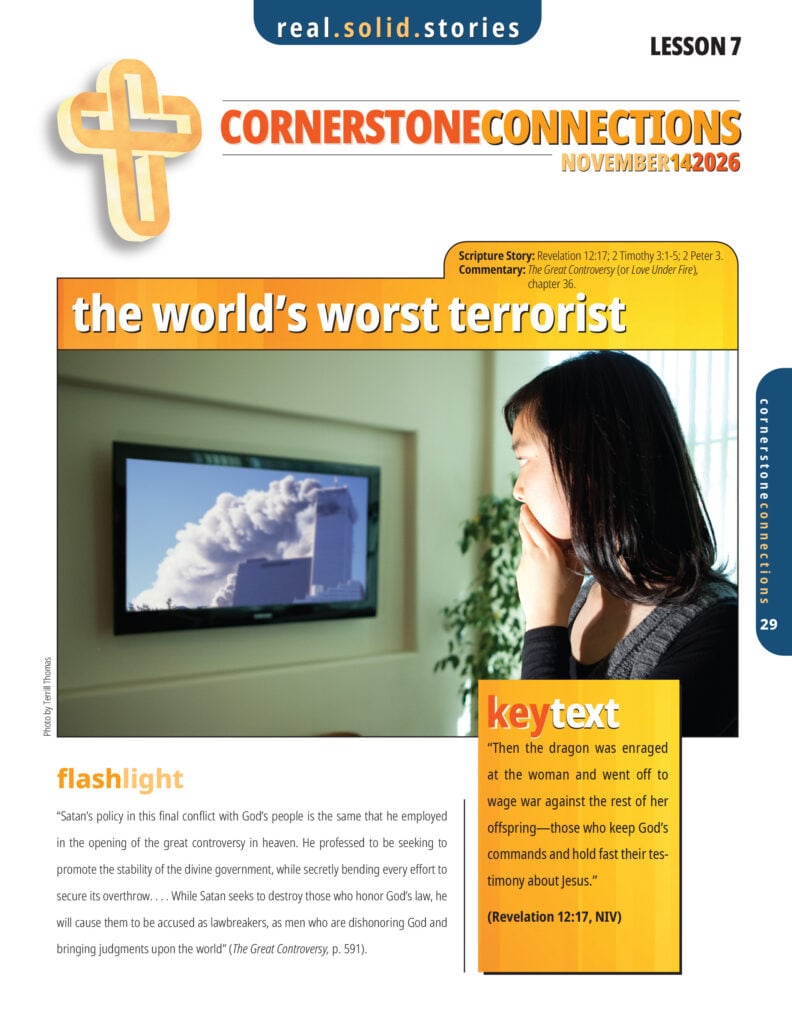
Media is everywhere. Images are almost instantaneously flashed around the globe. Sometimes those images bring inspiration, but not always. War, rumors of war, famines, plagues, catastrophic weather events, and persecution have almost become the norm. The question might be asked, “Is this a new thing?” The answer is no. As early as Cain and Abel persecution has existed. How did this all get started? Well . . . there was a snake in the garden (Genesis 3), but before that Lucifer caused problems in Heaven (Revelation 12:17). Evil has existed for millennia, but our lesson today will explore how the Lamb deals with the snake.
OPENING ACTIVITY: ALPHABET SOUP
- Write on slips of paper the alphabet. Leave 3 or 4 of the 26 letters out.
- Give each participant one of the letters. Do not give them out in any order.
- Blindfold each of the participants.
- Without allowing them to say their letter, have them line up in alphabetical order. (It’s very difficult to do.)
- After the first attempt, unblindfold them and have them try again to line up in alphabetical order without speaking or showing their letter.
- Have the participants that are in the correct order stay in the line and have the others attempt to stand in the correct position. Repeat until everyone is in their correct spot.
QUESTIONS
- Is this activity even possible to do being blindfolded and unable to speak? How?
- What were the most frustrating parts of this game?
- What life lesson can be learned from this?
- If this activity represents your spiritual life, how would you feel?
TRANSITION
Why does sin exist? What would it be like if the world were perfect? Is this what God really had in mind when He created us? How does sin end? Pull out your Bible, grab your phone/tablet and let’s see what the Bible has to say.
Read John 1:1-5.
In the beginning was the Word, and the Word was with God, and the Word was God. 2 He was with God in the beginning. 3 Through him all things were made; without him nothing was made that has been made. 4 In him was life, and that life was the light of all mankind. 5 The light shines in the darkness, and the darkness has not overcome it.
QUESTIONS
- How long has God been alive?
- Where did everything come from?
- What does John say about darkness and light?
- Describe what this passage says about the existence and character of God?
Read 2 Timothy 3:1-5.
But mark this: There will be terrible times in the last days. 2 People will be lovers of themselves, lovers of money, boastful, proud, abusive, disobedient to their parents, ungrateful, unholy, 3 without love, unforgiving, slanderous, without self-control, brutal, not lovers of the good, 4 treacherous, rash, conceited, lovers of pleasure rather than lovers of God—5 having a form of godliness but denying its power. Have nothing to do with such people.
QUESTIONS
- Describe what the last days will look like.
- Compare/contrast the description of the last days with how society looks currently.
- Have you thought about how society today is like this statement, or different from it?
- Make a list of events in the world that helped you form your decision.
- How do you feel about living in times like these/those?
- What would you like to tell God about how you feel about being alive in today’s social climate?
Read Revelation 12:7, 17.
7 Then war broke out in heaven. Michael and his angels fought against the dragon, and the dragon and his angels fought back. . .
17 Then the dragon was enraged at the woman and went off to wage war against the rest of her offspring—those who keep God’s commands and hold fast their testimony about Jesus.
QUESTIONS
- Who is the dragon?
- Who is the woman?
- Who are the children?
- Who is Michael?
- How does knowing who these characters are affect your view of the Great Controversy?
Read 2 Peter 3:3-7.
3 Above all, you must understand that in the last days scoffers will come, scoffing and following their own evil desires. 4 They will say, “Where is this ‘coming’ he promised? Ever since our ancestors died, everything goes on as it has since the beginning of creation.” 5 But they deliberately forget that long ago by God’s word the heavens came into being and the earth was formed out of water and by water. 6 By these waters also the world of that time was deluged and destroyed. 7 By the same word the present heavens and earth are reserved for fire, being kept for the day of judgment and destruction of the ungodly.
QUESTIONS
- According to this passage, what do the last days look like?
- How does the time of Noah compare to the last days?
- Do you think there will be more of less people saved than went on the ark? Why?
APPLICATION
According to scripture, the time of the end isn’t going to be very fun. Evil will rage like a roaring lion seeking who he will devour (1 Peter 5:8). Darkness will be prevalent, and evil will appear to reign. However, God has not abandoned His people. His sacrifice on the Cross has not lost its power, but the darkness is darkest just before dawn. God has won, and the victory is in sight—therefore, Jesus, please come!
FOLLOW UP
Look up in a concordance or www.biblegateway.com the following words: hope, love, second coming, Jesus saves, or redemption. Make a list of key principles in these passages. Write a letter to Jesus expressing your concerns and hopes as you wait for His second coming.
Lesson 2
SCRIPTURE PASSAGE
LEADER’S NOTE
For a Relational Bible Study (RBS) you’ll want to get into the Scripture passage and encourage the youth to imagine participating in the story while it’s happening. Then you will be able to better apply it to your own situation today.
You will need to ask God for the Holy Spirit to be present as your small group discusses the questions (no more than 3-6 people in a group is recommended). Start with the opening question. It is a personal question and the answer is unique for each individual. There is no right answer and nobody is an expert here, so don’t be surprised when you hear different responses. You are depending on the Holy Spirit to be present and to speak through your group. Say what God prompts you to say, and listen to what others share.
Take turns reading the chapter out loud. Follow that with giving the students some time to individually mark their responses to the questions (a PDF version of the handout is available as a download). This gives each person a starting point for responding when you start to share as a group. Next, begin the discussion by asking the students to share what they marked and why on each question as you work your way through. Feel free to take more time on some questions than others as discussion warrants.
Encourage each person in the group to apply what is discussed to their personal lives and to share with the group what they believe God wants them to do. Then ask them to pray that God will help each of them to follow through in doing so. Remind them to expect that God will show them ways to live out the message of this passage in the coming week, and that they are free to ask others in the group to help hold them accountable.
OVERVIEW
The end of the world—many people think it will happen. . . someday. But when? Throughout history there have been times of crisis when it seemed the end of the world had come. Indeed, individuals and groups of people have experienced their own end of the world (Nebuchadnezzar, Hitler, the religious leaders who killed Jesus, terrorists who strap themselves to explosives and die as they kill those around them, and active shooters who kill others and then turn their guns on themselves). But when will the end come for the entire world?
The Old Testament speaks about the “Day of the Lord” as the final “Day of Judgment” when everything will be set right by God instead of by humans. Old Testament prophets warned people about this time of reckoning and used it to motivate a change to live a Godly life, especially when people around them were living ungodly lives.
In the New Testament, when Jesus told His disciples about the future destruction of the temple, the disciples considered this would be “the end of the world” (see Matthew 24:3). Jesus described the end of the world as a major event that will occur when He returns a second time in glory and puts an end to sin and suffering. That’s when Christ’s people experience a welcomed face-to-face experience with Jesus Himself. (We won’t get into the millennium and what happens at the start and the end—as well as what happens during the millennium—in this study.)
Later in New Testament times Paul wrote to the younger pastor, Timothy, about practical pastoral concerns. One of these dealt with the anticipated evil in the last days. Paul considered this an indicator that the end of the world was near. Today we’ll look at this description and see if it relates to our current world, and if it relates to us personally.
Listen Up!
What thoughts/feelings come to your mind when you hear “the last days”?
Read 2 Timothy 3:1-5.
1 But mark this: There will be terrible times in the last days. 2 People will be lovers of themselves, lovers of money, boastful, proud, abusive, disobedient to their parents, ungrateful, unholy, 3 without love, unforgiving, slanderous, without self-control, brutal, not lovers of the good, 4 treacherous, rash, conceited, lovers of pleasure rather than lovers of God—5 having a form of godliness but denying its power. Have nothing to do with such people.
1. What things make you think that we’re living in “the last days”?
- Wars and rumors of wars.
- Families falling apart.
- Fear of going to school because of school shootings.
- So much selfishness and ego.
- Natural disasters like hurricanes, fires, floods, drought, etc.
- Lack of forgiveness.
- Today’s political mess.
- We’re making the world come to an end—violence, climate crisis.
- Other.
2. What causes you to disobey your parents?
- I know better than they do.
- They treat me like a little child.
- God told me I don’t have to obey them.
- They’re too old to understand my generation and my world.
- They don’t like my friends.
- Too many rules.
- They aren’t Christians.
- I want to do what I want to do.
- Other.
3. On a scale of 1-5, circle where you are when it comes to:
- Money-loving 1 2 3 4 5 Contented
- Proud 1 2 3 4 5 Humble
- Disobedient 1 2 3 4 5 Obedient
- Ungrateful 1 2 3 4 5 Grateful
- Out of control 1 2 3 4 5 Self-controlled
- Selfish 1 2 3 4 5 Loving
- Unforgiving 1 2 3 4 5 Forgiving
- Hating good 1 2 3 4 5 Loving good
- Other ____ 1 2 3 4 5 Opposite of other
4. What does having a “form of godliness” (vs. 5) look like?
- Going to church.
- Saying one thing but doing something else.
- Wearing a fake smile at church and saying, “Happy Sabbath.”
- Having power, but not God’s supernatural power.
- Saying, “Pray for _____ because _____” and you’re just gossiping.
- Using a lot of “God-talk” in your conversation.
- Acting like you’re superior to others.
- Other.
5. What will make God’s people stand out in the last days?
- Holy living.
- Calling sin by its right name.
- Loving others, even those who treat you badly.
- Respect for authority.
- Humility.
- Power.
- Incredible marketing that makes things go viral all the time.
- Being peacemakers.
- Other.
6. What are you willing to walk away from (vs. 5)?
- Phony people—hypocrites.
- Ungodliness.
- A form of godliness that has no Godly power.
- Church.
- My social media.
- What the world offers me.
- What God offers me.
- Other.
7. Which is it—external forces or internal forces—that cause you to be either good or bad?
8. How are we to reach ungodly people with the Gospel if we are to “have nothing to do with them” (vs. 5)?
SUMMARY
When parents or teachers are trying to convey something extremely important, they might say, “Pay attention” or “Listen up.” In essence, this was exactly what Paul was saying to young Timothy in the first verse of 2 Timothy 3. Whether you read it as, “But mark this” (NIV), or “You should know this” (NLT), or “But understand this” (ESV), they all come down to saying the same thing. “Pay attention! Listen up! What I have to say is really important.”
What did Paul want Timothy to know? In the last days, things will be terrible! The Great Controversy is between God and Satan, but it definitely involves all of us on earth as well. People lack love for God and others, loving only themselves, money, and pleasure. People disobey their parents, being ungrateful, unforgiving, and boastful—these also play a part in the Great Controversy. Slandering others and lacking self-control—again, part of the controversy. Our behavior indicates on which side of the controversy we stand, God’s side or Satan’s. Ask yourself, or evaluate your actions: “On whose side am I choosing to stand?”
APPLICATION
We focused on just a few verses from 2 Timothy 3, but these give us lots of opportunities to apply Scripture to our lives. Here are four ideas to get you thinking along with the Holy Spirit about how you can live out Scripture’s calling on your life this week. Take one of these or adapt it to your situation at this time. Each of these application options includes a downloadable item to spur the youth to take action.
- 1-5 FOR ME AND THEE
- Take question #3 from the study (a scale of 1-5 for different items) and share it with someone outside of your Youth Sabbath School class. This could be a peer, another family member, someone else at church, or use it for family worship.
- Introduce the idea first and share the passage of Scripture in .
- Let them know that you and your Youth Sabbath School class discussed this already, and you’d like to discuss it with others as well.
- You can share the entire RBS or download the “1-5 for Me and Thee” which has just question #3.
- Give them some time to think about it. Let them even respond silently and privately first. You’ve been thinking about it from class and they are just getting started on the topic, so patiently give them some time before they respond and you’re able to discuss it together.
- Follow up with prayers of gratitude for what God has done to shape you toward godliness, and ask God to move you more and more toward godliness in areas he would like to move you at this time.
- Continue to pray for each other after your time together, and feel free to check in with one another about this in the future.
- TAKE A WALK
Paul told Timothy to have nothing to do with people who have a form of godliness but deny its power.
- Take a walk for 15-30 minutes (or whatever time you choose) and commune with God about:
- Something or someone you could (and should) “walk away” from at this time; OR
- Something or someone you could (and should) “walk toward” in order to live a more godly life at this time and place of rampant ungodliness.
- You can do this by yourself, or do it with an accountability partner—both the walk of communion with God and the follow through as you rely on Godly power to flow through you in walking away from ungodliness or walking toward godliness.
- Download “Your Walk” for a visual reminder of your decision and action(s).
- ASK FOR A DO-OVER
God is not like us. He doesn’t hold grudges against us when we mess up. As a matter of fact, He invites us to come to Him and share that we’ve messed up. And with that, He wipes our slate clean and gives us a new start. That’s right! With God, we get to have do-overs.
- Review the list that Paul shared with Timothy in . It’s also available as a download called “Ask for a Do-Over.”
- Look to see where you may have fallen short on the list.
- Take a deep breath and honestly share your confession with God.
- Ask God for a do-over and trust Him to give you the power to stand on His side.
- MARK THIS .
Paul truly cared for Timothy and told him to pay close attention to his words. He also told him to look out for certain signs. Whom in your life do you care for deeply? Would you like to put them on notice about things happening now or what might soon come to pass?
- Download the handout “Mark This!” and give it to each Youth Sabbath School participant to create their own list of those individuals.
- Then pray and ask God to communicate to you ways in which you can share your faith with those on your list.
- As He begins to reveal ideas to you, implement them, and trust God for the outcome.