

Overview
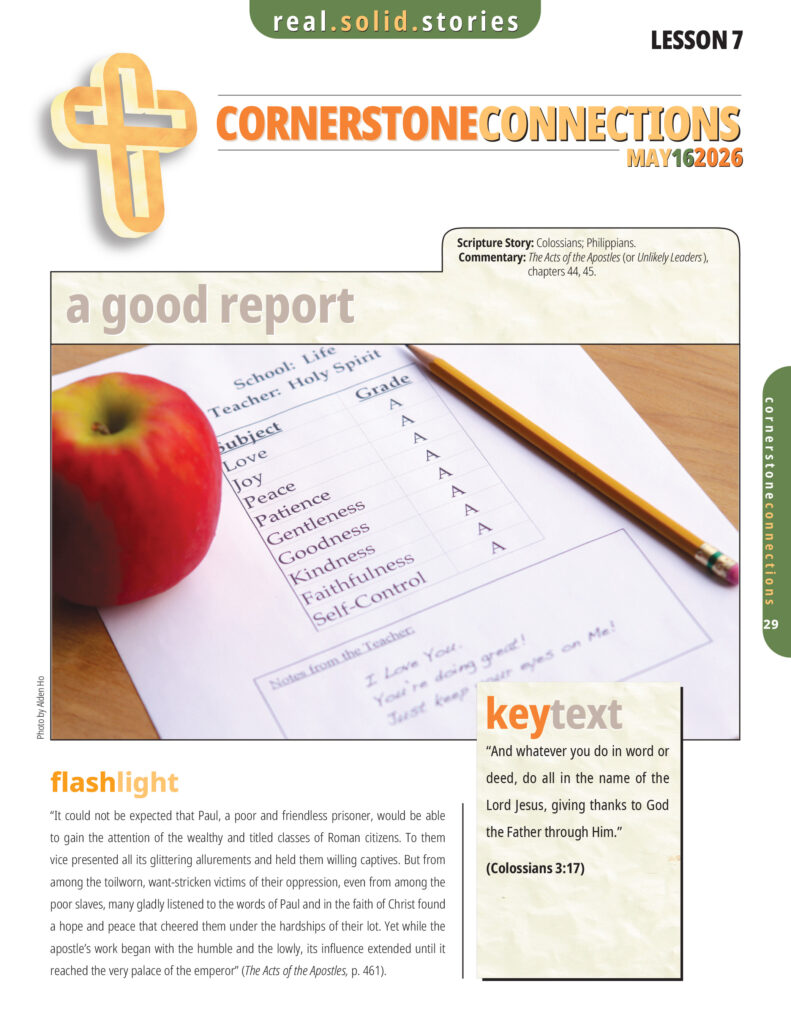
The Flashlight quote of the week speaks about the apostle Paul’s trials and his imprisonment for preaching the gospel of Jesus Christ. The trials that Paul faced were instrumental in drawing more attention to the gospel. It even gave him opportunity to witness to the prison guards in Caesar’s court. In your presentation of the lesson for this week you can show how the daily challenges and difficulties we may face in school, at home, on the job, or in our neighborhoods can be opportunities for witnessing, simply in the way we choose to handle these difficult situations. It may even be that God allowed certain circumstances to arise in our lives for the specific purpose of blessing, helping, or witnessing to someone else.
Scripture
Colossians 3:17
Discussion Video

Lesson 1
Scripture Passages
OVERVIEW
The life of Paul gives us a great illustration of the eternal qualities of God and the eternity He promised to us. Before Paul’s conversion, he was considered a religious authority who was good at keeping the laws of God. However, his keeping of the law did not get him any closer to being awarded eternal life. He was going around killing people who believed in Jesus, and his actions had no eternal impact, only the temporary loss of the martyrs’ lives. Jesus promised to raise His faithful followers back to eternal life. In contrast, after Paul decided to believe that Jesus is the promised Savior, he began to preach and teach everyone he met about Jesus, which made an eternal difference in the lives of millions from that time in history and even still today. Our words and actions have consequences also. The things of this world are temporary, but the things of God are the real and lasting, and will continue throughout eternity.
OPENING ACTIVITY:
COMMUNICATION GESTURES
The theme verse for this lesson is Colossians 3:17, which says, “And whatever you do, whether in word or deed, do it all in the name of the Lord Jesus, giving thanks to God the Father through Him.”
In this opening activity, the youth will test their communication skills to explore the idea of how we communicate. Words and deeds are emphasized in this verse, but sometimes our communication is non-verbal.
Divide the group into two teams. Each team will try to guess what their team member is trying to communicate through a gesture, facial expression, or hand motions. No words should be spoken by the one who is gesturing.
Here are some gestures to try out for the guessing game: shy, happy, angry, hiccups, concentrating, stop, stinky, awe, “I can’t hear you,” come, mercy, sneeze, peace, no, “I forgot something,” “Let’s go,” yes, love, “I have an idea,” laughing, “Can I help you,” “Go up,” friendly.
QUESTIONS
- How do you use non-verbal communication in your life?
- What are some misunderstandings that could occur due to non-verbal gestures?
- When you were playing the game, did you struggle to express yourself without words? Why or why not?
- In what ways do your non-verbal expressions show who you are as a person?
- How can you use your gestures in a way that would show that you are a representative of Jesus?
BIBLE STUDY GUIDE
Read each Bible passage, then discuss the questions.
Called to Write
Read Psalm 102:18 (NIV).
18Let this be written for a future generation, that a people not yet created may praise the LORD.
QUESTIONS
- How can you use your writing skills to tell others about Jesus?
- What would have happened if no one wrote down the things that happened in Jesus’ time?
- Compare and contrast the significance of the Bible with a great literary book like Shakespeare’s Romeo and Juliet.
- Is it possible to waste words? What words have eternal value?
- Although words are read and written constantly in your life, how can you make sure your words make the most long-lasting impact?
Speaking for God
Read Psalm 19:14 (NIV).
14May these words of my mouth and this meditation of my heart be pleasing in Your sight, LORD, my Rock and my Redeemer.
QUESTIONS
- People make videos and chat with friends about themselves all the time. What value is there in self-promotion?
- How can a person share their experiences without seeking self-promotion?
- Compare and contrast a popular YouTube video creator with a missionary giving a testimony about the service they are doing.
- How can your words be pleasing in God’s sight?
- Like Paul, who often spoke against the Christian believers before his conversion to being a Christian, how can your words lead either to death or to eternal life?
- Do you believe words have power? Why or why not?
Good Conquers Evil
Read Romans 12:21 (NIV).
21Do not be overcome by evil, but overcome evil with good.
QUESTIONS
- Light always overpowers darkness. How does this concept also become true between the things of this world and the eternal things God promised?
- When believers were killed during the time when Paul was against Christians, how did good overcome evil? Did the number of believers grow or become fewer?
- Evil will be destroyed when this earth is destroyed. How does Jesus’ plan to make a new earth illustrate the reality that He is eternal and the things of this world are temporary?
- What are some practical ways you can overcome evil around you with good? What are some sad or discouraging things that are happening that you could help turn around by adding some good into the situation?
SUMMARY
Words you speak and actions you do all require thought, internal commands, effort, energy, and intention. Granted, there are times you do involuntary actions, like blinking, or speaking without thinking, but your typical actions do have intention and take effort. As a follower of Jesus, you should keep your purpose and mission in focus as you choose your words and actions. Like, Paul, people sometimes make temporary mistakes by going around doing things that are against God, but choosing to believe that Jesus is the Savior and sharing Him with others is the best way to make an eternal difference in the world.
APPLICATION
Consider applying what you learned in this week’s lesson by doing one or all of these activities:
Journal about temporary things and eternal things. Write about ways you can invest less in the temporary and more into eternity.
Paint an “Eternity” themed mural on church property or in your community. Be sure to get permission and written authorization before painting anything.
Listen to “10,000 Reasons” by Matt Redman,
Read “Eternity’s Coming” by Clifford Goldstein,
Mold and shape a symbol of eternity—what eternity means to you—out of clay, let it dry, and then paint it.
Lesson 2
SCRIPTURE PASSAGE
LEADER’S NOTE
For a Relational Bible Study (RBS) you’ll want to get into the Scripture passage and encourage the youth to imagine participating in the story while it’s happening. Then you will be able to better apply it to your own situation today.
You will need to ask God for the Holy Spirit to be present as your small group discusses the questions (no more than 3-6 people in a group is recommended). Start with the opening question. It is a personal question and the answer is unique for each individual. There is no right answer and nobody is an expert here, so don’t be surprised when you hear different responses. You are depending on the Holy Spirit to be present and to speak through your group. Say what God prompts you to say, and listen to what others share.
Take turns reading the chapter out loud. Follow that with giving the students some time to individually mark their responses to the questions (a PDF version of the handout is available as a download). This gives each person a starting point for responding when you start to share as a group. Next, begin the discussion by asking the students to share what they marked and why on each question as you work your way through. Feel free to take more time on some questions than others as discussion warrants.
Encourage each person in the group to apply what is discussed to their personal lives and to share with the group what they believe God wants them to do. Then ask them to pray that God will help each of them to follow through in doing so. Remind them to expect that God will show them ways to live out the message of this passage in the coming week, and that they are free to ask others in the group to help hold them accountable.
OVERVIEW
We can read about Paul being in prison 2,000 years ago because of his faith and actions when it came to sharing Jesus with others. It almost sounds romantic rather than some seriously painful persecution.
More recent history informs us about the millions of lives lost during World War II, sparked by a madman with an inflated view of himself, who proved adept at sweeping the masses to join his vision. Even church leaders in Germany from many Christian denominations supported his cause, placing their national interests ahead of Jesus and then explaining that Jesus would endorse their myopic and self-centered desires.
That’s a temptation for all leaders, especially powerful ones. Drawing on Old Testament promises of making God’s people great (see especially Deuteronomy 28—see verses 1, 12-13, 44), it’s easy for Christians to want to rise to greatness by claiming such promises. But few follow the example of Jesus who willingly humbled Himself, even dying the death of a human criminal (see Philippians 2:5-11—part of our passage for this week’s Youth Sabbath School lesson). It’s easy to see ego-maniacs in action in countries with dictators, but it’s also been seen in democracies.
This RBS (Relational Bible Study) was written about one month before May 14, 2022. The international news for the past two months has focused on the war in Ukraine. What has happened in the past month—the time between when this RBS was written as Russia began its second attack, this time in the southeastern portion of Ukraine—and what is happening today?
Russian messaging has presented this as a requested rescue by oppressed Russians in Ukraine asking to be freed from modern-day Nazi atrocities being waged against them.
For people in Western nations it’s reported as an unprovoked Russian invasion into Ukraine, exemplifying another madman with a personal view of a being a savior for a renewed Russian empire in need of expansion through force. Those in America have become wary of one-sided reporting, although some have developed a habit of choosing to listen to only one side of a narrative while terming the other presentation as “fake news.”
Either way, the majority of North Americans have sided with Ukraine, admiring the former actor/comedian-turned-president of Ukraine who has demonstrated commitment to his country and led a surprising resistance against all odds. Ukraine’s President Zelensky even turned down his own safe escape for asylum to other countries so he could stay in Ukraine and lead the fight to the death for his country. But his focus isn’t on his death, but in fighting to remain the independent country of Ukraine.
Reports circulate about other Ukrainians following his example, even defying Russia’s flagship destroyer’s command to surrender, and then the destroyer itself was attacked and sunk by Ukrainian missiles. Reports of inhumane atrocities, common during war and yet life-altering for those who survive, create terror and admiration, fatalism and courage. The Ukrainians are fighting for their lives; no, fighting for a cause that is bigger than their lives. It makes North Americans wonder what we would do if faced with such an onslaught.
Let’s return to the Bible story. Paul, captured, tortured, jailed, and yet singing through the night (see Acts 16:11-40), later wrote to those Philippians who had joined him in placing their faith in Jesus, “Rejoice in the Lord always. I will say it again: Rejoice” (Philippians 4:4 NIV). This time Paul wasn’t writing from a Philippian jail, but to the Philippians from his Roman jail.
If you were Paul, what message would you send? If you were the Holy Spirit, what inspired message would you give Paul to pass along to the Philippian believers? For Paul, this wasn’t about being loyal to your nation, but to your God. And Paul’s God was made clear to humans through the God-man Jesus Christ. Paul was ready to endure any hardship, suffer any persecution, be jailed or killed. That seems very extreme to comfortable Christians who sometimes find it hard to wake up in time to even get to Sabbath School or church.
As you read the first portion of Paul’s letter to the Philippians, ask the Holy Spirit who inspired Paul to now inspire you as you read the message and apply it to your life today. The introduction includes the typical prayer Paul begins his letters with—grace (God’s undeserved gift to you that gives you power) and peace (Hebrew shalom that provides an inner peace only God can provide, and good no matter what’s happening around you).
The Way to Live
When did you receive a great gift? Where is a peaceful place for you?
Read Philippians 1:1-2:11.
Philippians Chapter 1
1 Paul and Timothy, servants of Christ Jesus, To all God’s holy people in Christ Jesus at Philippi, together with the overseers and deacons: 2 Grace and peace to you from God our Father and the Lord Jesus Christ.
Thanksgiving and Prayer
3 I thank my God every time I remember you. 4 In all my prayers for all of you, I always pray with joy 5 because of your partnership in the gospel from the first day until now, 6 being confident of this, that he who began a good work in you will carry it on to completion until the day of Christ Jesus.
7 It is right for me to feel this way about all of you, since I have you in my heart and, whether I am in chains or defending and confirming the gospel, all of you share in God’s grace with me. 8 God can testify how I long for all of you with the affection of Christ Jesus.
9 And this is my prayer: that your love may abound more and more in knowledge and depth of insight, 10 so that you may be able to discern what is best and may be pure and blameless for the day of Christ, 11 filled with the fruit of righteousness that comes through Jesus Christ—to the glory and praise of God.
Paul’s Chains Advance the Gospel
12 Now I want you to know, brothers and sisters, that what has happened to me has actually served to advance the gospel. 13 As a result, it has become clear throughout the whole palace guard and to everyone else that I am in chains for Christ. 14 And because of my chains, most of the brothers and sisters have become confident in the Lord and dare all the more to proclaim the gospel without fear.
15 It is true that some preach Christ out of envy and rivalry, but others out of goodwill. 16 The latter do so out of love, knowing that I am put here for the defense of the gospel. 17 The former preach Christ out of selfish ambition, not sincerely, supposing that they can stir up trouble for me while I am in chains. 18 But what does it matter? The important thing is that in every way, whether from false motives or true, Christ is preached. And because of this I rejoice.
Yes, and I will continue to rejoice, 19 for I know that through your prayers and God’s provision of the Spirit of Jesus Christ what has happened to me will turn out for my deliverance. 20 I eagerly expect and hope that I will in no way be ashamed, but will have sufficient courage so that now as always Christ will be exalted in my body, whether by life or by death. 21 For to me, to live is Christ and to die is gain. 22 If I am to go on living in the body, this will mean fruitful labor for me. Yet what shall I choose? I do not know! 23 I am torn between the two: I desire to depart and be with Christ, which is better by far; 24 but it is more necessary for you that I remain in the body. 25 Convinced of this, I know that I will remain, and I will continue with all of you for your progress and joy in the faith, 26 so that through my being with you again your boasting in Christ Jesus will abound on account of me.
Life Worthy of the Gospel
27 Whatever happens, conduct yourselves in a manner worthy of the gospel of Christ. Then, whether I come and see you or only hear about you in my absence, I will know that you stand firm in the one Spirit, striving together as one for the faith of the gospel 28 without being frightened in any way by those who oppose you. This is a sign to them that they will be destroyed, but that you will be saved—and that by God. 29 For it has been granted to you on behalf of Christ not only to believe in him, but also to suffer for him, 30 since you are going through the same struggle you saw I had, and now hear that I still have.
Philippians Chapter 2
Imitating Christ’s Humility
1 Therefore if you have any encouragement from being united with Christ, if any comfort from his love, if any common sharing in the Spirit, if any tenderness and compassion, 2 then make my joy complete by being like-minded, having the same love, being one in spirit and of one mind. 3 Do nothing out of selfish ambition or vain conceit. Rather, in humility value others above yourselves, 4 not looking to your own interests but each of you to the interests of the others.
5 In your relationships with one another, have the same mindset as Christ Jesus: 6 Who, being in very nature God, did not consider equality with God something to be used to his own advantage; 7 rather, he made himself nothing by taking the very nature of a servant, being made in human likeness. 8 And being found in appearance as a man, he humbled himself by becoming obedient to death— even death on a cross! 9 Therefore God exalted him to the highest place and gave him the name that is above every name, 10 that at the name of Jesus every knee should bow, in heaven and on earth and under the earth, 11 and every tongue acknowledge that Jesus Christ is Lord, to the glory of God the Father.
1. Why start with a prayer for Paul’s readers to receive “grace and peace”?
- It’s what the world needed then, and what it also needs now.
- “Grace” is the New Testament key word, and “Peace” is the Old Testament key word.
- This was the code used to identify yourself as a follower of Jesus.
- It’s like saying, “Happy Sabbath,” or “God bless.”
- Paul always started his letters this way.
- It’s important to identify the true source of grace and peace.
- Paul had the power to pass these along.
- These are supernatural gifts from God that Paul highly values.
- Other.
2. Finish this sentence about others in your group: Every time I think of you, I:
- Rejoice.
- Weep.
- Thank God.
- Gossip.
- Worry.
- Feel jealous.
- Pray.
- Wonder what you think of me.
- Other.
3. Who has partnered with you in spreading the Good News about Christ?
- I don’t really do much to spread the Good News.
- I primarily work solo.
- Fellow church members.
- My friends.
- Hardly anybody.
- Someone in my family.
- People I connect with on social media.
- I expect others to talk about Jesus; not me.
- Other.
4. How does your love for others overflow “more and more” (1:9)?
- It doesn’t.
- I just pass on the love God has given me.
- If others show me some love, they are more likely to get some love.
- It’s like the seasons—wet, dry, cold, warm (it varies).
- It takes a lot of discipline and purposeful planning on my part.
- I pick and choose who I love, and who I love in an overflowing way.
- I need to get more love in order for it to overflow more and more.
- Other.
5. What are examples of your experiences of suffering for Christ?
- I haven’t.
- Nobody knows the trouble I’ve seen!
- Torture or prison.
- Financial insecurity.
- Loss of reputation.
- Feelings of rejection.
- When someone sits in my spot at church and I have to sit elsewhere.
- Other.
6. How would you describe “the mind of Christ” (2:5)?
- Humble.
- Confident.
- Very, very smart.
- Sacrificial.
- Obedient.
- Out of this world, and yet active in this world.
- Unselfish.
- Full of hope.
- Other.
7. What has God already done in your life? What is God still working on in your life (2:6)?
8. What risks has Christ taken for you? What risks have you taken for Christ? What risks will you take for Christ? When? Where? Why?
SUMMARY
God’s grace and peace impact outward realities, making them subject to divine oversight and of minor consequence to us. When we receive God’s grace and peace, the way Jesus demonstrated it and makes possible with the Holy Spirit in our lives, it changes how we relate to everyone and everything around us. We put time with Jesus first, wanting to be like Him in all things. It means giving up what so many think are the highest priorities—good grades, lots of attention, popularity, success as the world defines it, more and more for ourselves, and hoping everyone will like us and even envy us. Instead, putting Christ first changes our priorities so we live for Him, which means serving others and choosing priorities that feed our love for Jesus and others, letting Christ define us rather than the shifting opinions of others. And that’s the way to live—to really live—both now and for eternity.
APPLICATION
Grace and peace change our perspective on everything. You can apply that to your plans for this summer and next school year, to your friends and family, as well as to your finances and your future. Here are a few ideas to apply it to the international conflict that continues to grab headlines in terms of the Russian invasion of Ukraine and all that has happened there. You might be thousands of miles away, but you’re able to get multiple updates daily. Here are some things you can do about it, not as a Russian or a Ukrainian, but as a follower of Jesus.
- GIVE AND TAKE
The phrase “give and take” usually means some type of compromise or equal sharing—I give you some things and you give me some things in return; or I give up some of my desires and I accept some of your desires. It’s sort of like, “I’ll rub your back if you’ll rub mine.” But from a Christian perspective the flow isn’t merely back and forth, but more like a flow-through. We take what Jesus gives us and we give it to others whether or not they have given anything to us. That’s different! Here are four categories in which you can “take” from Jesus and “give” to others what Jesus gave to you, not what others might have given to you or what they might deserve. You’re giving to them based on what you have taken from Jesus’ gift to you. Choose one of these categories and put it into practice this week. If you’ve received a lot from Jesus, do more than one category:
- Things you say —a truth, an encouragement, a hope, a promise from God, a statement of faith, etc.
- Things you don’t say —a put-down, a condemnation, a lie, a cover-up, a meaningless cliché, something you don’t believe yourself; or just stop talking and do more listening, etc.
- Things you do —go to someone instead of away from them, stay in the moment rather than departing due to fear or uncertainty, support, encourage, challenge, pray with, pray for, hug and hold dear, say, “tell me more,” cry, laugh, lean on God, etc.
- Things you don’t do —have all the answers, talk all the time, dismiss as unimportant what seems important to someone, say “I’ll pray for you” without praying right then and there for starters, fight in your own strength, agree mindlessly with whatever someone says, let fear guide you rather than courage in the face of fear, break confidences, try it on your own, quit, etc.
- GIVE PRAYERS
- Pray for Ukraine. You can pray for the people, for the country, for both. You can also pray for Russia—the people and the country and the leaders in Moscow as well as in the field. (Note , especially verses 12-14 and 18-21 about supernatural forces at work against human powers at war on earth—your prayers impact both the seen and the unseen powers on earth!)Daniel 10
- If you don’t know what to pray about, just turn to a news source and let that inform your prayers. Take what the news says and interpret it through the eyes of God.
- Another way to decide what to pray is to think of the topic and wait for God to send you impressions about what to pray for regarding that topic. Then make those impressions from God your prayer to Him. That’s your communication between heaven and earth—like Jacob’s ladder that connects heaven to earth, and earth to heaven (see ; ).Genesis 28:12John 1:51
- GIVE MONEY
One pastor in a small SDA church in Canada hosted a concert in honor of those suffering in Ukraine. After several songs, people asked local Ukrainians present to share a few words about their family and friends in Ukraine. Unable to speak because of the intense emotions they were experiencing, they asked a Canadian man married to a Ukrainian woman to speak on behalf of the Ukrainians in that Canadian community who are profoundly impacted by what is happening on the other side of the world at this time. Toward the end of the concert the offering plates got passed. Those present donated more than $4,300.
How do you get that money to Ukraine? This church passed the money on to ADRA (Adventist Development and Relief Agency) for an efficient transfer of funds to go directly to serve those adversely affected by the current humanitarian crisis in Ukraine. You can add your dollars, individually or as a Youth Sabbath School, by donating through ADRA at https://donations.adra.org/humanitarianresponse-ws?_ga=2.24281210.1925013215.1650326860-875986802.1650326860
And to find out more about Ukraine, look over the articles at https://adra.org