

Overview
Paul had a complicated mission. He was sent to teach the Gentiles about Jesus and His sacrifice, people who did not know God at all. He had a responsibility to show them the character of Jesus in a way that they would understand. He had to give “milk” to the baby Christians and more solid sustenance to the more mature believers. He had to balance encouragement with reprimands for bad behavior. He had to meet the needs of people from every walk of life. It certainly was not an easy calling!
Scripture
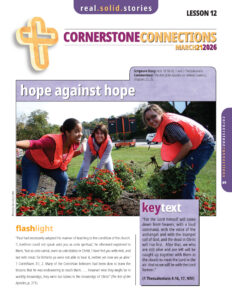
1 Thessalonians 4:16, 17
Discussion Video

Lesson 1
SCRIPTURE PASSAGES
OVERVIEW
It’s often said that a journey begins with the first step. What would it have been like to be one of the first missionaries to spread the Gospel to the world? Your message would be brand new. Nobody would have ever heard it before. Do you think you could convince people that the Gospel is true? What if what you were teaching went against everything that was commonly believed? If you had been one of the first missionaries that is what you could have expected, and that is exactly what Paul and the others experienced.
OPENING ACTIVITY:
NEXT LEVEL GETTING TO KNOW YOU!
- What is your social-emotional learning superpower?
- Which of the following traits do you think best describes you: funny, thoughtful, caring, or outgoing?
- How do you most like to connect with your friends? Through social media, by talking over the phone, texting, or in person?
- Who is an adult that you know you can trust?
- What is something people don’t know about you that you wish they knew?
- Who is a friend at school that you know you can count on?
- When you are stressed, what do you do to relax?
- What makes you feel the most appreciated and understood?
- How would your friends or a relative describe you?
- What is something that you are thankful for?
TRANSITION
In some places the early missionaries had an easy time sharing the message of salvation—people believed it. In other places the new ideas had to simmer awhile. Not matter what happened, Paul was willing to be used by God. It wasn’t easy, but it was what God asked of him.
BIBLE STUDY GUIDE
Read Acts 18:24-28.
24 Meanwhile a Jew named Apollos, a native of Alexandria, came to Ephesus. He was a learned man, with a thorough knowledge of the Scriptures. 25 He had been instructed in the way of the Lord, and he spoke with great fervor and taught about Jesus accurately, though he knew only the baptism of John. 26 He began to speak boldly in the synagogue. When Priscilla and Aquila heard him, they invited him to their home and explained to him the way of God more adequately.
27 When Apollos wanted to go to Achaia, the brothers and sisters encouraged him and wrote to the disciples there to welcome him. When he arrived, he was a great help to those who by grace had believed. 28 For he vigorously refuted his Jewish opponents in public debate, proving from the Scriptures that Jesus was the Messiah.
QUESTIONS
- What was the difference between the message of John and Jesus?
- How did Apollos react when Priscilla and Aquilla shared the truth of Jesus with him?
- How might you have reacted?
Read 1 Thessalonians 1:2-4.
2 We always thank God for all of you and continually mention you in our prayers. 3 We remember before our God and Father your work produced by faith, your labor prompted by love, and your endurance inspired by hope in our Lord Jesus Christ.
4 For we know, brothers and sisters loved by God, that he has chosen you,
Read 2 Thessalonians 1:3-7.
3 We ought always to thank God for you, brothers and sisters, and rightly so, because your faith is growing more and more, and the love all of you have for one another is increasing. 4 Therefore, among God’s churches we boast about your perseverance and faith in all the persecutions and trials you are enduring.
5 All this is evidence that God’s judgment is right, and as a result you will be counted worthy of the kingdom of God, for which you are suffering. 6 God is just: He will pay back trouble to those who trouble you 7 and give relief to you who are troubled, and to us as well. This will happen when the Lord Jesus is revealed from heaven in blazing fire with his powerful angels.
QUESTION
- In what ways are these two passages similar?
Read 1 Thessalonians 4:13-18.
13 Brothers and sisters, we do not want you to be uninformed about those who sleep in death, so that you do not grieve like the rest of mankind, who have no hope. 14 For we believe that Jesus died and rose again, and so we believe that God will bring with Jesus those who have fallen asleep in him. 15 According to the Lord’s word, we tell you that we who are still alive, who are left until the coming of the Lord, will certainly not precede those who have fallen asleep. 16 For the Lord himself will come down from heaven, with a loud command, with the voice of the archangel and with the trumpet call of God, and the dead in Christ will rise first. 17 After that, we who are still alive and are left will be caught up together with them in the clouds to meet the Lord in the air. And so we will be with the Lord forever. 18 Therefore encourage one another with these words.
QUESTIONS
- What is the major theme of this passage?
- How would this passage be of comfort to someone?
Read 1 Thessalonians 5:1-11.
1 Now, brothers and sisters, about times and dates we do not need to write to you, 2 for you know very well that the day of the Lord will come like a thief in the night. 3 While people are saying, “Peace and safety,” destruction will come on them suddenly, as labor pains on a pregnant woman, and they will not escape.
4 But you, brothers and sisters, are not in darkness so that this day should surprise you like a thief. 5 You are all children of the light and children of the day. We do not belong to the night or to the darkness. 6 So then, let us not be like others, who are asleep, but let us be awake and sober. 7 For those who sleep, sleep at night, and those who get drunk, get drunk at night. 8 But since we belong to the day, let us be sober, putting on faith and love as a breastplate, and the hope of salvation as a helmet. 9 For God did not appoint us to suffer wrath but to receive salvation through our Lord Jesus Christ. 10 He died for us so that, whether we are awake or asleep, we may live together with him. 11 Therefore encourage one another and build each other up, just as in fact you are doing.
QUESTIONS
- What does this passage mean when it says, “Day of the Lord”?
- How does this day come and why is that important to know?
- What type of sleep is being referred to in this passage?
- From where does our salvation come?
Read 2 Thessalonians 2:1-4.
1 Concerning the coming of our Lord Jesus Christ and our being gathered to him, we ask you, brothers and sisters, 2 not to become easily unsettled or alarmed by the teaching allegedly from us—whether by a prophecy or by word of mouth or by letter—asserting that the day of the Lord has already come. 3 Don’t let anyone deceive you in any way, for that day will not come until the rebellion occurs and the man of lawlessness is revealed, the man doomed to destruction. 4 He will oppose and will exalt himself over everything that is called God or is worshiped, so that he sets himself up in God’s temple, proclaiming himself to be God.
QUESTIONS
- What does this passage warn about the coming of the Lord?
- Why is it important to know who you are worshipping?
Read 2 Thessalonians 3:1-4.
1 As for other matters, brothers and sisters, pray for us that the message of the Lord may spread rapidly and be honored, just as it was with you. 2 And pray that we may be delivered from wicked and evil people, for not everyone has faith. 3 But the Lord is faithful, and he will strengthen you and protect you from the evil one. 4 We have confidence in the Lord that you are doing and will continue to do the things we command.
QUESTIONS
- Why does Paul hope that the Gospel will be spread quickly?
- At what is God faithful?
- Why is this important?
Read 2 Thessalonians 3:13-15.
13 And as for you, brothers and sisters, never tire of doing what is good.
14 Take special note of anyone who does not obey our instruction in this letter. Do not associate with them, in order that they may feel ashamed. 15 Yet do not regard them as an enemy, but warn them as you would a fellow believer.
QUESTIONS
- Why should a person not grow weary of doing good?
- How should someone who stops doing what they know is right be treated?
APPLICATION
God went with Paul everywhere. Although he wasn’t always successful, God was with him. As you look at these passages, you begin to see a pattern of preaching, teaching, and discipleship. Not everyone believed, but those who did were to be cherished and prayed for. Today you are being asked to do a similar task. Share the Good News with others and train those who show interest. Are you ready to answer God’s calling in your life?
FOLLOW UP
Don’t give up—keep loving and praying for people.
Make a prayer list of people who you think need Jesus.
Pray specifically for them each day.
Write down how you see God working in their lives.
Lesson 2
SCRIPTURE PASSAGES
For a Relational Bible Study (RBS) you’ll want to get into the Scripture passage and encourage the youth to imagine participating in the story while it’s happening. Then you will be able to better apply it to your own situation today.
You will need to ask God for the Holy Spirit to be present as your small group discusses the questions (no more than 3-6 people in a group is recommended). Start with the opening question. It is a personal question and the answer is unique for each individual. There is no right answer and nobody is an expert here, so don’t be surprised when you hear different responses. You are depending on the Holy Spirit to be present and to speak through your group. Say what God prompts you to say, and listen to what others share.
Take turns reading the chapter out loud. Follow that with giving the students some time to individually mark their responses to the questions (a PDF version of the handout is available as a download). This gives each person a starting point for responding when you start to share as a group. Next, begin the discussion by asking the students to share what they marked and why on each question as you work your way through. Feel free to take more time on some questions than others as discussion warrants.
Encourage each person in the group to apply what is discussed to their personal lives and to share with the group what they believe God wants them to do. Then ask them to pray that God will help each of them to follow through in doing so. Remind them to expect that God will show them ways to live out the message of this passage in the coming week, and that they are free to ask others in the group to help hold them accountable.
LEADER’S NOTE
Paul’s travels marked a large portion of his ministry, and should be examined carefully. Through his travels, Paul met many interesting people, assisting many on their road to salvation and ministry. Two of those people were Priscilla and Aquila, who graciously took Paul in, and in return were blessed with the gift of the Holy Spirit. In this section of the story, we learn that Paul sailed from Corinth to Cenchrea, later to Syria, then to Ephesus, where he left Pricilla and Aquila, stopping at Caesarea and Jerusalem and soon returning to Antioch. After a short stay there, he traveled again through Galatia and Phrygia, teaching and preaching to many. It can be overwhelming to keep track of Paul’s travels, but it is important to note that in each of these places, he met new believers and taught them. The people of each of these cities waited eagerly for his arrival and his teaching, and in essence developed and maintained the church after he left. One of these eager believers was Apollos in Ephesus, who originally hailed from Egypt. It is clear that the lines between Gentile and Jew were being obliterated within this new church, and many accepted his eager teaching and astonishing faith with open arms. When Pricilla and Aquila heard him, they too were pleased, and took the time to mentor him into becoming an even stronger Christian. Using these tools, he went on to fiercely debate some of the Jews in public debates, and his passionate sermons grew even stronger.
This short anecdote really showed the formation of this new church, and the strength of the believers within it. It is a sharp contrast from the way the Jewish leaders governed their ministry: sharp, bigoted, and elitist. Instead, this new church stuck to scripture and not tradition, preferred to spread the message rather than keep it for themselves, and welcomed anyone with open arms. This was the church that Jesus intended as His flock from the start, and it remains true until today. Each one of us has a role within the church, and our job is to help others discover and develop it. We must bring others in, not push them out. Just like Paul and his helpers, we must pray fervently to execute the mission God has left us in recruiting others into His fold, especially as we approach the final times.
Missionary Ministers
Can you recall a time when you found encouragement from a fellow believer?
Read Acts 18: 1-3.
After this, Paul left Athens and went to Corinth. 2 There he met a Jew named Aquila, a native of Pontus, who had recently come from Italy with his wife Priscilla, because Claudius had ordered all Jews to leave Rome. Paul went to see them, 3 and because he was a tentmaker as they were, he stayed and worked with them.
Read Acts 18:18-28.
18 Paul stayed on in Corinth for some time. Then he left the brothers and sisters and sailed for Syria, accompanied by Priscilla and Aquila. Before he sailed, he had his hair cut off at Cenchreae because of a vow he had taken. 19 They arrived at Ephesus, where Paul left Priscilla and Aquila. He himself went into the synagogue and reasoned with the Jews. 20 When they asked him to spend more time with them, he declined. 21 But as he left, he promised, “I will come back if it is God’s will.” Then he set sail from Ephesus. 22 When he landed at Caesarea, he went up to Jerusalem and greeted the church and then went down to Antioch.
23 After spending some time in Antioch, Paul set out from there and traveled from place to place throughout the region of Galatia and Phrygia, strengthening all the disciples.
24 Meanwhile a Jew named Apollos, a native of Alexandria, came to Ephesus. He was a learned man, with a thorough knowledge of the Scriptures. 25 He had been instructed in the way of the Lord, and he spoke with great fervor and taught about Jesus accurately, though he knew only the baptism of John. 26 He began to speak boldly in the synagogue. When Priscilla and Aquila heard him, they invited him to their home and explained to him the way of God more adequately.
27 When Apollos wanted to go to Achaia, the brothers and sisters encouraged him and wrote to the disciples there to welcome him. When he arrived, he was a great help to those who by grace had believed. 28 For he vigorously refuted his Jewish opponents in public debate, proving from the Scriptures that Jesus was the Messiah.
-
To how many places did Paul travel as stated in these verses?
- 5.
- 7.
- 9.
- 10.
- 4.
- 12.
- 8.
- Other.
-
Who were Pricilla and Aquila?
- Two random people Paul met in his travels.
- Tent makers.
- Believers in Corinth.
- A Jewish couple who hailed from Italy.
- A couple that was thrown out of Italy.
- Paul’s brother and sister.
- Mentors of new believers in the early church.
- Other.
-
What did Paul do in Cenchrea?
- Shaved his head.
- Got a wig.
- Shaved his head as a form of conforming to Jewish traditions.
- Shaved his head as a sign of severing a vow.
- Defied God.
- Defied men and worthless traditions.
- Taught and preached.
- Other.
-
What was Apollos doing in Ephesus?
- Escaping the Romans.
- Fervently teaching the word.
- Teaching false and inaccurate things.
- He immigrated from Egypt.
- He was teaching to the best of his abilities.
- He was teaching the story of John’s baptism.
- He was fervently preaching about his faith.
- Other.
-
How did Priscilla, Aquila, and other believers assist him?
- They coached him in his teaching style.
- They taught him more stories regarding Jesus.
- They silenced him.
- They encouraged him to travel to Achaia.
- They wrote to other believers to attend to his travels.
- They taught him the ways of God.
- They prayed with him.
- Other.
-
What was the significance of Apollos’ work in the ministry?
- He went on to fiercely debate the Jews.
- He was open to change and advice.
- He opened his heart to God.
- He was a major asset to the early church.
- He was a roadblock to success.
- He taught many believers about Jesus.
- He is an example that Gentiles can be just as fierce believers as Jews.
- Other.
- How can we support other believers with eager hearts and passionate faith?
- How can we find the faith to prophesy as fervently as Apollos, Paul, and other leaders?
SUMMARY
Sometimes looking at all the big evangelists of the Bible and even of our time, it is easy to feel overwhelmed, discouraged, or intimidated about sharing the gospel. We may feel like we do not know where to begin, what to say, and how to say it. But, at looking at the story of Apollos, we are reassured that each of us have something to contribute to the ministry. Our job as Christians is to support and uplift one another, and through encouraging and ministering to others, we are strengthening our faith ourselves. Although we may not all be able to travel and preach around the world as Paul did, we can each make an impact in our own way, putting our faith and love for God in first priority, and having a willing heart that is open to change, just like King David said in Psalm 51.
APPLICATION
The story of Paul’s travels and the development of the early church is especially important to us as modern-day believers. It is always a necessary part of studying to sit back and meditate about how a story applies to us today as youth.
Below you will find three applications that can benefit the youth in your group and help them meditate on the word shared today. These applications work both individually and in a group.
- SUPPORT EACH OTHER
Whether we are new believers or seasoned members of the faith, we all need the support of our heavenly brothers and sisters.
- Pay special attention to those that are closest to you at church. How are they working to spread the gospel?
- Say an extra prayer for them, or even with them, and maybe take time to reach out to them with a few inspiring words. You never know how a little bit of Christian fellowship encourages a fellow minister of the word!
- MISSION TRIPS
Some people are fortunate to have the experience of traveling to a different country to conduct mission work. However, as this is not always possible, there are other ways to conduct mission work within your own community.
- Do some research and find a local place where you can do an act of service with your youth group or even on your own.
- While you are there, try to find a way to minister to somebody, even through your actions.
- Remember to pray for the people or community that you are serving.
- NEW BELIEVERS
Many people at church tend to focus on a new believer as they are working towards baptism, but what happens after baptism? It can be daunting to start a new life in Christ, and the Bible compares it to babies taking their first steps.
By yourself, and as a church, take time to pray and talk to the newest members of your church, being the supportive community that was established in the first church.
How can you support the new believers at your church?
How can you integrate them in the social community of Christ?