

Overview
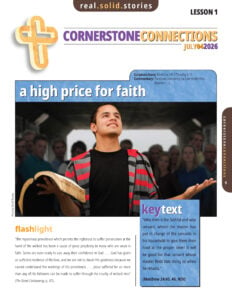
The early Christians faced nightmarish circumstances in order to stand for their faith. It is difficult to imagine having to endure such things, let alone being willing to endure them. However, these people found courage to face the worst. Their relationship with God was so strong that they were willing to be martyred rather than turn from their beliefs. A simple belief does not give that kind of courage. Because of a strong belief people have been willing to fight wars. They have been willing to kill people. But a belief does not give a person the courage to accept death without a fight. Only God can live in a person and turn a nightmare into a heroic stand.
Scripture
Discussion Video

Lesson 1
Scripture Passages
OVERVIEW
Have you ever taken a canoe paddling trip down a river? Generally, paddling trips are designed to start at a point on the river, travel downstream with the current, then exit the river at a designated spot. Paddling against the current is difficult, and most likely not part of the plan on a paddling trip. But, if you miss the spot where you are supposed to exit to meet the bus that will take you back to your car, then you might have to dig in and paddle upstream briefly to get back to the marked exit spot. It is not easy to paddle against the current. In this world, there are two currents going in two directions—either toward sin and selfishness or toward God and other-centered love. As followers of God, we are in a position that is not so easy. Sin has multiplied and gained power through time, which has formed a wild river of passion, pleasure, entertainment, high feelings, and self-centered living. We must paddle against that raging river with Jesus at the front directing our canoe.
OPENING ACTIVITY: COUNTING M&Ms
Supplies: pint jar, M&Ms, small pieces of paper, pencils
It is natural for humans to want to be liked, accepted, and valued by other people. Maintaining good relationships with others can be a rocky road, because there is peer pressure. One person might absolutely hate all green vegetables, while another person loves broccoli and peas. If the topic comes up in a conversation, it might feel a little awkward for the veggie lover to speak up to share how much they love their mom’s steamed broccoli. The vegetable hater could influence the pea enthusiast to not like the green stuff as much; or vice versa, maybe she could be convinced to give broccoli another try.
- Experiment with the idea of peer pressure.
- Give each student a small piece of paper.
- Show them a pint jar filled with M&Ms.
- They will try to guess the correct number of M&Ms in the jar that you have counted ahead of time.
- Once they write their guess down, ask them to put that paper in their pocket or hold it secretly.
- Now, form groups—at least two groups, maybe several groups if you have a lot of people.
- Have each group discuss how many M&Ms they think are in the jar.
- Have each group come to agreement on a number and write it down.
- Now, come back together.
- Ask the students to turn over their original small paper and write down their own “final” guess secretly after having been influenced by the group discussion.
- Now discuss the questions below.
- At the end of the discussion, reveal the correct number.
- Whoever has guessed the closest to the write number gets to take the jar of M&Ms home.
QUESTIONS
- As humans we are swayed by peer pressure whether we want to be or not. How did discussing the number with a group change your final guess?
- Was your original guess close to the same number as what your group decided on together? Or did some people guess 901 and others guess 101?
- If there was a big difference in the numbers guessed, how did the group decide whether to go higher or lower? Was it the loudest person, the majority rule, or did some people use persuasive arguments?
- When you make decisions, how are you influenced by friends or famous people who you admire?
- In what ways does the Bible influence your decisions?
- Does peer pressure generally influence you in good ways (studying harder, play sports better, being kind) or bad ways (excluding others, listening to music with curse words, lying)?
- How can you avoid following negative peer pressure?
BIBLE STUDY GUIDE
Read each Bible passage, then discuss the questions.
Persecution Expected
Read 2 Timothy 3:12 (NIV).
12In fact, everyone who wants to live a godly life in Christ Jesus will be persecuted.
QUESTIONS
- Peer pressure could be considered persecution in some ways. Have you ever felt persecuted? What happened?
- Would you say the persecution this verse predicts is similar to bullying?
- What are some distinguishing factors of a godly life vs. an ungodly life?
- What are some godly characteristics you see in your life?
- What do you plan to continue doing so that you avoid drifting into an ungodly life?
War in Your Soul
Read 1 Peter 2:11-12 (NIV).
11 Dear friends, I urge you, as foreigners and exiles, to abstain from sinful desires, which wage war against your soul. 12 Live such good lives among the pagans that, though they accuse you of doing wrong, they may see your good deeds and glorify God on the day He visits us.
QUESTIONS
- In what way are you a foreigner or exile in this world?
- Do you ever feel a war being waged in your soul? What are the issues that create the conflicts?
- What are pagans? What pagan concepts are still promoted and followed in 2022?
- How does this verse illustrate the concept of paddling against the current of worldly ways?
- When have you felt accused or excluded because of your faith? Was it worth it to stand up for your Christian beliefs?
Firm Faith
Read Colossians 2:4-5 (NIV).
4 I tell you this so that no one may deceive you by fine-sounding arguments. 5 For though I am absent from you in body, I am present with you in spirit and delight to see how disciplined you are and how firm your faith in Christ is.
QUESTIONS
- In order to paddle upstream you need to be strong and focused. How do these verses suggest you keep focused?
- What are you doing to have firm faith in Christ?
- How can you avoid being deceived by the arguments others give for what they believe or what they do?
The Point Is . . .
Originally, God’s way formed the river of life with peace, love, and joy unending. When sin diverted that flow, we discovered that we would need to be rescued and follow God’s plan to get back to the eternal life God planned to spend with us. As followers of Jesus and the Bible we need to paddle upstream against the current of this sinful world. The Bible says we will face many problems, persecution, distress, and death—all part of that current we are paddling against. Our Heavenly Father will help us. He promised to never leave us nor forsake us (Deuteronomy 31:8). However, we cannot drift along in the river of sin either. Commit today to trust in God to give you the strength to stand up for your faith until Jesus comes back.
APPLICATION
Consider applying what you learned in this week’s lesson by doing one or all of these activities:
- Write a letter to God expressing your thoughts and feelings about peer pressure.
- Commit to reading your Bible for a certain amount of time (15 minutes, 30 minutes, 1 hour, etc.) every day this week.
- Take a canoe paddling trip and contemplate the ideas you learned in today’s lesson.
- Give a testimony at church or on your favorite social media that shares . . .
- How you were able to stand up for something you believe in and why it is important to you personally.
- Draw an illustration that shows what it means to go against the current of this sinful world.
Lesson 2
SCRIPTURE PASSAGE
LEADER’S NOTE
For a Relational Bible Study (RBS) you’ll want to get into the Scripture passage and encourage the youth to imagine participating in the story while it’s happening. Then you will be able to better apply it to your own situation today.You will need to ask God for the Holy Spirit to be present as your small group discusses the questions (no more than 3-6 people in a group is recommended). Start with the opening question. It is a personal question and the answer is unique for each individual. There is no right answer and nobody is an expert here, so don’t be surprised when you hear different responses. You are depending on the Holy Spirit to be present and to speak through your group. Say what God prompts you to say, and listen to what others share.Take turns reading the chapter out loud. Follow that with giving the students some time to individually mark their responses to the questions (a PDF version of the handout is available as a download). This gives each person a starting point for responding when you start to share as a group. Next, begin the discussion by asking the students to share what they marked and why on each question as you work your way through. Feel free to take more time on some questions than others as discussion warrants.Encourage each person in the group to apply what is discussed to their personal lives and to share with the group what they believe God wants them to do. Then ask them to pray that God will help each of them to follow through in doing so. Remind them to expect that God will show them ways to live out the message of this passage in the coming week, and that they are free to ask others in the group to help hold them accountable.
OVERVIEW
Usually the RBS (Relational Bible Study) covers an entire passage of Scripture. This week we’ll look at three short verses on the topic of sharing the Gospel, even though many who share the Gospel experience persecution for doing so.
When Jesus was on earth and the Roman Empire seemed to be in charge, the term “Gospel,” which literally means “good news,” was the term used specifically about the Roman empire. For example, if Caesar had a new son, that was Gospel (good news)—proclaim it throughout the land because we have the assurance of another Caesar for the next generation. When the Romans won a battle, that would spur more “Gospel” (good news) because Rome won! The early Christians co-opted the term to mean the good news about Jesus, not about Rome or Caesar. Today, when most people hear the term “the Gospel” they think about the good news of Jesus, not something about Rome.
But Christians in New Testament times who shared the Gospel of Jesus Christ suffered persecution—from Romans and from Jews. The Romans had a pantheon of gods, including Caesar. In some places, people had to proclaim, “Caesar is lord” each year or be thrown into jail or killed. When you have lots of gods already, adding one more wasn’t a big deal. But for followers of Jesus, there was only one lord, and it wasn’t Caesar. So the Romans persecuted Christians, and even called them “atheists” because they didn’t believe Caesar was a god.
The Jews persecuted Christians because of the claim that Jesus was the Messiah. The Jews continued to look for the promised Messiah, denying it was Jesus because Jesus didn’t overthrow the Romans and put the Jews in charge of the world. Furthermore, the Christians blamed the Jews for killing Jesus.
While Christians in other parts of the world suffer persecution and even death right now, most Christians in North America experience religious freedom rather than persecution for following Jesus. We might get teased, or feel insecure, or sense some degree of loss by making Jesus number one in our lives. But it’s rarely a matter of life or death or even much suffering. This makes it difficult to believe we would, or even need to, suffer persecution for following Jesus. We may have heard of a “time of trouble” toward the end of the world where people will persecute Christ’s true followers, even hunting them down.
Are the young people in your Youth Sabbath School ready and willing to take a stand for Jesus? Have they already done so? Young people are usually the ones who join causes. Christ’s early disciples were young people. Most revolutions begin with young people. A current example of a young person taking a strong stand for a social issue is Greta Thunberg, the teen from Sweden who started a school strike to bring attention to environmental issues on planet earth. Google “Greta Thunberg” or click here: https://www.britannica.com/biography/Greta-Thunberg to find out more.
Malala Yousafzai received the Nobel Peace Prize at the age of 17 for her proactive movement for educating females in Pakistan. Google “Malala Yousafzai” or refer to the book I Am Malala.
Consider the age of participants in recent social movements such as #MeToo and BLM (Black Lives Matter), regardless of which side of these causes you place yourself. Young people gravitate to a cause. Is the Gospel a cause for young people today? Is Christ a cause for those in your Youth Sabbath School?
The Russian invasion of Ukraine earlier this year sparked attention, especially because of the heroic response of the relatively young president of Ukraine, and the way the people of Ukraine fought back. Their willingness to die rather than let their country be overrun by invaders demonstrates the resolute devotion the early Christians had for Jesus. How do you compare to such commitment?
What are the issues that grab your attention today? Does taking a stand for Christ matter in today’s world? Would it be as divisive as other social issues? As you consider three short verses from the New Testament, feel free to read the verses before and after them to get more context. There will be two multiple-option questions for each of the three verses, followed by two general questions for this topic: “Is This Really Good News?” This could question whether or not the news of Jesus is really good, or it could be an emphatic statement—Jesus is really good news!
Is This Really Good News?
What is one of your regular sources of news?
Read Matthew 24:14.
14 And this gospel of the kingdom will be preached in the whole world as a testimony to all nations, and then the end will come.
Read John 16:33.
33 “I have told you these things, so that in me you may have peace. In this world you will have trouble. But take heart! I have overcome the world.”
Read 2 Timothy 3:12.
12 In fact, everyone who wants to live a godly life in Christ Jesus will be persecuted.
1. What makes “news” seem like “good news” (“Gospel” = good news)?
- When you like it.
- The information is positive about one’s country, leader, or conquests.
- The information is about Jesus.
- Anything that comes after “bad news” seems like “good news.”
- When you’re expecting bad news, but it turns out to be not that bad.
- The right people/team winning.
- Not hearing any more news.
- It requires a change of heart or a change of mind.
- Other.
2. When will the Gospel be preached to the whole world (Matthew 24:14)?
- When everyone has internet access.
- More people need to preach the Gospel.
- More people need to live the Gospel.
- It just needs to go viral on social media.
- The world changes, so the Gospel has to be shared in new ways.
- The world changes, so the message of the Gospel needs to change.
- This requires angels to step in and do it.
- When God’s people get serious about the Gospel commission.
- Other.
3. What gives Christ’s followers peace when they face persecution?
- Persecution usually isn’t that bad.
- It’s only physical pain (and possibly death), but not spiritual pain.
- Rising above it.
- Knowing you’re suffering for the sake of Christ.
- Knowing Christ has already been through this.
- Knowing Christ’s followers have experienced this for centuries.
- Jesus provides a peace beyond human understanding.
- Knowing you’re part of Christ’s winning team.
- Other.
4. Why do followers of Jesus have persecution/trouble/trials (John 16:33)?
- They don’t.
- That’s what Jesus faced, so that’s what His followers face.
- Only when they deserve it.
- Their very existence or presence offends certain people.
- Satan is behind all of this.
- Followers of Jesus promote the kingdom of God.
- This tests their true convictions and builds their faith.
- Other.
5. Why did Paul say that all who live godly lives will suffer persecution?
- Because that’s just a fact of life—true for everyone.
- Paul had suffered lots of persecution as a follower of Christ.
- Timothy had suffered lots of persecution as a follower of Christ.
- He knew Christ’s future followers would suffer lots of persecution.
- It depends on when you live.
- It depends on where you live.
- It depends on how you live.
- Other.
6. How do you relate to persecution?
- Avoid it.
- Meet it head-on.
- Embrace it.
- Ignore it.
- Rise above it.
- Flee from it.
- Pray through it.
- Other.
7. What Gospel (“good news”) do you share?
8. What persecution or trials have you experienced? Was this because you were sharing the Gospel?
SUMMARY
For the early Christians, persecution came with being a follower of Jesus. Remember, the religious and political systems joined forces to crucify Jesus, so they would do the same to any who would continue what Jesus started. That’s why Jesus told His followers it would happen. And yet they continued to spread this Gospel, this “good news” about Jesus. The more experienced persecution, the more others seemed to follow. This continued with the Apostle Paul, and Paul passed it on to his pastor protégé Timothy. What is your practice today? Does your stand for Christ result in persecution? Does it matter?
APPLICATION
How will persecution relate to your life this week? Yesterday was Independence Day in Canada. Monday will be Independence Day in the United States. If you live in one of these two countries, you probably experience little or no persecution because you follow Jesus. But here are some ways you can apply this week’s topic to your life in the coming days.
- IDENTIFY THE GOSPEL
For many Christians, the word “Gospel” is just another item in their Christian vocabulary. But what is the “Gospel”? Can you take the literal meaning “good news” and then state what is the good news from Jesus? What is your “good news” about Jesus? Is this something you’ve memorized or heard others speak, or is it something you have experienced? If you’ve experienced it, how long ago was that? The first four books of the New Testament are sometimes called “The Gospels” because they each tell the story of Jesus. You can pick out specific stories or messages that are good news. Here are a few examples: Matthew 10:29-30; Mark 5:1-20; Luke 24:30-35; John 4:39-42.
- Once you have identified your personal version of the Gospel, share that with someone else, and then ask them to share with you their version of the Gospel.
- Keep sharing “good news” with others throughout the week.
- PRAY FOR THOSE PERSECUTED
The website for The Voice of the Martyrs is www.persecution.com. You can access stories, a free magazine, and three ways to get involved with prayer for those who are currently being persecuted. You can also donate to this cause. WARNING: the stories you read may seem unreal to you, especially if you live in a country with religious freedom. But persecution is happening right now to people in some parts of the world, simply for being a follower of Jesus.
- If you would like a website the Seventh-day Adventist Church operates regarding religious liberty, from somewhat of a North American perspective, go to where you can also access a weekly newsletter in addition to other sources.
- THEN PRAY!
- LOOK FOR GOOD NEWS
We get bombarded by news all the time. Some of this is news about friends and family, and some is about the community, the country, or the world. Usually, bad news grabs more attention than good news, so that’s what gets posted. And now we live in a wash of “fake news” which refers to either news reported in such a lopsided manner that it’s not true or even a conspiracy theory, or it’s news you don’t agree with for any reason. Where can you find accurate, good news (Gospel)?
- Search for a place you haven’t looked previously.
- Cut off bad sources of news.
- Find people who are consistently Gospel (good news) people—go to them! And you can always turn to the Gospels of Matthew, Mark, Luke, and John.
Be proactive and go look for some good news this week.