

Overview
The last words a person speaks are usually of utmost importance—especially if they know they’re the last words they will speak. Christ’s last words were no different.
Scripture
Discussion Video

Lesson Plan 1
SCRIPTURE PASSAGE
OVERVIEW
This lesson is going show that we are an important part of the mission and story of the Gospels.
OPENING ACTIVITY:
NO LOOK TEXT OFF—NEW YEAR’S EDITION
Goal: The goal of the game is simple—be the first student to text back the given phrase
accurately.
How to Play:
- Have competing students stand or sit at the front of the room.
- Give the competing students the phone number (probably yours) to which they will be sending the text message.
- Have students open their texting app.
- Have each competing student type their name in the text (this helps to define the winner).
- Place blindfolds on competing students. If you don’t have blindfolds, you can have people who aren’t competing cover the eyes of the competitors. Another option would be to have students text underneath a towel or table.
- Show the phrase to the audience and also read it to the competing students. You can do this through PowerPoint slides. (Next level would be using a program like Poll Anywhere to show the audience what the texts look like as they come in.)
- You can decide the winner one of two ways:
- The first student to text the phrase 100% correct wins.
- The student who texts in the most accurate version of the phrase.
- Happy New Year
- I love New Year’s resolutions
- My Youth Leader is super amazing
- Therefore, if anyone is in Christ, he is a new creation.
- For behold, I create new heavens and a new earth,
- Sing to him a new song; play skillfully on the strings, with loud shouts.
- Wealth brings many new friends, but a poor man is deserted by his friend.
- And I will give you a new heart, and a new spirit I will put within you.
- for John baptized with water, but you will be baptized with the Holy Spirit not many days from now.
- For neither circumcision counts for anything, nor uncircumcision, but a new creation.
- How hard was it to do something you do every single day without looking at your screen? Why was it hard, or easy?
- Was it better to play the game or to listen to the things people ended up texting?
- Have you ever mistakenly texted something super embarrassing or funny?
TRANSITION
It is really challenging when our words are misunderstood or people don’t understand the message we are trying to get across. Like in the game, in our mind we are being very clear but the message doesn’t always land the way we hope it will. Today we are going to be looking at some of the last words of Jesus. And to the end Jesus’ disciples have a hard time understanding exactly what Jesus is talking about.
What is interesting is that Jesus gets to have multiple last words! God always gets to have the last word! Jesus spoke last words on the cross. Matthew’s gospel has His last words as The Great Commission, and in our text for today we are going to look at Luke’s account of Jesus’ last words. I hope that as we look at the story today we will see that perhaps there really is no true ending to the story of God. God always has been, and now because of Jesus we will always be with Him forever! No more last words, just new phases of the story. I know that’s a little mind blowing, but I hope that we find more clarity than the disciples had.
BIBLE STUDY GUIDE
As we begin the new year, we also begin a new phase of God’s working with His people. We get a wonderful look at this through the Biblical author Luke. You may or may not know that Luke also wrote the book of Acts. In fact, for a long time it was really seen as one continuous story. I think in our modern setting it is like a great book series or a movie trilogy. And while Luke/Acts is just two books it is much like a trilogy with the Hebrew Scriptures being the first book of the trilogy, the Gospels the second, and Acts-Revelation-our-time being the third part of the trilogy!
So it is very appropriate that as we begin the new year we begin this amazing new phase of how God is working with and through humanity! Today we are going to dive into the introduction of the book of Acts as well as Luke’s account of Jesus’ final words to the disciples. Let’s dive in but before we do let’s have another word of prayer as a group.
Read Acts 1:1-3.
1 In my former book, Theophilus, I wrote about all that Jesus began to do and to teach 2 until the day he was taken up to heaven, after giving instructions through the Holy Spirit to the apostles he had chosen. 3 After his suffering, he presented himself to them and gave many convincing proofs that he was alive. He appeared to them over a period of forty days and spoke about the kingdom of God.
QUESTIONS
- Scholars are unsure whether “Theophilus” was a real person or a general term for God ( Theo ) friend ( phileo which is translated as loving as a friend). Discuss why Luke addressed the book this way and how it might impact our reading of it.
- The 40 days after Jesus’ resurrection are somewhat mysterious. It is both a long time, and with Jesus, not nearly long enough. It also seems like one of those symbolic numbers in scripture that comes up a lot. How does this reinforce to you the literalness of Jesus’ resurrection? What questions or proofs might you need if you encountered Jesus in that 40-day period?
- Notice that Jesus spoke about the “kingdom of God” during the 40 days. That seemed to be a main focus of His during this time. What is the kingdom of God? And should we be more focused on that now, if it was so important to Jesus? What would that look like?
A few years ago I learned that some Christians actually believe in three different baptisms.
- The first is the baptism of the heart. A good example of this would be Jesus’ conversation with Nicodemus about being born again and choosing God to be in control of our lives. Today we sometimes use the phrase “giving my heart to Jesus” as a symbol of this first baptism.
- The second baptism is the one we are most familiar with and it is the water baptism that is symbolic of washing away sins, dying to our old self, and also a public statement of our commitment to Jesus.
- The text we are about to read talks about a third baptism. In most Adventist experiences we don’t mention this baptism as much. It is the baptism of the Holy Spirit, and to Jesus and the Acts church it is an important step in discipleship. Let’s read the passage and discuss this third baptism.
Read Acts 1:4-5.
4 On one occasion, while he was eating with them, he gave them this command: “Do not leave Jerusalem, but wait for the gift my Father promised, which you have heard me speak about. 5 For John baptized with water, but in a few days you will be baptized with the Holy Spirit.”
QUESTIONS
- Why would Jesus want them to stay in Jerusalem?
- The baptism of the Holy Spirit is a promise from the Father ( ) for all believers. What does that look like today? How do we know when we’ve experienced that baptism?
- What do you think of the three-step baptism process? Does that line up with your view of scripture? How might that change your experience with baptism as a high school student?
- This might be a good time to pray for the Holy Spirit to be evident in your group and to share stories of that evidence!
Read Acts 1:6-8.
6 Then they gathered around him and asked him, “Lord, are you at this time going to restore the kingdom to Israel?”
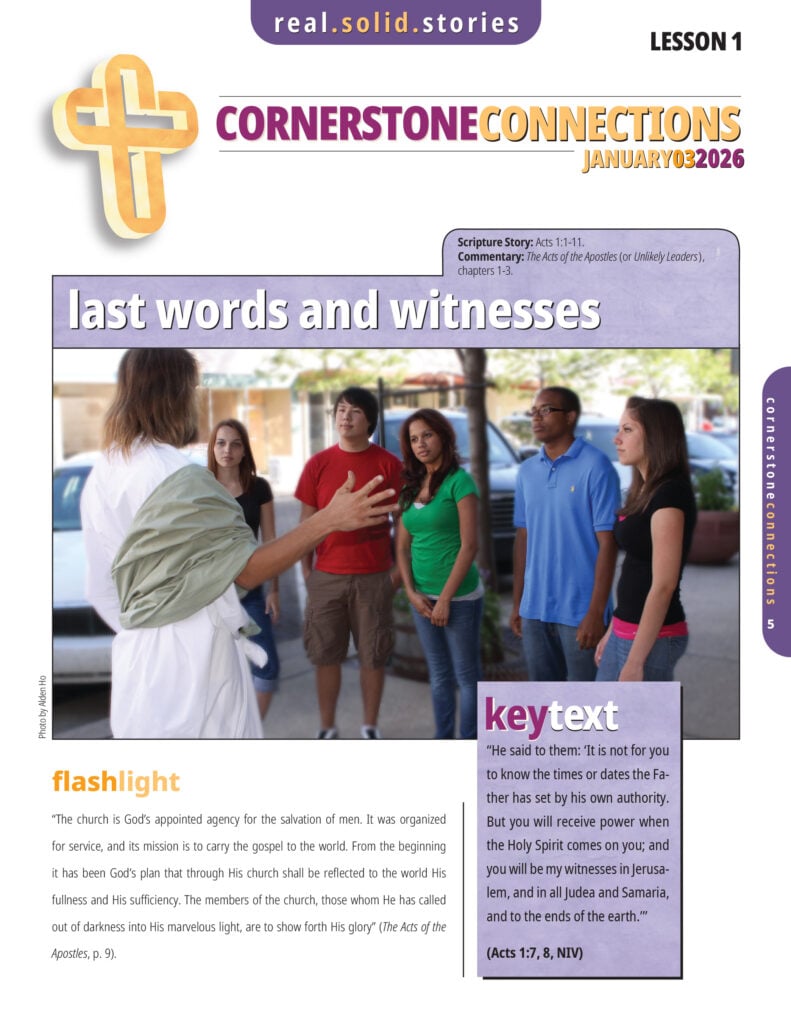
7 He said to them: “It is not for you to know the times or dates the Father has set by his own authority. 8 But you will receive power when the Holy Spirit comes on you; and you will be my witnesses in Jerusalem, and in all Judea and Samaria, and to the ends of the earth.”
QUESTIONS
- Reread verse 6—this is one of the most humorous verses to me. The disciples still don’t understand after all the time. (Think back to our blind texting game—the message just never got across.) Jesus has been talking about the Kingdom of God and they are worried about the Kingdom of Israel. How might we be more concerned about our own kingdoms (future plans, school, country, world) instead of the Kingdom of God? How might we instead infuse the Kingdom of God into our kingdoms?
- Jesus is unfazed by the disciples and answers their question in a different way. How comfortable are you that it is up to God to know times and seasons? Are you able to trust that God knows best? When is this difficult?
- The baptism of the Holy Spirit also brings power. The previous verse reminds of God’s authority, then the word “but” is inserted to let us know that God has also empowered us through the Holy Spirit! How does that make you feel? When have you been empowered by God? How did you know when God was empowering you?
- Notice that God empowers us to be a witness! How are you a witness in your church? In your community? Beyond your community?
Read Acts1:9-11.
9 After he said this, he was taken up before their very eyes, and a cloud hid him from their sight.
10 They were looking intently up into the sky as he was going, when suddenly two men dressed in white stood beside them. 11 “Men of Galilee,” they said, “why do you stand here looking into the sky? This same Jesus, who has been taken from you into heaven, will come back in the same way you have seen him go into heaven.”
QUESTIONS
- This is the beginning of doing acts. The disciples are caught staring off and the angels come and say, “What are you just sitting around for? There’s a lot of work to do here!” How do we often pine for heaven and lose sight of the work to be done until Jesus comes again? How do we remind ourselves that we have been called to action by Jesus, to spread the Gospel?
APPLICATION
Over the next several weeks as we study the book of Acts, we will be talking a lot about the Holy Spirit! Today was just the beginning. If you haven’t taken a spiritual gifts test recently, this would be a great time to do that!
Even better, you might want to chart your youth group’s spiritual gifts! That way you can encourage one another as you practice those gifts or even try to figure out what your spiritual gifts are! Your youth leader could create a chart of what each student’s gifts are and then as a group try to help plan your youth programming using each members’ gifts.
There is a great assessment tool on the General Conference Youth Ministries website that you can use! Check it out and dive into letting the Holy Spirit empower and change your youth group, your church, and your community!
Lesson Plan 2
SCRIPTURE PASSAGE
LEADER’S NOTE
For a Relational Bible Study (RBS) you’ll want to get into the Scripture passage and encourage the youth to imagine participating in the story while it’s happening. Then you will be able to better apply it to your own situation today.
You will need to ask God for the Holy Spirit to be present as your small group discusses the questions (no more than 3-6 people in a group is recommended). Start with the opening question. It is a personal question and the answer is unique for each individual. There is no right answer and nobody is an expert here, so don’t be surprised when you hear different responses. You are depending on the Holy Spirit to be present and to speak through your group. Say what God prompts you to say, and listen to what others share.
Take turns reading the chapter out loud. Follow that with giving the students some time to individually mark their responses to the questions (a PDF version of the handout is available as a download). This gives each person a starting point for responding when you start to share as a group. Next, begin the discussion by asking the students to share what they marked and why on each question as you work your way through. Feel free to take more time on some questions than others as discussion warrants.
Encourage each person in the group to apply what is discussed to their personal lives and to share with the group what they believe God wants them to do. Then ask them to pray that God will help each of them to follow through in doing so. Remind them to expect that God will show them ways to live out the message of this passage in the coming week, and that they are free to ask others in the group to help hold them accountable.
OVERVIEW
Happy New Year!
Now what?
Christmas is past, and the New Year begins today. Some stay up until midnight to bring in the New Year on New Year’s Eve, but what happens next?
Some people say, “Vacation is over, so we have to go back to school.” That’s it—just “school”?
Just as we could predict, “The pandemic will continue,” we could say, “Christ’s coming to earth 2,000 years ago brought a ‘New Year’ or ‘Jubilee’ for all people on earth.”
Now what?
As we begin the year 2022, our Sabbath School lessons move from Christ’s birth, ministry, death, and resurrection to what happens after Christ ascended back to heaven. Our lessons in 2021 form the pivot point of human history on this planet.
Now what?
We begin today with our first lesson, recorded in the book of Acts—the only book written about the history of what happened after Christ’s resurrection, and the only “second book” written by a Gospel writer (and he was a Gentile author—scandalous!).
While Acts 1 names “Theophilus” as the target, this name literally means “friend of God.” If you’re a “friend of God,” this book of the Bible might be targeted specifically for you!
Now What?
What happens in your life after Christmas and New Year’s?
Read Acts 1:1-11.
1 In my former book, Theophilus, I wrote about all that Jesus began to do and to teach 2 until the day he was taken up to heaven, after giving instructions through the Holy Spirit to the apostles he had chosen. 3 After his suffering, he presented himself to them and gave many convincing proofs that he was alive. He appeared to them over a period of forty days and spoke about the kingdom of God. 4 On one occasion, while he was eating with them, he gave them this command: “Do not leave Jerusalem, but wait for the gift my Father promised, which you have heard me speak about. 5 For John baptized with water, but in a few days you will be baptized with the Holy Spirit.”
6 Then they gathered around him and asked him, “Lord, are you at this time going to restore the kingdom to Israel?”
7 He said to them: “It is not for you to know the times or dates the Father has set by his own authority. 8 But you will receive power when the Holy Spirit comes on you; and you will be my witnesses in Jerusalem, and in all Judea and Samaria, and to the ends of the earth.”
9 After he said this, he was taken up before their very eyes, and a cloud hid him from their sight.
10 They were looking intently up into the sky as he was going, when suddenly two men dressed in white stood beside them. 11 “Men of Galilee,” they said, “why do you stand here looking into the sky? This same Jesus, who has been taken from you into heaven, will come back in the same way you have seen him go into heaven.”
1. What was unique about Luke’s Gospel (compared to the others)?
- Luke is the only Gospel written by someone who wasn’t a Jew.
- Luke is the only Gospel writer who wrote a sequel.
- Luke’s Gospel was for only one person—Theophilus (friend of God).
- The story of the Good Samaritan ( ).
- Lots of details about the Holy Spirit.
- Lots of stories about marginalized people Jesus accepted/healed.
- Written primarily for Jews to show Jesus was their Messiah.
- Only Luke wrote about Christ’s crucifixion and resurrection.
- Other.
2. What did Jesus do during the 40 days before His ascension?
- Jesus started a youth group.
- Jesus started the Christian church.
- Kept proving to His disciples that He really had been resurrected.
- Prepared the disciples to receive the Holy Spirit.
- Finally told them which one of the disciples really was the greatest.
- Re-taught the disciples what they didn’t understand earlier.
- Taught all of His disciples how to fish (for people).
- Gave them a new start, like starting a new year.
- Other.
3. Why didn’t Jesus spend ALL of His time with His disciples the 40 days He was on earth after His resurrection?
- They didn’t need it.
- They did need it.
- Jesus was very busy with a lot of other things.
- Jesus had to check in with His Father in heaven periodically.
- To better prepare them to operate without His physical presence.
- The disciples had a very limited attention span.
- Jesus was developing a back-up plan with some other people.
- Other.
4. What does it mean to be “baptized with the Holy Spirit”?
- Extra power demonstrated by a follower of Christ.
- I have no idea.
- A person can speak in tongues.
- A person can do miracles.
- It happens automatically when a person gets baptized by immersion.
- A baptized person has to be re-baptized to receive the Holy Spirit.
- It only happened after Christ had been resurrected.
- Other.
5. When Jesus disappears, where and when can you see Him again?
- You can’t.
- Just about anywhere.
- Not until He comes in power and glory at the 2 nd Advent.
- Spiritual things are spiritually discerned.
- What many people refer to as “luck” or “coincidence.”
- In “the least of these” ( ).
- When reading Scripture or while praying.
- In Youth Sabbath School.
- Other.
6. What’s the significance of the message from two men dressed in white?
- The message affirmed what Jesus had already told them.
- The number “two” symbolized truth—testimony of two witnesses.
- Dressing in white symbolized something pure/heavenly.
- These two guys wanted to apply to replace Judas as the 12 th disciple.
- Jesus would return during the disciples’ lifetime.
- Jesus would return visibly in the sky—from heaven to earth.
- They served as crisis counselors as the disciples experienced loss.
- Other.
7. What would you like Jesus to do, but He doesn’t do it (like the disciples wanted Jesus to restore the Israelite kingdom, but He didn’t)?
8. Verses 7-8 have the word “you” 3 times. How do they apply to “you” right now?
APPLICATION
“Now what?” for you? Based on Acts 1:1-11, here are some ways for you to live out what God has revealed in this portion of Scripture. Choose one or more of these, or adapt them to your specific situation, starting today.
THE ACTIONS OF JESUS.
Each Sabbath last year we considered the various actions of Jesus during His time on earth 2,000 years ago.
- Download the handout “The Actions of Jesus” and use it during your time of reflection to list Christ’s actions in three periods of time: 1) During Christ’s ministry on earth; 2) Christ’s actions on earth since He returned to heaven; and 3) Christ’s actions in your life.
- Return to this list several times during the week and add to it.
- Which list is the longest? Which is the shortest? What prayer requests does this prompt you to make?
TESTIMONY OF 2.
Throughout the Old Testament, the “testimony of 2” remained the standard to verify something to be true (Deuteronomy 19:15; 17:6; Numbers 35:30; Zechariah 4:11-14). This appears even more often in the New Testament (Matthew 18:16; Mark 9:4; John 8:17; 2 Corinthians 13:1; 1 Timothy 5:19; Revelation 11:1-19). When Christ ascended to heaven, two men in white suddenly appeared among the disciples and testified that Jesus would return to earth in a way similar to how He left.
- Consider the testimony of two people in your life. It might be two parents or a teacher and a school principal, or a pastor and Youth Sabbath School leader.
- Download “Testimony of 2” and think back to what you believe is true based on the testimony of two witnesses, and then compare with others in your Youth Sabbath School as well as someone a generation or two older than you, and compare with a child.
WAIT.
In Acts 1:4, Jesus instructed His disciples to wait in Jerusalem until the promised Holy Spirit came to them from heaven. How long would you wait? We now know the Holy Spirit arrived 10 days after Jesus ascended, but they weren’t told hold long it would be. So they waited . . . and waited . . . and waited.
- How long would you wait for Jesus/the Holy Spirit? Try it this week.
- Set aside just one minute (a total of just 60 seconds) of being alone, praying for God to send you the Holy Spirit. See what happens.
- Stretch that the next day to two minutes, and three minutes the third day.
- After one week, you’ll be at 7 minutes.
- While that’s much less than 10 days of waiting, what happens to you when you wait for God to send you the Holy Spirit?
Compare with a partner who is doing the same thing as you—waiting for the Holy Spirit each day.