

Overview
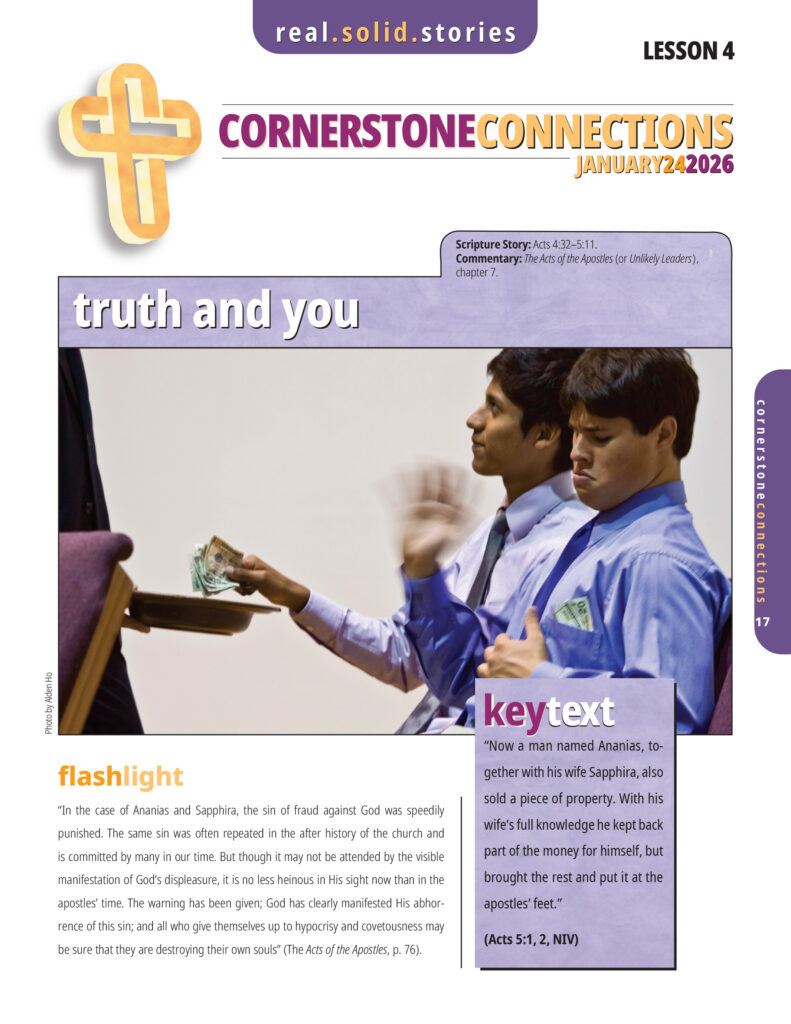
One of the most compelling snapshots of generosity in the Bible is found in Acts 4:32-36. Following that poignant picture of God’s people “sharing everything they had” and giving “to anyone as he had need” is the unsettling story of Ananias and Sapphira. The juxtaposition of the narratives is jolting to say the least.
Scripture
Acts 4:32–5:11.
Discussion Video

Lesson 1
Scripture Passages
OVERVIEW
God desires us to live lives of truth, integrity, and generosity.
OPENING ACTIVITY:
TWO TRUTHS AND A LIE
Two Truths and a Lie is a classic ice breaker game. The goal is to share three facts about yourself—only two of which are true. Players have to guess which statements are truly factual, and which ones are lies. It may work best for the leaders to go first, giving your students time to come up with their own two truths and a lie before it’s their turn.
QUESTIONS
- What are some ways people today present a false impression of themselves?
- What may draw nonbelievers to the church—people who look like they “have it all together,” or people who are honest about their struggles and seeking to take care of each other?
- How can we present a more real version of who we are? What healthy balance may there be between being too vulnerable and too fake?
- How can we encourage others to be more genuine?
TRANSITION
This week’s story is one of the most shocking in the Bible. And while the sudden deaths of Ananias and Sapphira may be hard to wrap our heads around at first, they boil down to two things: greed and public image.
The early Christian community looked out for and took care of each other. In a time when the average person owned only a handful of things, wealthy church members sold their property and donated the money to the church to help people in need.
Ananias and Sapphira had wealth to spare. They felt moved by the Holy Spirit to sell their possessions and donate the money—but they soon had second thoughts. So they decided they’d keep a good chunk of the cash for themselves, while letting everyone think they were donating 100%.
The issue wasn’t the amount of money. God asks us to reserve 10% of our income for Him; any offerings beyond that are to be given as the Holy Spirit moves us. The issue was that Ananias and Sapphira wanted to look good, to make people think they were pious and generous when they were really saving much of it for themselves. They pretended they’d given all they had, all that the Holy Spirit had moved them to share. They had lied to the church, and, Peter declared, they had lied to the Holy Spirit.
Today’s ultra-wealthy often make headlines by donating many millions to a cause, getting lots of praise when the amount given may only be equal to, say, one tenth of one percent of their wealth—far short of even the 10% God calls for. For these donors, they get to impress people with their generosity, while keeping more money than the average person could make in ten thousand lifetimes.
These days the expression “Have your cake and eat it too” may not make much sense at first glance (what’s the point of having cake if you can’t eat it?). The old proverb has the same basic meaning as “You can’t have it both ways.” As true as that was for Ananias and Sapphira, they—and the early Christian church—were about to learn the meaning of another saying: “You can’t take it with you.”
BIBLE STUDY GUIDE
SHARING IS CARING
When a rich young man asked Jesus what good thing he needed to do to live forever, Jesus told him to sell his possessions, give the money to the poor, then “Come, follow Me.” Matthew 19:22 tells us, “When the young man heard this, he went away sad, because he had great wealth.” Then Jesus told His disciples, “Truly I tell you, it is hard for someone who is rich to enter the kingdom of heaven.”
Read Acts 4:32-37.
32 All the believers were one in heart and mind. No one claimed that any of their possessions was their own, but they shared everything they had. 33 With great power the apostles continued to testify to the resurrection of the Lord Jesus. And God’s grace was so powerfully at work in them all 34 that there were no needy persons among them. For from time to time those who owned land or houses sold them, brought the money from the sales 35 and put it at the apostles’ feet, and it was distributed to anyone who had need.
36 Joseph, a Levite from Cyprus, whom the apostles called Barnabas (which means “son of encouragement”), 37 sold a field he owned and brought the money and put it at the apostles’ feet.
QUESTIONS
- How realistic would such a plan be for a church community today? What risks would doing so today involve?
- Is it easier to be generous if you have a little, or if you have a lot? How so?
- How can we look out for people in need today?
- What might God be calling well-off Christians to do today to ensure people’s needs are met?
- How might you strike a balance between taking care of your own needs and interests and taking care of others?
- “Prosperity gospel” preachers declare that if we follow God, He will always bless us with good health and wealth. They teach that when we give generously to God, financial blessings will inevitably follow in return. How does this distort Jesus’ teachings? How can this false teaching discourage and exploit people? Read for a bit of what Jesus had to say.
Read Matthew 6:19-21.
19 “Do not store up for yourselves treasures on earth, where moths and vermin destroy, and where thieves break in and steal. 20 But store up for yourselves treasures in heaven, where moths and vermin do not destroy, and where thieves do not break in and steal. 21 For where your treasure is, there your heart will be also.
LAST WORDS
Like the religious leaders Jesus condemned for finding excuses for greed, Ananias and Sapphira cared more about their public image—and their own selfish desires—than the needs of anyone around them. To prevent their cancerous attitude from infecting the church, God made a lesson out of them.
Read Acts 5:1-11.
1 Now a man named Ananias, together with his wife Sapphira, also sold a piece of property. 2 With his wife’s full knowledge he kept back part of the money for himself, but brought the rest and put it at the apostles’ feet.
3 Then Peter said, “Ananias, how is it that Satan has so filled your heart that you have lied to the Holy Spirit and have kept for yourself some of the money you received for the land? 4 Didn’t it belong to you before it was sold? And after it was sold, wasn’t the money at your disposal? What made you think of doing such a thing? You have not lied just to human beings but to God.”
5 When Ananias heard this, he fell down and died. And great fear seized all who heard what had happened. 6 Then some young men came forward, wrapped up his body, and carried him out and buried him.
7 About three hours later his wife came in, not knowing what had happened. 8 Peter asked her, “Tell me, is this the price you and Ananias got for the land?”
“Yes,” she said, “that is the price.”
9 Peter said to her, “How could you conspire to test the Spirit of the Lord? Listen! The feet of the men who buried your husband are at the door, and they will carry you out also.”
10 At that moment she fell down at his feet and died. Then the young men came in and, finding her dead, carried her out and buried her beside her husband. 11 Great fear seized the whole church and all who heard about these events.
QUESTIONS
- What does it mean to lie to the Holy Spirit?
- How did Ananias expect Peter to respond when he delivered the money?
- “Great fear seized all who heard what had happened.” How would you feel if prominent people in your church dropped dead after being exposed as hypocrites?
- Many have come to God though the witness of miracles. What effect does an event like the judgment on Ananias and Sapphira have on God’s people?
- Hypocrisy is always a big issue in churches. How have hypocritical people affected your spiritual journey?
- The Bible tells a few other stories of offerings which God did not accept, including that of Cain ( ) and King Saul ( ). What made the difference?
- says, “Remember this: Whoever sows sparingly will also reap sparingly, and whoever sows generously will also reap generously. Each of you should give what you have decided in your heart to give, not reluctantly or under compulsion, for God loves a cheerful giver.” How can we apply this to our lives?
WHO’S YOUR MASTER?
In the Sermon on the Mount, Jesus talked about how people hypocritically “do good” to impress other people, and how money makes an excellent tool, but a poor master.
Read Matthew 6:1-4.
1 “Be careful not to practice your righteousness in front of others to be seen by them. If you do, you will have no reward from your Father in heaven.
2 “So when you give to the needy, do not announce it with trumpets, as the hypocrites do in the synagogues and on the streets, to be honored by others. Truly I tell you, they have received their reward in full. 3 But when you give to the needy, do not let your left hand know what your right hand is doing, 4 so that your giving may be in secret. Then your Father, who sees what is done in secret, will reward you.
Read Matthew 6:24.
24 “No one can serve two masters. Either you will hate the one and love the other, or you will be devoted to the one and despise the other. You cannot serve both God and money.
QUESTIONS
- How can we have a healthy perspective about money and material things?
- How do you think God rewards us when we do good deeds in secret?
- Compared to people a hundred or a thousand years ago, we may be richer than they could have ever imagined. Is it harder now than before to have a healthy attitude about wealth?
- What kind of things do you think people coveted in years past?
- What kind of things do people covet today?
- Are they essentially the same, or quite different?
APPLICATION
God calls us to live with truth, integrity, and generosity. That can start with our priorities. Jesus said, “Do not store up for yourselves treasures on earth, where moths and vermin destroy, and where thieves break in and steal. But store up for yourselves treasures in heaven, where moths and vermin do not destroy, and where thieves do not break in and steal. For where your treasure is, there your heart will be also” (Matthew 6:19-21).
Consider:
Praying that God will show you how He wants to use you to bless others.
Researching the biggest needs in your community.
Getting involved with church and community ministries that serve those who are struggling.
Starting an investment project in which you give the extra money you make from a side project to a missions offering. You might give God a portion of the money you make selling things online, a set amount for every point you score, or a thank you offering for an answered prayer or particular ways God has blessed you.
Lesson 2
SCRIPTURE
LEADER’S NOTE
For a Relational Bible Study (RBS) you’ll want to get into the Scripture passage and encourage the youth to imagine participating in the story while it’s happening. Then you will be able to better apply it to your own situation today.
You will need to ask God for the Holy Spirit to be present as your small group discusses the questions (no more than 3-6 people in a group is recommended). Start with the opening question. It is a personal question and the answer is unique for each individual. There is no right answer and nobody is an expert here, so don’t be surprised when you hear different responses. You are depending on the Holy Spirit to be present and to speak through your group. Say what God prompts you to say, and listen to what others share.
Take turns reading the chapter out loud. Follow that with giving the students some time to individually mark their responses to the questions (a PDF version of the handout is available as a download). This gives each person a starting point for responding when you start to share as a group. Next, begin the discussion by asking the students to share what they marked and why on each question as you work your way through. Feel free to take more time on some questions than others as discussion warrants.
Encourage each person in the group to apply what is discussed to their personal lives and to share with the group what they believe God wants them to do. Then ask them to pray that God will help each of them to follow through in doing so. Remind them to expect that God will show them ways to live out the message of this passage in the coming week, and that they are free to ask others in the group to help hold them accountable.
OVERVIEW
Turning a new leaf with a newly formed church, the disciples have sped into action after the Pentecostal blessing. The church is rapidly growing, and although Jesus has gone to heaven, His legacy has been a sweeping of believers across the nation and even into Gentile territory. The twelve were extremely busy spreading the message and giving powerful testimonies, but with a church this large, there needed to be organization outside of the preaching ministry. The believers, however, branched the church out into various different ministries. In particular, they worked to reduce the number of poor members by selling properties and donating the money to the apostles who in turn allocated it to members in need. The book Acts of the Apostles states that although this practice began out of the goodness of believers’ hearts (such as Joseph of Arimethea), it soon became a competition in which people felt forced to give to remain “good” in the eyes of others. From this stems the conflict of Ananias and Sapphira. Ananias sold a property and claimed to give the full proceedings to the apostles but, in reality, only gave a small percentage. When Peter gave him the chance to redeem himself, he continued lying, and was struck dead. Sapphira, his wife, was also called in and given a chance to tell the truth, but when she failed to do so, she too was struck dead.
As Peter states, the root of this problem was not that they did not give the full amount; it was that they lied. The property was theirs, and so was the money: if they had come to Peter and stated they were giving 20% of the proceedings this would have been totally acceptable and even a cause for blessing. However, as Acts of the Apostles states, Ananias and Sapphira’s intentions were not from the heart; instead, it was just to look good in this distorted competition that the devil created. They did not care about the cause, instead they cared about how they looked. The story of Ananias and Sapphira is meant to bring awareness to the consequences of getting caught up in selfish superficiality and lying.
“Liar, Liar” Relational Bible Study
Have you ever recognized that you are being lied to?
Read Acts 4:32-5:11.
32 All the believers were one in heart and mind. No one claimed that any of their possessions was their own, but they shared everything they had. 33 With great power the apostles continued to testify to the resurrection of the Lord Jesus. And God’s grace was so powerfully at work in them all 34 that there were no needy persons among them. For from time to time those who owned land or houses sold them, brought the money from the sales 35 and put it at the apostles’ feet, and it was distributed to anyone who had need.
36 Joseph, a Levite from Cyprus, whom the apostles called Barnabas (which means “son of encouragement”), 37 sold a field he owned and brought the money and put it at the apostles’ feet.
5 Now a man named Ananias, together with his wife Sapphira, also sold a piece of property. 2 With his wife’s full knowledge he kept back part of the money for himself, but brought the rest and put it at the apostles’ feet.
3 Then Peter said, “Ananias, how is it that Satan has so filled your heart that you have lied to the Holy Spirit and have kept for yourself some of the money you received for the land? 4 Didn’t it belong to you before it was sold? And after it was sold, wasn’t the money at your disposal? What made you think of doing such a thing? You have not lied just to human beings but to God.”
5 When Ananias heard this, he fell down and died. And great fear seized all who heard what had happened. 6 Then some young men came forward, wrapped up his body, and carried him out and buried him.
7 About three hours later his wife came in, not knowing what had happened. 8 Peter asked her, “Tell me, is this the price you and Ananias got for the land?”
“Yes,” she said, “that is the price.”
9 Peter said to her, “How could you conspire to test the Spirit of the Lord? Listen! The feet of the men who buried your husband are at the door, and they will carry you out also.”
10 At that moment she fell down at his feet and died. Then the young men came in and, finding her dead, carried her out and buried her beside her husband. 11 Great fear seized the whole church and all who heard about these events.
-
Why were the believers donating money to the disciples?
- To eradicate the poor.
- To reduce the poverty rate in the church.
- Because they had no clue what to do with the money.
- To grow the church.
- To contribute to the church’s ministries.
- To look good in the eyes of the other people.
- To get rid of unnecessary properties.
- Other.
-
What did Ananias and Sapphira say they were going to do for this cause?
- Sell their entire property.
- Sell a part of their property.
- Donate the full proceedings to the church.
- Donate half of the proceedings to the church.
- Give their house to the church.
- They did not say they were going to do anything.
- Give a small donation while keeping the rest.
- Other.
-
What did they do instead?
- They did what they said.
- They gave only some of the proceedings instead of all.
- They lied about their donation.
- They gave the property instead of the money.
- Sapphira lied even after knowing her husband’s demise.
- They didn’t bring any money.
- They lied to God.
- Other.
-
What did Peter do about this?
- Gave them a second chance.
- Demanded the rest of the money.
- He had no clue that they were lying.
- Gave Sapphira a second chance even after her husband’s death.
- Rebuked them.
- Killed Ananias.
- Let God deal with them.
- Other.
-
What is the significance of the deaths of Ananias and Sapphira?
- It serves as a reminder of the consequences of lying.
- It serves as a reminder of the consequences of refusing God’s second chances.
- It was meant to provoke fearful donations from believers.
- It was meant to serve as a dire warning.
- It was used to bring awareness to the toxic competition charity had become.
- It serves as a reminder of the consequences of selfishness.
- Other.
-
What was the true sin that Ananias and Sapphira committed?
- Lying.
- Not giving the money.
- Not giving the money they said they would give.
- Refusing the gift of mercy and second chances.
- Not selling the property.
- Attempting to lie to God.
- Superficial motives of donation.
- Other.
- What is the consequence of refusing God’s gift of mercy and forgiveness?
- How do we avoid giving into selfish motives to focus on the cause we are serving?
SUMMARY
As sinners, God does not expect us to be perfect. Therefore, He will give many second chances for us to redeem ourselves from any mistakes that we’ve made. Ananias and Sapphira were each given multiple chances to redeem themselves, but they did not take them. Unfortunately, their story ends in death, and although this may have seemed like a drastic measure, death is the ultimate consequence that unrepented sin brings. The story of Ananias and Sapphira spread fear among the believers, but ultimately it served as a reminder of the message of repentance and forgiveness that was being spread, as well as the dangers of lying and refusing the mercy that God has so graciously given to us.
APPLICATION
The story of Ananias and Sapphira is as important to us as it was to the early believers in their day. It is always a necessary part of studying to sit back and meditate how a story applies to us today as youth. Below you will find three applications that can benefit the youth in your group and help them meditate on the word shared today. These applications work both individually and in a group.
- SECOND CHANCES
It can be hard to see the story of Ananias and Sapphira as a positive one, but it does showcase the goodness and mercy of God through the endless second chances He offers. Just as the early believers were encouraged to do, we are to move with patience, mercy, and love.
- Think of someone against whom you are holding a grudge.
- Why are you still angry with them?
- Thinking back to the endless chances God has given you, ask Him to open your heart and allow that person a chance to redeem themselves.
- SELFISH COMPETITION
Charity work can easily become a competition of “the bigger the better,” whilst the real cause of service vanishes.
- As a youth group or on your own, plan an act of service to do.
- Focus on the cause, and put aside any competition or selfish motives.
- How does this change the experience of volunteering?
- LIAR, LIAR
Lying is a direct breach of the 9th Commandment; it’s also considered one of the abominations to God. However, it is very easy to give into the urge to lie, and the truth of the matter is practically everyone has told a lie at least once in their lives.
Ask God for forgiveness for telling the lie, and ask Him for His help to resist the temptation of telling a lie.
Think of a lie that you’ve told recently, no matter how big or small.
Why did you tell it?
Ask God for forgiveness for telling the lie, and ask Him for His help to resist the temptation of telling a lie.