

Overview
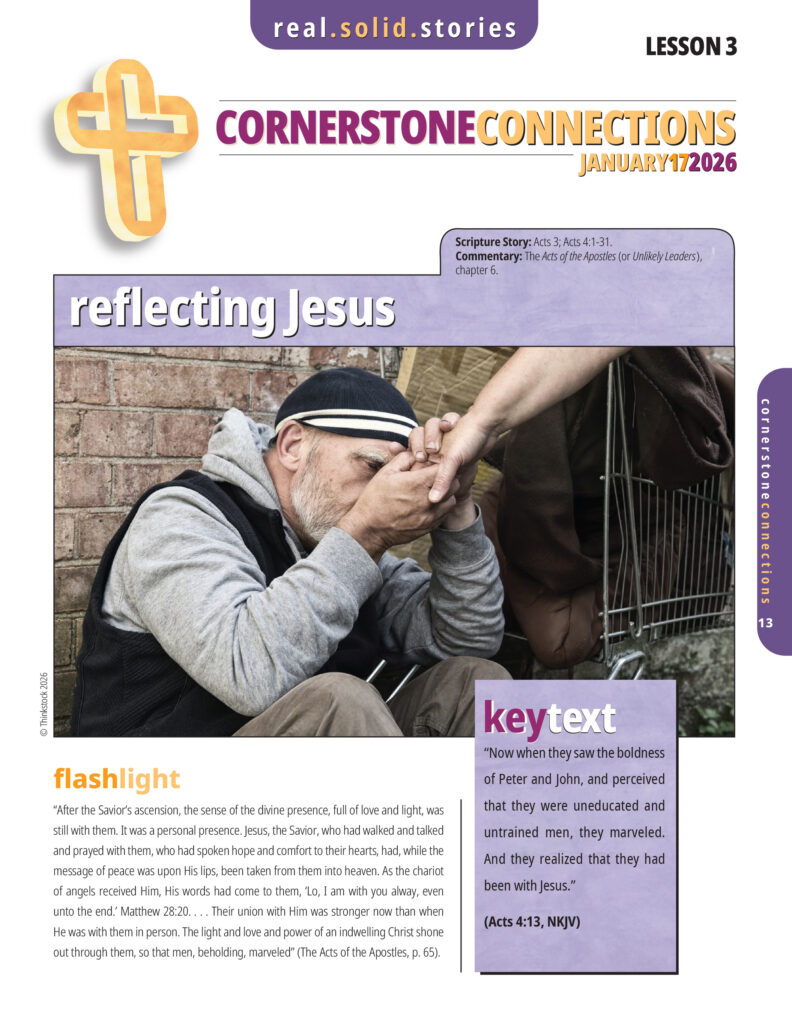
The story of Peter and John healing the crippled beggar provides a great launching pad for spiritual conversations on a variety of topics. This healing story is followed with an explanation that Peter preached to the onlookers. Soon the Sanhedrin got involved and before they knew it, Peter and John landed in jail.
Scripture
Discussion Video

Lesson 1
SCRIPTURE PASSAGES
Acts 3:1-26
Acts 4:1-31
NOTE: While we usually use the New International Version for Youth Sabbath School lessons, this week we have used the Amplified Version of the Bible. The New International Version uses the word “lame” as a descriptor for the man who could not walk. Since “lame” now has multiple meanings, and is no longer used to describe individuals with disabilities, we used a translation that more accurately describes him as “a man who had been unable to walk from birth.”
OVERVIEW
Reality television has taken over America. People are constantly trying to go from fat to thin, scraggly to beautiful, single to married, and many other amazing feats. Today’s story would make a great episode—at first glance it might look a little like an episode of COPS and Benny Hinn combined. How would you feel if one day you were in church and a guest speaker showed up and healed someone you’ve known from birth who couldn’t walk? Wouldn’t that be something to sit up and take note of? It’s part of our story, but it isn’t the only astonishing thing. Our story starts with a bang and only gets better as the passage goes on.
OPENING ACTIVITY: LEARNING TO LIVE
Supplies
- XL button-up shirts (2 or 3, depending on how many students you have)
- Several pairs of thick socks
- Blindfolds
- Rulers with thick string taped to each end
INSTRUCTIONS
Explain to your students that they are going to experience some alternative ways of being challenged.
- Tie a ruler between a student’s ankles. Have them attempt to walk around the room.
- Place a blindfold over a student’s eyes and have them attempt to walk across a room that is free of obstacles, and then place a few obstacles in their way and have them attempt to walk across the room again. Be careful and don’t let anyone walk into a wall or trip over a chair, etc.
- Have a student put on one of the button-up shirts and put the socks over their hands and see if they can button up the shirt.
- Blindfold a student and have them attempt to button up a shirt.
- Blindfold a student, put a ruler between their feet, and have them walk around the room.
QUESTIONS
- Which of the activities proved to be the most challenging?
- If you had to choose one challenge, which would it be and why?
- How would having challenges such as these affect how you live?
- In what ways are people with extra challenges treated differently?
- What would it have been like to have gone into a village after Jesus healed everyone and removed their extra challenges?
TRANSITION
What happens when the weaker become stronger? How do people’s opinions change when the timid become courageous? What would it be like to face the disciples of a risen Savior who have gone from being timid, uneducated, and uncouth individuals to men and woman who are not afraid to speak the truth and do it with authority? This is how our story begins.
BIBLE STUDY GUIDE
Read Acts 3:1-10 (AMP).
1 Now Peter and John were going up to the temple at the hour of prayer, the ninth hour (3:00 p.m.), 2 and a man who had been unable to walk from birth was being carried along, whom they used to set down every day at that gate of the temple which is called Beautiful, so that he could beg alms from those entering the temple. 3 So when he saw Peter and John about to go into the temple, he began asking [them] for coins. 4 But Peter, along with John, stared at him intently and said, “Look at us!” 5 And the man began to pay attention to them, eagerly expecting to receive something from them. 6 But Peter said, “Silver and gold I do not have; but what I do have I give to you: In the name (authority, power) of Jesus Christ the Nazarene—[begin now to] walk and go on walking!” 7 Then he seized the man’s right hand with a firm grip and raised him up. And at once his feet and ankles became strong and steady, 8 and with a leap he stood up and began to walk; and he went into the temple with them, walking and leaping and praising God. 9 All the people saw him walking and praising God; 10 and they recognized him as the very man who usually sat begging for coins at the Beautiful Gate of the temple, and they were filled with wonder and amazement and were mystified at what had happened to him.
QUESTIONS
- What are the key elements in this passage?
- Describe the emotions of the following people:
- Man who was healed
- Peter and John
- Crowd of witnesses
Read Acts 3:11-21 (AMP).
11 Now while he was still holding on to Peter and John, all the people, utterly amazed, ran together and crowded around them at the covered porch called Solomon’s portico. 12 And Peter, seeing this, said to the people, “You men of Israel, why are you amazed at this? Why are you staring at us, as though by our own power or godliness we had made this man walk? 13 The God of Abraham, Isaac, and Jacob, the God of our fathers, has glorified His Servant and Son Jesus [doing Him this honor], the One whom you handed over and disowned and rejected before Pilate, when he had decided to release Him. 14 But you disowned and denied the Holy and Righteous One and asked for [the pardon of] a murderer to be granted to you. 15 But you killed the Prince (Author, Originator, Source) of life, whom God raised [bodily] from the dead. To this [fact] we are witnesses [for we have seen the risen Christ]. 16 And on the basis of faith in His name, it is the name of Jesus which has strengthened this man whom you see and know; and the faith which comes through Him has given him this perfect health and complete wholeness in your presence.
17 “Now, brothers, I know that you acted in ignorance [not fully aware of what you were doing], just as your rulers did also. 18 And so God has fulfilled what He foretold by the mouth of all the prophets, that His Christ (Messiah, Anointed) would suffer. 19 So repent [change your inner self—your old way of thinking, regret past sins] and return [to God—seek His purpose for your life], so that your sins may be wiped away [blotted out, completely erased], so that times of refreshing may come from the presence of the Lord [restoring you like a cool wind on a hot day]; 20 and that He may send [to you] Jesus, the Christ, who has been appointed for you, 21 whom heaven must keep until the time for the [complete] restoration of all things about which God promised through the mouth of His holy prophets from ancient time.
QUESTIONS
- Why were the people amazed?
- What did Peter and John tell the people to do?
- What might have been different if the teachers and people had understood the teachings of the prophets about the coming of the Messiah?
Read Acts 4:1-4 (AMP).
1 And while Peter and John were talking to the people, the priests and the captain [who was in charge of the temple area and] of the temple guard and the Sadducees came up to them, 2 being extremely disturbed and thoroughly annoyed because they were teaching the people and proclaiming in [the case of] Jesus the resurrection of the dead. 3 So they arrested them and put them in jail until the next day, because it was evening. 4 But many of those who heard the message [of salvation] believed [in Jesus and accepted Him as the Christ]. And the number of the men came to be about 5,000.
QUESTIONS
- What did the religious leaders think of Peter and John’s new outlook on life?
- How did the healing of this man affect the people who witnessed this miracle?
Read Acts 4:8-17 (AMP).
8 Then Peter, filled with [the power of] the Holy Spirit, said to them, “Rulers and elders of the people [members of the Sanhedrin, the Jewish High Court], 9 if we are being put on trial today [to interrogate us] for a good deed done to [benefit] a disabled man, as to how this man has been restored to health, 10 let it be known and clearly understood by all of you, and by all the people of Israel, that in the name of Jesus Christ the Nazarene, whom you [demanded be] crucified [by the Romans and], whom God raised from the dead—in this name [that is, by the authority and power of Jesus] this man stands here before you in good health. 11 This Jesus is the stone which was despised and rejected by you, the builders, but which became the chief Cornerstone. 12 And there is salvation in no one else; for there is no other name under heaven that has been given among people by which we must be saved [for God has provided the world no alternative for salvation].”
13 Now when the men of the Sanhedrin (Jewish High Court) saw the confidence and boldness of Peter and John, and grasped the fact that they were uneducated and untrained [ordinary] men, they were astounded, and began to recognize that they had been with Jesus. 14 And seeing the man who had been healed standing there with them, they had nothing to say in reply. 15 But after ordering them to step out of the Council [chamber], they began to confer among themselves, 16 saying, “What are we to do with these men? For the fact that an extraordinary miracle has taken place through them is public knowledge and clearly evident to all the residents of Jerusalem, and we cannot deny it. 17 But to keep it from spreading further among the people and the nation, let us [sternly] warn them not to speak again to anyone in this name.”
QUESTIONS
- Describe the importance of Jesus to the plan of salvation.
- In what ways had Peter and John changed?
- Why weren’t the rulers able to do what they wanted with Peter and John?
- How had being with Jesus changed Peter and John?
Read Acts 4:29-31 (AMP).
29 And now, Lord, observe their threats [take them into account] and grant that Your bond-servants may declare Your message [of salvation] with great confidence, 30 while You extend Your hand to heal, and signs and wonders (attesting miracles) take place through the name [and the authority and power] of Your holy Servant and Son Jesus.” 31 And when they had prayed, the place where they were meeting together was shaken [a sign of God’s presence]; and they were all filled with the Holy Spirit and began to speak the word of God with boldness and courage.
QUESTIONS
- How did all the disciples feel about the events that happened to Peter and John?
- What occurred when all the believers were all together?
APPLICATION
Being with Jesus changes a person. Being filled with the Holy Spirit changes a person. Do you think the disciples of Jesus had an advantage over people today? Were they the only ones who could be filled with the Holy Spirit? In our scripture passage the disciples had changed because they followed Jesus with all their hearts and had been filled with the Holy Spirit. Jesus promised to send the Holy Spirit to all the believers. You have the same opportunity to follow Jesus and be filled with the Holy Spirit that the disciples had. If you want to be like Peter and John, you’ll want to make sure that you make a complete commitment to follow Jesus with all your heart and be willing to listen to that still small voice that will guide you on your journey with Jesus.
FOLLOW UP
Each day during the coming week ask God for the following:
1. A desire to follow Jesus
2. An ability to love unconditionally
3. Ears to hear the voice of the Holy Spirit
4. An ability to stand up for the “least” of these
5. People who will hold you accountable
Lesson 2
SCRIPTURE
Acts 3:1-26 (AMP)
NOTE: While we usually use the New International Version for Youth Sabbath School lessons, this week we have used the Amplified Version of the Bible. The New International Version uses the word “lame” as a descriptor for the man who could not walk. Since “lame” now has multiple meanings, and is no longer used to describe individuals with disabilities, we used a translation that more accurately describes him as “a man who had been unable to walk from birth.”
LEADER’S NOTE
For a Relational Bible Study (RBS) you’ll want to get into the Scripture passage and encourage the youth to imagine participating in the story while it’s happening. Then you will be able to better apply it to your own situation today.
You will need to ask God for the Holy Spirit to be present as your small group discusses the questions (no more than 3-6 people in a group is recommended). Start with the opening question. It is a personal question and the answer is unique for each individual. There is no right answer and nobody is an expert here, so don’t be surprised when you hear different responses. You are depending on the Holy Spirit to be present and to speak through your group. Say what God prompts you to say, and listen to what others share.
Take turns reading the chapter out loud. Follow that with giving the students some time to individually mark their responses to the questions (a PDF version of the handout is available as a download). This gives each person a starting point for responding when you start to share as a group. Next, begin the discussion by asking the students to share what they marked and why on each question as you work your way through. Feel free to take more time on some questions than others as discussion warrants.
Encourage each person in the group to apply what is discussed to their personal lives and to share with the group what they believe God wants them to do. Then ask them to pray that God will help each of them to follow through in doing so. Remind them to expect that God will show them ways to live out the message of this passage in the coming week, and that they are free to ask others in the group to help hold them accountable.
OVERVIEW
In the times of Jesus, the day began at 6 o’clock in the morning and ended at 6 o’clock in the evening. For the devout Jew there were three special hours of prayer—9 a.m., 12 midday, and 3 p.m. They agreed that prayer was beneficial wherever it was offered; but they felt that it was doubly precious when offered in the Temple courts. It is very interesting that the apostles kept up the custom in which they had been trained. It was the hour of prayer and Peter and John were going into the Temple to observe it. A new faith had come to them, but they did not use that as an excuse for a license which broke all law. They were aware that the new faith and the old discipline could walk hand in hand.
It also was the custom for people begging for alms to sit at the entrance to a temple or a shrine. Such a place was considered the best, because when people are on their way to worship God, they are ready to be generous to others.
The man at the gate in Jerusalem must have known Peter and John and observed their joyous faces. He knew from experience that they would be good marks. He asked for alms. It may have been a reiterated appeal which he had chanted for years, and he began to repeat it this time especially for Peter and John.
The apostles stopped and looked at him intently. They fixed their eyes on him. The text means they stopped, looked at the man, and really thought about him and what he was asking. That’s significant, for they saw a man who could not walk seated helplessly next to the magnificence of the bronze, silver, and gold of the Corinthian gate. What a contrast!
They offered this man the healing that could only come from the compassion of persons filled with the power of Jesus. They were moved by the post-Pentecost power within them via the Holy Spirit, and the process of making someone whole, which would have taken modern corrective surgery and months of prolonged healing and learning to walk, took place in a split second.
The early preachers preached with this same power expressed in the healing of this man. Their messages always stressed the basic fact that the crucifixion was the greatest crime in human history. Whenever they spoke of it there was a kind of shocked horror in their voices. They tried to stamp listeners’ minds with the realization of the sheer crime of the cross. It is as if they said, “Look what sin can do.”
These proclamations also stressed the vindication of the resurrection. It is simple fact that without the resurrection the church would never have come into being. The resurrection is proof that Jesus is indestructible and is Lord of life and of death.
These believers always stressed the power of the risen Lord. They never regarded themselves as the sources of power but only as channels of power. They were aware of their limitations but were also aware that there was no limitation to what the risen Christ could do through them and with them.
All the messages preached by the first century leaders and believers in Christ could be summed up by what is found in the parenthesis of our text – Acts 3:1-26. When we come into a knowledge and conviction about Christ, this knowledge brings the obligation to repent and to turn from evil to doing good. The hand of compassion, extended by Spirit-filled men and women, in the name of Jesus Christ, the risen Lord, is filled with power to turn people’s thoughts toward heaven. Our task as Christians is to let everyone know that He who was crucified was none other than the Prince of Life. They preserved a murderer, a destroyer of life, and sought to destroy the Savior, the author of life. But God raised Him from the dead, proving that in fighting against Jesus, they were fighting against God. The doctrine of Jesus Christ was confirmed through the resurrection.
“Power to Jump . . . !”
Describe a time that you believe you jumped your highest.
Read Acts 3:1-26.
1 Now Peter and John were going up to the temple at the hour of prayer, the ninth hour (3:00 p.m.), 2 and a man who had been unable to walk from birth was being carried along, whom they used to set down every day at that gate of the temple which is called Beautiful, so that he could beg alms from those entering the temple. 3 So when he saw Peter and John about to go into the temple, he began asking [them] for coins. 4 But Peter, along with John, stared at him intently and said, “Look at us!” 5 And the man began to pay attention to them, eagerly expecting to receive something from them.
6 But Peter said, “Silver and gold I do not have; but what I do have I give to you: In the name (authority, power) of Jesus Christ the Nazarene—[begin now to] walk and go on walking!” 7 Then he seized the man’s right hand with a firm grip and raised him up. And at once his feet and ankles became strong and steady, 8 and with a leap he stood up and began to walk; and he went into the temple with them, walking and leaping and praising God. 9 All the people saw him walking and praising God; 10 and they recognized him as the very man who usually sat begging for coins at the Beautiful Gate of the temple, and they were filled with wonder and amazement and were mystified at what had happened to him.
11 Now while he was still holding on to Peter and John, all the people, utterly amazed, ran together and crowded around them at the covered porch called Solomon’s portico. 12 And Peter, seeing this, said to the people, “You men of Israel, why are you amazed at this? Why are you staring at us, as though by our own power or godliness we had made this man walk? 13 The God of Abraham, Isaac, and Jacob, the God of our fathers, has glorified His Servant and Son Jesus [doing Him this honor], the One whom you handed over and disowned and rejected before Pilate, when he had decided to release Him. 14 But you disowned and denied the Holy and Righteous One and asked for [the pardon of] a murderer to be granted to you. 15 But you killed the Prince (Author, Originator, Source) of life, whom God raised [bodily] from the dead. To this [fact] we are witnesses [for we have seen the risen Christ]. 16 And on the basis of faith in His name, it is the name of Jesus which has strengthened this man whom you see and know; and the faith which comes through Him has given him this perfect health and complete wholeness in your presence.
17 “Now, brothers, I know that you acted in ignorance [not fully aware of what you were doing], just as your rulers did also. 18 And so God has fulfilled what He foretold by the mouth of all the prophets, that His Christ (Messiah, Anointed) would suffer. 19 So repent [change your inner self—your old way of thinking, regret past sins] and return [to God—seek His purpose for your life], so that your sins may be wiped away [blotted out, completely erased], so that times of refreshing may come from the presence of the Lord [restoring you like a cool wind on a hot day]; 20 and that He may send [to you] Jesus, the Christ, who has been appointed for you, 21 whom heaven must keep until the time for the [complete] restoration of all things about which God promised through the mouth of His holy prophets from ancient time.
22 Moses said, ‘The Lord God will raise up for you a Prophet like me from your countrymen; you shall listen to Him and obey everything He tells you. 23 And it will be that every person that does not listen to and heed that Prophet will be utterly destroyed from among the people.’
24 Indeed, all the prophets who have spoken, from Samuel and those who came after him, also announced these days. 25 You are the sons (descendants) of the prophets and [heirs] of the covenant which God made with your fathers, saying to Abraham, ‘And in your seed (descendant) all the families of the earth shall be blessed.’ 26 It was for you first of all that God raised up His Servant and Son [Jesus], and sent Him to bless you by turning every one of you from your wicked ways.”
1. What was the reason that this man was at the temple gate?
- He wanted to be baptized.
- He was just a “church mouse.”
- This man was the owner of the church property.
- This gentleman was in need.
- He wanted/needed to get some money.
- He wanted to see if Jesus’ disciples had any power.
- He was seeking out the best dressed temple worshippers.
- He was alarmed that he missed Jesus’ healing touch.
- He felt like this was the only safe place in town to beg.
- Other.
2. The disciples gave healing to this man. What can you give others?
- Truth.
- Grace.
- Food.
- Housing.
- Acceptance.
- Healing.
- Time.
- Compassion.
- Other.
3. If you saw a person who could not walk in your church healed, how would you react?
- This is a joke.
- I can do the same thing.
- I’m never coming back to this church again.
- Shock and awe.
- There is something weird about this person.
- I need to ask some questions about this.
- How could this have happened—this is very different.
- I’m going to get closer to that person—they must know God!
- Other.
4. Why was this such a powerful preaching moment?
- The people were amazed at the miracle performed.
- The people were “easy pickings” for baptism.
- This was an opportunity to witness of God’s power.
- There were a lot of religious people present.
- Peter and John could become preaching celebrities.
- The power of Christ’s resurrection was still thick in the air.
- There were people who wanted to give a lot of money.
- Other.
5. What was the summary of Peter’s sermon?
- What happened here is not ordinary.
- Change has come to Palestine.
- Get rid of your evil deeds.
- Come follow me, “I know Jesus!”
- You people need to wake up; Jesus is alive!
- Don’t be fooled; this is a fulfillment of prophecy.
- This same power to resurrect will happen again when Jesus comes.
- What you witnessed is God at work through humans.
- Other.
6. What are the habits you need to forsake?
- Lying.
- Gossiping.
- Stealing.
- Don’t know of any.
- Ego tripping.
- Porn.
- Negativity.
- Rudeness.
- Other.
7. Describe a time when God absolutely blew your mind.
8. When you overcame a specific sin or harmful habit, what feelings did you have?
SUMMARY
Christ came into the world to bring a blessing with Him. And He sent His Spirit to be the great blessing. Christ came to bless us by turning us from our iniquities and saving us from our sins. We were all like this man at the temple gate, until we heard the words of life from Christ. We, by nature, cling to sin, but God’s grace helps us to turn from it. Let none think that they can be happy continuing in sin. Let none think that they understand or believe the gospel who only seek deliverance from the punishment of sin, but do not expect happiness in being delivered from sin itself. And let none expect to be turned from their sin, except by believing in, and receiving, Christ, the Son of God, as their wisdom, righteousness, sanctification, and redemption.
APPLICATION
After witnessing such a powerful, heaven-inspired phenomenon, Peter challenged the people to repent and be converted, to change their thinking about Jesus as their Messiah, and to serve Him. That is also a challenge to us to change our thinking about the risen Christ, and/or deepen our connecting moments with Him, while inspiring others toward the same.
Below, find some application activities to reinforce this lesson. These are simply to provide ideas for your usage, or to invite you to imagine and create some of your own, as you impact the lives of teens for God’s glory.
1. Coin Toss
- Identify a local charity that assists at-risk youth and work with your class to take up a collection at church.
- Create a station with a large bowl in your church for the members to bring loose change/coins and toss it in the bowl. Put up a sign with information about the charity.
- Each Sabbath for one month have several of the youth sit at the station to monitor the bowl with all the money.
- At the end of the month take the money and make a presentation to the local charity.
- Have a debriefing session to talk about how this impacted your church and your class.
2. Skit Makers
- As a class, write a skit about this story and use it as the children’s story for your church, or an AYM experience.
- Use as your cast the older members of your church (man who gets healed, Peter, John, the people who observed this event, etc.).
- Then let the children speak to what parts of the story were their favorites and why.
- At the end, read a modern-day summary of the story for the kids and attendees.
3. Helping Hands
- Share your experience with your church.
- Plan a trip to a nursing home and spend about 2 hours praying with and helping the residents.
- Make it a prayer journey with the patients and staff.
- Plan for it to be a prayer service project.
- Offer care packages to those present as permitted by the staff.
- Interact with the persons there, listen to their stories, help serve food, ask how you can be of assistance, etc.
- Make it a very spiritual time along with a time for service.
- Plan a time to debrief after the trip as a class.