
SCRIPTURE PASSAGES
OVERVIEW
Nothing haunts the Seventh-day Adventist imagination like the Time of Trouble.
Though it’s right there in Daniel 12:1, the Time of Trouble has always been a distinctly Seventh-day Adventist concept. While closely related to other Protestant interpretations of end-time persecution, the Time of Trouble stands out with its recognition that the greatest persecution comes from the most religious people. The worst actions come from those who believe they’re doing God’s work.
In the Time of Trouble, God will let nature—both physical and human—take its course. Politics, religion, and society will all reap the tragic results of rejecting God. Yet God does not want us to despair, but to rest in Him, assured that He will never leave nor forsake us (Deuteronomy 31:6; Hebrews 13:5; Matthew 28:20).

OPENING ACTIVITY
Supplies needed: Paper, pens (if desired)
Share the following questionnaire with your students (download pdf version), either by passing out individual printed papers, having them note down their answers on their own paper, or simply discussing it with them.
- When I think of the Time of Trouble, I think:
- War, famine, and religious persecution have happened a thousand times throughout history, and are happening right now in different parts of the world, so what’s so significant (or different) about this future event?
- The world is becoming more and more secular, especially the United States, so how is it that Seventh-day Adventists think that Christians will be able to enforce their beliefs on the world?
- As Ellen White wrote, “Force is the last resort of every false religion”—so given the opportunity in a world gone mad, it’s no wonder that people will try to force their warped view of God.
- How will I cling to God when everything’s falling apart?
2. If I wake up one day and it seems clear that the Time of Trouble has begun, I’m going to think:
- “I wish I’d done more to show God’s love when there was still time.”
- “I’m just here for the memes.”
- “Like the Israelites in the wilderness, I can’t wait to see what miracles God does for His people.”
- “How can anyone reject God’s love?”
3. As I try to imagine the world of today turning into the one predicted by prophecy, I think:
- People “getting on soap boxes” about God, fundamentalists declaring that they must rule the country, people choosing to live as if their actions don’t affect anyone else—how exactly will the Time of Trouble be different from what’s happening now?
- How has God been so patient with humans all these centuries? What is He waiting for?
- Are we so stuck on old-fashioned descriptions of the end of times that we won’t recognize it when it’s happening around us?
- What kind of people will be the last to switch to being loyal to Jesus? How will we recognize their shift in allegiance?
QUESTIONS
- Why do you think God will allow the world to fall apart, no longer restrained by His mercies and providence, at the end of time?
- Jesus describes Himself telling some of His self-proclaimed followers, who boast of prophesying and performing miracles in Jesus’ name, “I never knew you—Away from me, you evildoers!” ( Luke 7:21-23 ). He told His disciples, “the time is coming when anyone who kills you will think they are offering a service to God” ( John 16:2 ). How do you think Christians can become so misguided?
- What do you think is the difference between the religious worldview of those who will perform or go along with the persecution of the last days, and those who will be persecuted? Put another way, how do the persecutors picture God, compared to how God’s last day people do?
TRANSITION
The Time of Trouble will test the faith of God’s people like no other moment in history. The time to prepare our hearts and characters to endure is now, but we should not despair that we won’t be able to endure it. God promises to give us all the strength we need, and to cut that time short (Matthew 24:22). As the world spirals, God promises to take care of His people as surely as He protected Elijah, Daniel, and the widow of Zarephath.
BIBLE STUDY GUIDE
A time to reap, a time to weep
Read Daniel 12:1. (The NRSV Updated Edition was chosen here for the term “time of anguish.”)
1 “At that time Michael, the great prince, the protector of your people, shall arise. There shall be a time of anguish such as has never occurred since nations first came into existence. But at that time your people shall be delivered, everyone who is found written in the book.”
A less understood part of Adventism’s concept of the Time of Trouble is its spiritual dimension. For the believer, it is also “the time of Jacob’s trouble,” a spiritual parallel to Jacob’s midnight wrestling with the angel as he feared that his sin against Esau would finally catch up to him (Genesis 32:22-32). Like Jacob, God’s people will experience a true “dark night of the soul.” As the prophet Jeremiah wrote, “How awful that day will be! No other will be like it. It will be a time of trouble for Jacob, but he will be saved out of it” (Jeremiah 30:7).
Read Genesis 32:22-30 (NIV).
22 That night Jacob got up and took his two wives, his two female servants and his eleven sons and crossed the ford of the Jabbok. 23 After he had sent them across the stream, he sent over all his possessions. 24 So Jacob was left alone, and a man wrestled with him till daybreak. 25 When the man saw that he could not overpower him, he touched the socket of Jacob’s hip so that his hip was wrenched as he wrestled with the man. 26 Then the man said, “Let me go, for it is daybreak.”
But Jacob replied, “I will not let you go unless you bless me.”
27 The man asked him, “What is your name?”
“Jacob,” he answered.
28 Then the man said, “Your name will no longer be Jacob, but Israel, k because you have struggled with God and with humans and have overcome.”
29 Jacob said, “Please tell me your name.”
But he replied, “Why do you ask my name?” Then he blessed him there.
30 So Jacob called the place Peniel, saying, “It is because I saw God face to face, and yet my life was spared.”
QUESTIONS
- Why do you think God chose to give Jacob this shocking and overwhelming experience?
- Why do you think Jacob asked to be blessed?
- How did this experience help redeem Jacob’s past actions?
- How do you think we may “wrestle with God” during the time of trouble? How might we simply cling to Him?
- Peniel means “face of God.” What do you think it means to “see God face to face”?
- Malachi 3:2 says, “But who can endure the day of his coming? Who can stand when he appears? For he will be like a refiner’s fire or a launderer’s soap.” What does it mean to spiritually go through the “refiner’s fire”?
- Adventists apply Revelation 22:11 to the “close of probation” at the beginning of the time of trouble: “Let the one who does wrong continue to do wrong; let the vile person continue to be vile; let the one who does right continue to do right; and let the holy person continue to be holy.” If the Time of Trouble is when God divides the “sheep from the goats,” and some are surprised to discover they’re on God’s side, how might the Time of Trouble take people by surprise?
Days of Noah
We typically emphasize the chaos of the last days, but Jesus gives us another striking description: “As it was in the days of Noah, so it will be at the coming of the Son of Man. For in the days before the flood, people were eating and drinking, marrying and giving in marriage, up to the day Noah entered the ark; and they knew nothing about what would happen until the flood came and took them all away” (Matthew 24:37-39).
In other words, for many, if not most people, much of life will go on pretty much as it always has—to a great extent, at least. They’ll try to keep life as “normal” as possible. Despite the chaos, they’ll be focused on their wealth and their next vacation and the latest fads. Perhaps it will be easy, because they’ve grown used to plague and persecution and natural disaster that isn’t particularly affecting them in their day-to-day life.
QUESTIONS
- How could someone get so caught up in ordinary things that they’re oblivious to the last days?
- Eating, drinking, marriage—they’re all quite fine in and of themselves, but in this end-time context, they’re clearly a distraction. What everyday lesson does this have for us as we look forward to the end and seek a deeper connection with God in the meantime?
The Sabbath
Read Exodus 20:8-11.
8 “Remember the Sabbath day by keeping it holy. 9 Six days you shall labor and do all your work, 10 but the seventh day is a sabbath to the Lord your God. On it you shall not do any work, neither you, nor your son or daughter, nor your male or female servant, nor your animals, nor any foreigner residing in your towns. 11 For in six days the Lord made the heavens and the earth, the sea, and all that is in them, but he rested on the seventh day. Therefore, the Lord blessed the Sabbath day and made it holy.
Read Revelation 14:6-7.
6 Then I saw another angel flying in midair, and he had the eternal gospel to proclaim to those who live on the earth—to every nation, tribe, language and people. 7 He said in a loud voice, “Fear God and give him glory, because the hour of his judgment has come. Worship him who made the heavens, the earth, the sea and the springs of water.”
The Sabbath plays a central role in the Adventist interpretation of the Time of Trouble. Revelation, chapters 13 and 14 reveal that worship is a central issue in the end-time spiritual crisis. The first angel’s message of Revelation 14 calls people to worship God while referencing the Sabbath commandment. As Jon Paulien wrote, “Seven times in Revelation chapters 13 and 14 the word `worship’ is applied to the unholy trinity. `They worshiped the dragon.’ `Worship the beast.’ `Worship the image of the beast.’ Only one time in this whole section is there a call to worship the true God. If true versus false worship is the central issue at the end, this passage (Rev. 14:7) is the central text of the section, perhaps of the entire book. When Revelation finally gets around to calling on people to worship the true God, it does so in the context of the fourth commandment, the Sabbath command. In a special sense, therefore, the author of Revelation understood the Sabbath to be the crucial issue in the final crisis” (Paulien, Jon. What the Bible Says About the End-Time, p. 126).
QUESTIONS
- What about the Sabbath makes it an ideal test of allegiance?
- What makes the Sabbath commandment different from any of the others? [Answers may include that its use is limited to one day a week, and that, unlike, for instance, the commandments against theft and murder, it has no basis in self-interest. We keep it for no “logical” reason other than to honor God and take Him at His word, making it an ideal test of our spiritual loyalty. The only self-interest element is that the Sabbath was made for US as a gift because God knew we needed it: to rest, come together, and worship our Lord.]
- If the devil is allowed to openly counterfeit everything about God in the last days, why would those guided by him want to counterfeit the Sabbath?

APPLICATION
The Bible doesn’t tell us about the Time of Trouble to scare us. It lets us know ahead of time so that we may watch for it and be prepared, knowing that God will never leave us, no matter what happens. It helps us know that God is always active in history, even when He steps aside to let the universe see what the world would be like without Him.
Consider:
- Tracing what the Bible says about the last days by using a concordance (such as biblegateway.com ) to see where the Bible uses expressions like “last days” and “the day of the Lord,” and reading relevant chapters like Matthew 24-25 , Mark 13 , and 2 Thessalonians 2 .
- Praying for God to help prepare your heart for the last days, and to use you to help others.
- Reading the first chapter of C.S. Lewis’ The Last Battle , with its allegorical depiction of an end-time deceiver manipulating others through a false messiah.
- Meditating on God’s promises to watch out for and protect His people, such as those found in Psalm 34 , Isaiah 49:14-16 , and Habakkuk 3 .
Lesson Plan 2: “On the Plain of Dura” Relational Bible Study
SCRIPTURE PASSAGE
LEADER’S NOTE
For a Relational Bible Study (RBS) you’ll want to get into the Scripture passage and encourage the youth to imagine participating in the story while it’s happening. Then you will be able to better apply it to your own situation today.
You will need to ask God for the Holy Spirit to be present as your small group discusses the questions (no more than 3-6 people in a group is recommended). Start with the opening question. It is a personal question and the answer is unique for each individual. There is no right answer and nobody is an expert here, so don’t be surprised when you hear different responses. You are depending on the Holy Spirit to be present and to speak through your group. Say what God prompts you to say, and listen to what others share.
Take turns reading the chapter out loud. Follow that with giving the students some time to individually mark their responses to the questions (a PDF version of the handout is available as a download). This gives each person a starting point for responding when you start to share as a group. Next, begin the discussion by asking the students to share what they marked and why on each question as you work your way through. Feel free to take more time on some questions than others as discussion warrants.
Encourage each person in the group to apply what is discussed to their personal lives and to share with the group what they believe God wants them to do. Then ask them to pray that God will help each of them to follow through in doing so. Remind them to expect that God will show them ways to live out the message of this passage in the coming week, and that they are free to ask others in the group to help hold them accountable.
OVERVIEW
When you think of trouble, what comes to mind? Is it a result of something you or someone else did, and you’re receiving the consequences of the action? Or does trouble come whether you instigated it or not?
Trouble is an equal opportunist. It can come because of our own actions, or without provocation on our part. It’s not a question of, “Will trouble find its way to my front door?” The answer is, “It will.”
Everyone faces trouble. However, for the believer in Christ, the question should become, “What will be my response when trouble comes knocking?” Perhaps we need to consider those like Daniel and the three Hebrew boys who faced personal times of trouble. Daniel continued in prayer during his those difficult times, while the three Hebrew boys exercised a strong faith in the ability of God to deliver them during their time of trouble, without Daniel’s presence.
In the face of their greatest trouble, these individuals remained faithful to their God. Perhaps these stories hold the keys to how we should all feel and react as we face the troubling times ahead. Like them, we can face difficulties with confidence and assurance that our God delivers those who stand for His great name. And even if God chooses not to deliver at that time, we will stand firm for the right, in hope and trust in His delivering power.
While the topic for this week’s lesson deals with the time of trouble expected at the end of the world, we turn to the Old Testament example of the time of trouble Shadrach, Meshach, and Abednego faced, found in Daniel chapter three. As Hebrew captives in Babylon, they certainly had already faced troublous times with the apostasy in Jerusalem that led to their captivity. The first two chapters of Daniel identify other times of trouble for them, with Daniel as the leader of their small group of four faithful Jews among 10,000 Jews who had been taken captive to Babylon. But chapter three describes how these three faced another time of trouble without Daniel leading the way or even being by their side.
Would they remain faithful to God by relying on Him even when their godly leader wasn’t present? Had earlier times of trouble in their lives prepared them for this particular time of trouble?
By the way, if music is a big deal to your youth, notice the role music played as Nebuchadnezzar built an image he covered with gold. This image He created was in contrast to the image God gave him in the dream found in Daniel two that limited Babylon’s golden kingdom to just the top of the image, to be replaced by other empires.
On the Plain of Dura
American Idol, The Voice, The Masked Singer—which do you like best?
Read Daniel 3:1-30.
King Nebuchadnezzar made an image of gold, sixty cubits high and six cubits wide, and set it up on the plain of Dura in the province of Babylon. 2 He then summoned the satraps, prefects, governors, advisers, treasurers, judges, magistrates and all the other provincial officials to come to the dedication of the image he had set up. 3 So the satraps, prefects, governors, advisers, treasurers, judges, magistrates and all the other provincial officials assembled for the dedication of the image that King Nebuchadnezzar had set up, and they stood before it.
4 Then the herald loudly proclaimed, “Nations and peoples of every language, this is what you are commanded to do: 5 As soon as you hear the sound of the horn, flute, zither, lyre, harp, pipe and all kinds of music, you must fall down and worship the image of gold that King Nebuchadnezzar has set up. 6 Whoever does not fall down and worship will immediately be thrown into a blazing furnace.”
7 Therefore, as soon as they heard the sound of the horn, flute, zither, lyre, harp and all kinds of music, all the nations and peoples of every language fell down and worshiped the image of gold that King Nebuchadnezzar had set up.
8 At this time some astrologers z came forward and denounced the Jews. 9 They said to King Nebuchadnezzar, “May the king live forever! 10 Your Majesty has issued a decree that everyone who hears the sound of the horn, flute, zither, lyre, harp, pipe and all kinds of music must fall down and worship the image of gold, 11 and that whoever does not fall down and worship will be thrown into a blazing furnace. 12 But there are some Jews whom you have set over the affairs of the province of Babylon—Shadrach, Meshach and Abednego—who pay no attention to you, Your Majesty. They neither serve your gods nor worship the image of gold you have set up.”
13 Furious with rage, Nebuchadnezzar summoned Shadrach, Meshach and Abednego. So these men were brought before the king, 14 and Nebuchadnezzar said to them, “Is it true, Shadrach, Meshach and Abednego, that you do not serve my gods or worship the image of gold I have set up? 15 Now when you hear the sound of the horn, flute, zither, lyre, harp, pipe and all kinds of music, if you are ready to fall down and worship the image I made, very good. But if you do not worship it, you will be thrown immediately into a blazing furnace. Then what god will be able to rescue you from my hand?”
16 Shadrach, Meshach and Abednego replied to him, “King Nebuchadnezzar, we do not need to defend ourselves before you in this matter. 17 If we are thrown into the blazing furnace, the God we serve is able to deliver us from it, and he will deliver us from Your Majesty’s hand. 18 But even if he does not, we want you to know, Your Majesty, that we will not serve your gods or worship the image of gold you have set up.”
19 Then Nebuchadnezzar was furious with Shadrach, Meshach and Abednego, and his attitude toward them changed. He ordered the furnace heated seven times hotter than usual 20 and commanded some of the strongest soldiers in his army to tie up Shadrach, Meshach and Abednego and throw them into the blazing furnace. 21 So these men, wearing their robes, trousers, turbans and other clothes, were bound and thrown into the blazing furnace. 22 The king’s command was so urgent and the furnace so hot that the flames of the fire killed the soldiers who took up Shadrach, Meshach and Abednego, 23 and these three men, firmly tied, fell into the blazing furnace.
24 Then King Nebuchadnezzar leaped to his feet in amazement and asked his advisers, “Weren’t there three men that we tied up and threw into the fire?”
They replied, “Certainly, Your Majesty.”
25 He said, “Look! I see four men walking around in the fire, unbound and unharmed, and the fourth looks like a son of the gods.”
26 Nebuchadnezzar then approached the opening of the blazing furnace and shouted, “Shadrach, Meshach and Abednego, servants of the Most High God, come out! Come here!”
So Shadrach, Meshach and Abednego came out of the fire, 27 and the satraps, prefects, governors and royal advisers crowded around them. They saw that the fire had not harmed their bodies, nor was a hair of their heads singed; their robes were not scorched, and there was no smell of fire on them.
28 Then Nebuchadnezzar said, “Praise be to the God of Shadrach, Meshach and Abednego, who has sent his angel and rescued his servants! They trusted in him and defied the king’s command and were willing to give up their lives rather than serve or worship any god except their own God. 29 Therefore I decree that the people of any nation or language who say anything against the God of Shadrach, Meshach and Abednego be cut into pieces and their houses be turned into piles of rubble, for no other god can save in this way.
30 Then the king promoted Shadrach, Meshach and Abednego in the province of Babylon.
1. Why did Nebuchadnezzar build the statue on the Plain of Dura?
- He wanted everyone to worship together.
- He wanted everyone to worship him.
- This was in direct contradiction to the dream in Daniel 2 .
- The music would be awesome.
- To test the faithfulness of the Jewish captives.
- To test his power over his entire realm.
- This would be his legacy—to leave a name for himself.
- God told him to do it.
- Other.
2. What do you sacrifice if you don’t fit in a large group?
- Nothing.
- Friendship.
- Safety.
- Popularity.
- Being talked about.
- Isolation.
- Others thinking they are better than you.
- Getting labeled as “weird.”
- Other.
3. What influences us enough to make us “bow” or “worship”?
- Fashion.
- Music.
- Friends—our peer group.
- Social media, and social media challenges.
- Our phones.
- Parents and teachers.
- Sports.
- God.
- Other.
4. Why did the three Jewish friends trust God would deliver them?
- They were willing to take a great risk.
- They had tremendous faith.
- They prayed about it.
- They were scared since God hadn’t always answered their prayers.
- It started with little things that built their trust in God.
- They had nothing to lose as captives in Babylon.
- They leaned on past experiences.
- Other.
5. What does it mean to worship?
- Anything that has to do with God is worship.
- Whatever takes the majority of your time is what you worship.
- Wherever you invest the majority of your talent(s).
- What you spend your money on indicates what you worship.
- Going to church.
- Going to a concert.
- Having a crush on someone can be a form of worship.
- Praise and posture indicate who or what you worship.
- Other.
6. What are “times of trouble” from which God can deliver you?
- Passing a test.
- “Friends” talking about you behind your back.
- Praying and not getting the answer you want.
- Family stress and breakups.
- Depression.
- Financial pressures.
- Negative self-talk about one’s body image.
- Other.
7. What can give you the confidence to face your “time of trouble” like Shadrach, Meshach, and Abednego did together?
8. What “times of trouble” have you already experienced in your life? What “time of trouble” are you experiencing now? How will God see you through your next “time of trouble”?
CLOSING
Thinking of the time of trouble causes many people much fear and anxiety. However, God in His Word reminds us that He did not give us a spirit of fear; but rather, He gave us a spirit of power, love, and a sound mind. This means when times of trouble come, we can face them confidently just as Shadrach, Meshach, and Abednego did in Daniel 3.
No matter what troubles may come, God’s Spirit gives power to face the circumstances head-on. No matter the difficulty that shows up, God’s Spirit surrounds us and fills us with His love. And finally, no matter what dangers lay ahead, God’s Spirit can calm our fears, give us His peace, and protect our thoughts from racing all over the place.
Times of trouble will come, and when they do, we must know in Whom we firmly place our trust. Remember, our God is bigger than any trouble we can or will ever face. The story of Shadrach, Meshach, and Abednego is not some made-up fairy tale that helps lull us to sleep at night. No! It’s an actual, factual story placed in the Bible to keep ever before us that when it comes to times of trouble, we will never face them alone.
APPLICATION
You might not face a literal fiery furnace, but you are sure to face your own times of trouble in the future. This might happen by yourself or with a small group. It could be the pressure you feel from others or from circumstances or something else. Your trust in God will be tested and revealed in such times. Your preparation comes before you face trouble. Try one or more of these applications so you can face your times of trouble trusting God.
- PAPER REMEMBERS, PEOPLE FORGET .
Think back on a time when you found yourself facing something that seemed to be a hopeless situation.
- Grab an index card or sticky note pad and write it out.
- Then place it on a mirror, on a wall near your bed, or on your computer where you can see it to remind yourself of how God has delivered YOU in the past from times of trouble.
- PAY IT FORWARD—CLOSE THE CIRLCE .
- On a sheet of paper write out the names of 5 to 7 friends or family members. Make sure that everyone knows one another.
- Choosing the first name on the list, call that person and tell them about a time that God did something big for you or how He delivered you.
- Then ask that person to share with you a time God did something for them.
- Before hanging up, ask that person to call the next person on your list and repeat the process.
- Ask that individual to then call the next person on the list and repeat the process again asking them to call until it reaches back to you to close the circle.
- You can do it by text as well. This can also be done in a circle of friends and family for worship at home.
- SNAP CHAT .
God is so awesome! Sometimes we need to remind ourselves of just how awesome and faithful He really is.
- As you go through the week, snap a picture of something in nature that speaks to your spirit and reminds you of God’s goodness and faithfulness.
- Then, share that picture with friends telling them just how that picture reminds you of God’s goodness and faithfulness.
-
YOU MIGHT BE A POET BUT YOU JUST DIDN’T KNOW IT.
- Let out the poet in you. Write God a poem.
- Share with Him the things that are on your heart.
- Share with Him your joys, fears, or concerns.
If you feel bold, share it. If not, keep it in your Bible or on your device and revisit it from time to time.
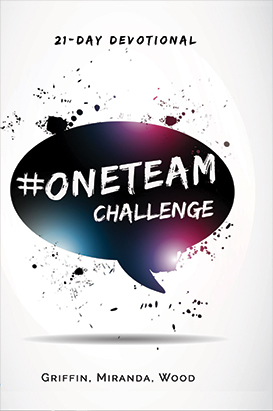
#OneTeam Challenge
By Vandeon Griffin, Tracy Wood, and Armando Miranda
The #ONETEAM CHALLENGE is a 21-day devotional written by leaders for leaders. As co-laborers in the Seventh-day Adventist Church commissioned to lead and serve the youth and young adult generation, we share the burdens and triumphs of ministry.
In this devotional, we will walk together through scripture and journey through the lessons of life and ministry. Daily, you will be challenged with reflective questions and to share your affirmations on social media to encourage and inspire others. We are #ONETEAM!